-
Call Now
1800-102-2727


Central Neural System: Brain, Spinal Cord, Practice Problems and FAQs

Every organism in this world interacts with its environment and responds to stimuli. In fact, that is one of the defining characteristics of all living beings. Humans are considered to be one of the most intelligent creatures who not only observe and learn from their environment but also manipulate it to facilitate their survival.
Have you ever wondered what helps you learn and memorise your lessons? What helps you decide whether you should walk down to the school on a Monday morning or take a ride on the bicycle? How are you able to solve brain teasers and puzzles? Why do you salivate when you think of delicious food?
The answer to all these questions lies in the way our nervous system works.
Have you noticed that there are some actions that we take upon deliberate decision making whereas for some actions such as pulling your hand away from a very hot cup of tea, does not even require thinking? This is because the nervous system has different control centres for such voluntary and involuntary actions. Come let us learn about the central nervous system in humans.
Table of Contents
- Overview of Central Nervous System
- Brain
- Spinal Cord
- Practice Problems of Central Neural System
- FAQs of Central Neural System
Overview of Central Nervous System
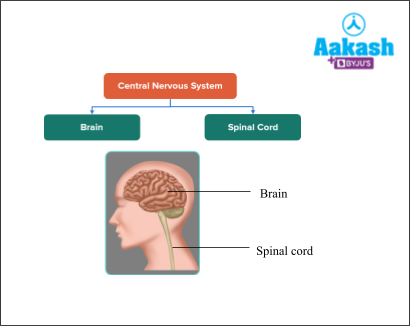
Central nervous system lies in the central or main axis of the body. It is the main site for processing information and controlling body activities.
CNS consists of two main parts-
- Brain
- Spinal cord
Cerebral Meninges
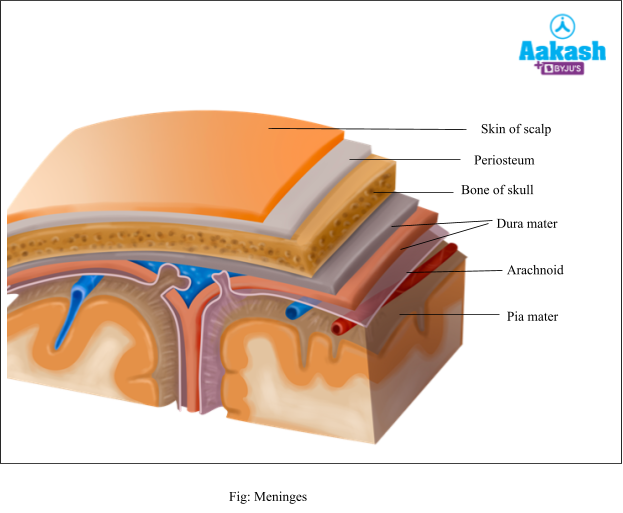
These are the protective coverings made of connective tissues, which cover the brain and spinal cord. Meninges consist of three layers of tissue -
- The outermost layer known as dura mater.
- A very thin middle layer known as arachnoid.
- An inner layer, which is in contact with the brain tissue, known as pia mater.
A fluid called cerebrospinal fluid lies in the spaces between the meninges and protects the brain from shcks and mechanical injuries.
Brain
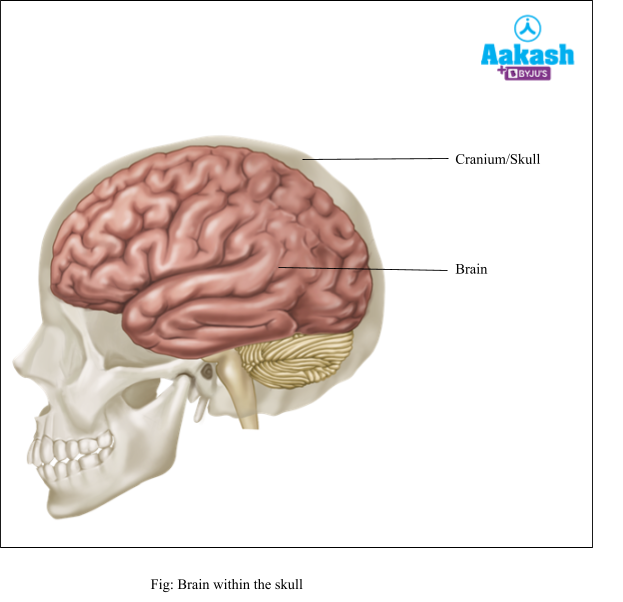
The brain, also known as encephalon, acts as the centre for command and control in our body and is the main information processing unit. The study of brain is called ‘encephalology’
The brain is situated in the cranial cavity in the skull. The cranium of the skull protects the brain from mechanical injury.
Parts of Brain
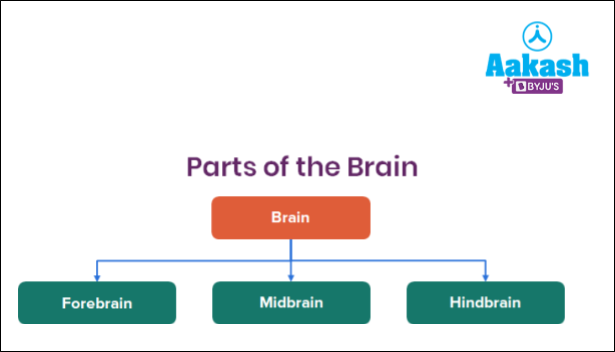
The brain is soft and white colored organ which is divided into three main regions-
- Forebrain (Prosencephalon)
- Midbrain (Mesencephalon)
- Hindbrain (Rhombencephalon)
Forebrain(Prosencephalon)
Forebrain or Prosencephalon is the main thinking part of the brain. It is responsible for controlling all the voluntary actions of the body. The forebrain is composed of the cerebrum (largest part of the brain) and the diencephalon (thalamus, hypothalamus). The important role of the forebrain is in processing sensory information that is collected from various sense organs such as ears, eyes, nose, tongue, skin, etc.. The brain is mainly occupied by the forebrain.
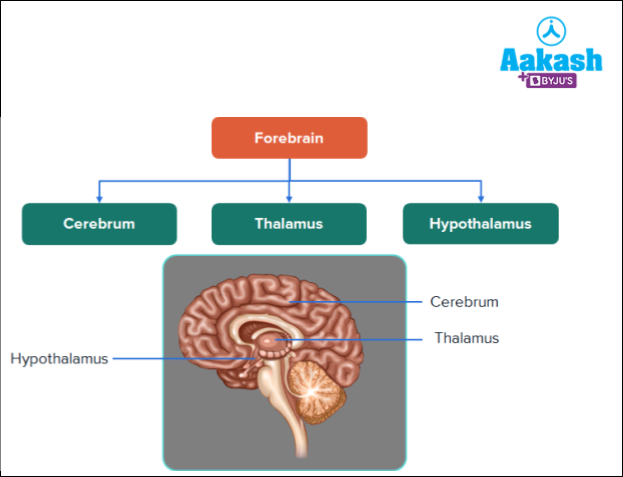
Cerebrum
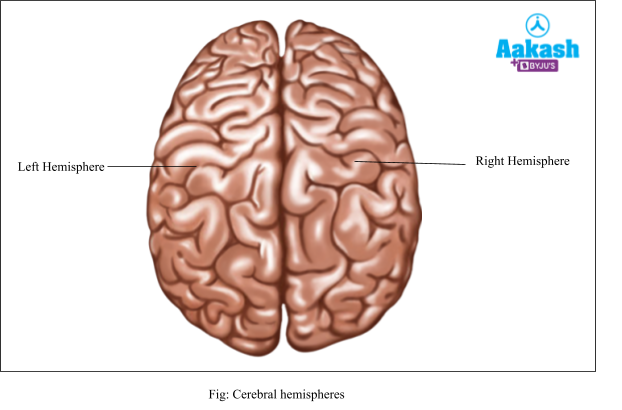
Cerebrum forms the largest part of the brain. A deep cleft divides the cerebrum longitudinally into two halves:
- Left cerebral hemisphere
- Right cerebral hemisphere
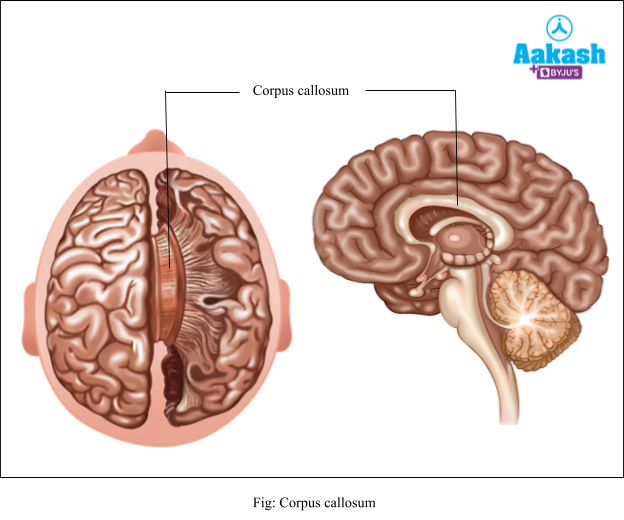
The cerebral hemispheres are connected by a large C- shaped curved tract of myelinated axons, known as corpus callosum. It stretches across the midline of the brain.
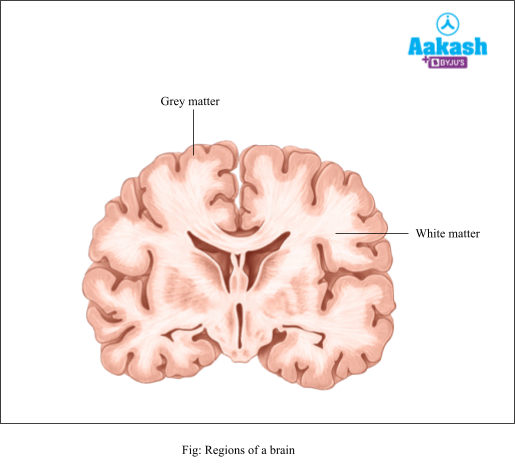
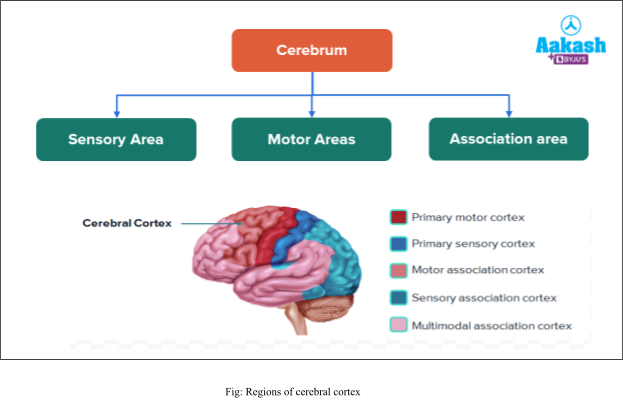
The outer layer of the cerebral hemisphere is called the cerebral cortex and is extensively folded. It is mainly composed of the cell bodies of neurons which gives it a greyish appearance. Hence, the cerebral cortex is referred to as the grey matter.
The inner part of the cerebral hemispheres contains the myelinated axon fibres of the neurons which give it an opaque white appearance. Hence, this part is known as the white matter.
The cerebral cortex contains three important areas- motor areas, sensory areas and association areas. The sensory areas process sensory information such as light, sound, touch, etc., whereas the motor areas plan and control the voluntary movements. The association areas are mainly responsible for complex functions like intersensory associations, memory and communication.
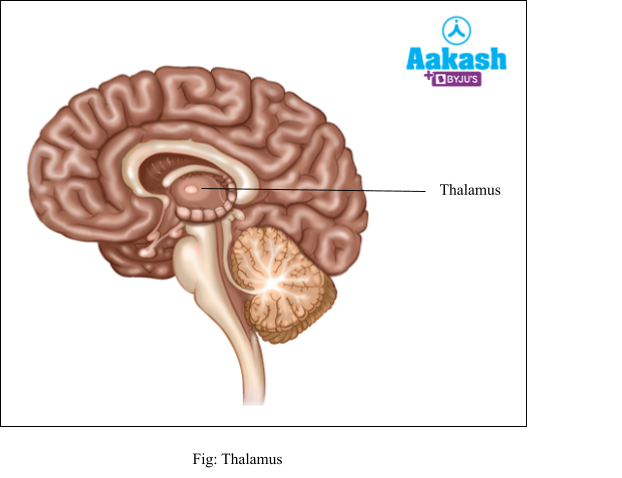
Thalamus
The is wrapped around an important structure known as the thalamus. The thalamus is mainly responsible for coordinating between sensory and motor signals.
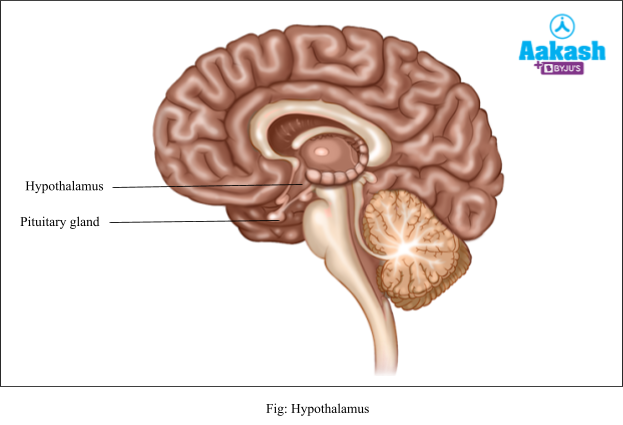
Hypothalamus
The hypothalamus lies at the base of the thalamus and is responsible for controlling body temperature, the urge for eating and drinking, etc.
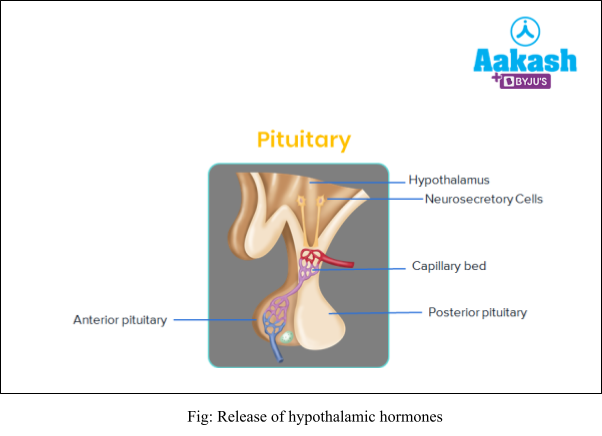
It contains several groups of neurosecretory cells, which secrete a number of hormones known as hypothalamic hormones which control the actions of the pituitary gland.
Limbic System
A group of deep structures in the forebrain like amygdala, hippocampus, etc., along with the inner parts of the cerebral hemispheres, form the limbic system. This system, in coordination with the hypothalamus is involved in the regulation of sexual behaviour, expression of emotional reactions and motivation.

Midbrain (mesencephalon)
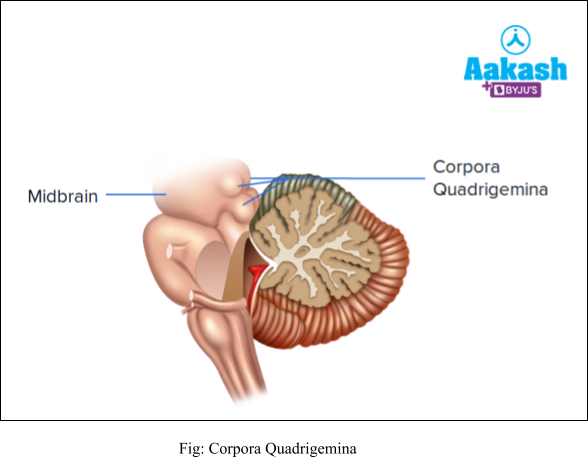
Midbrain is significantly small. It is located between the thalamus or hypothalamus of the forebrain and pons of the hindbrain. It is involved in the relay of impulses back and forth between the cerebrum, cerebellum, pons, and medulla.

The dorsal portion of the midbrain mainly consists of two pairs (i.e., four) of rounded swellings (lobes) known as corpora quadrigemina.
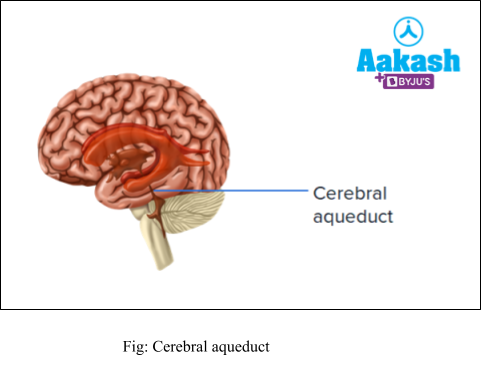
A canal named cerebral aqueduct runs through the midbrain and carries the cerebrospinal fluid.
Hindbrain (Rhombencephalon)
The hindbrain consists of pons, medulla oblongata, and cerebellum.
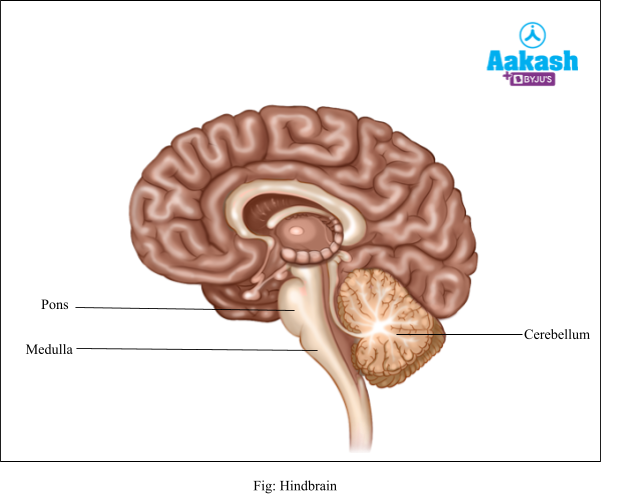
It is the main control centre of the body’s physiological activities such as -
- Heart rate
- Breathing
- Blood pressure
- Sleep and waking up functions, etc.
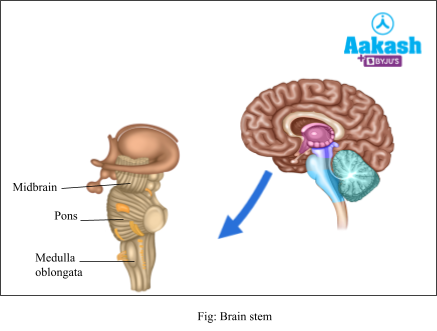
Pons Varolii
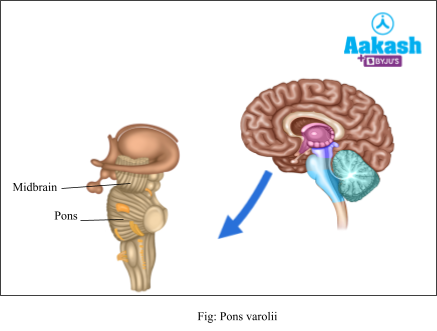
An oval mass that lies just above the medulla is known as the pons varolii. It consists of nerve fibres that interconnect the cerebrum and cerebellum. It contains the respiratory control centres.
Medulla Oblongata
Medulla oblongata is the lowermost part of the brain. It is connected to the spinal cord and contains the centres that control vital involuntary functions such as respiration, cardiovascular reflexes and gastric secretions.
Midbrain, pons and medulla oblongata together form the brainstem which serves as the connection between the brain and spinal cord.
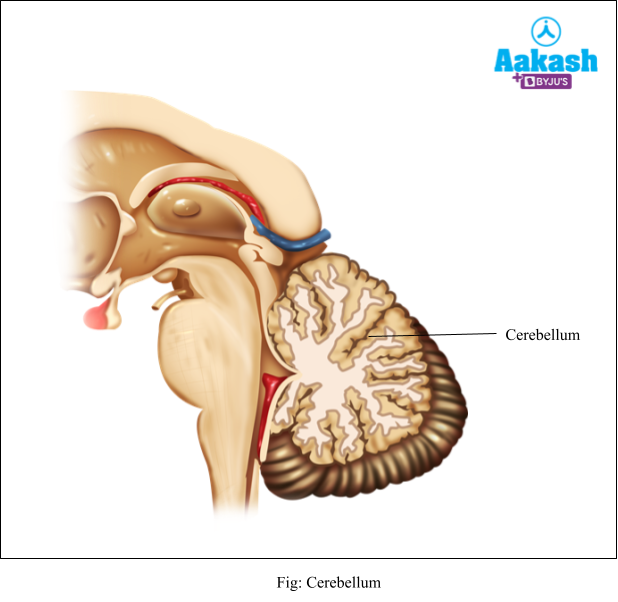
Cerebellum
The cerebellum is mainly responsible for maintaining balance and posture and coordinating muscular movements.. It is the second largest part of the brain and has a highly convoluted surface to accommodate more neurons.
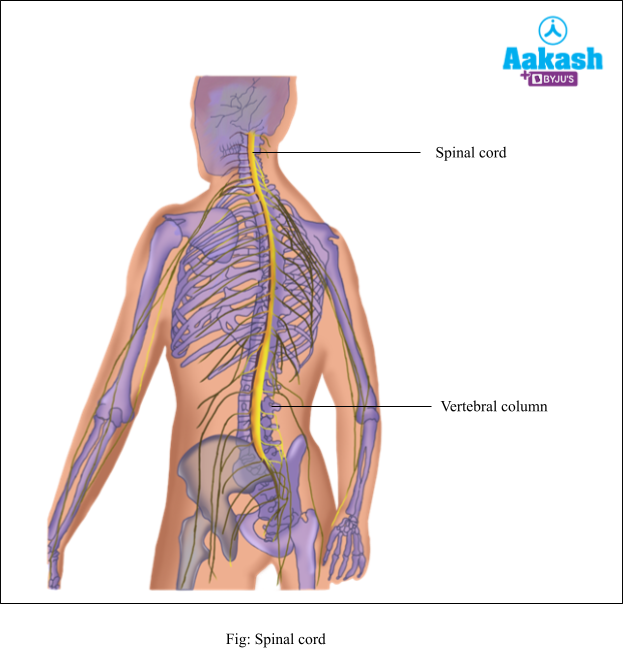
Spinal Cord
It is also called ‘Myelon’. It is a long, thin, tubular structure made up of two types of nervous tissue - grey matter on the inner side and white matter on the outer side. Grey matter consists of cell bodies of neurons whereas the white matter consists of the myelinated axons. This arrangement of neurons is exactly opposite to the arrangement of neurons in the brain. It runs through the central hollow space of the vertebral column and is protected by it. It is the pathway for messages sent by the brain to the body and vice versa. The spinal cord is also responsible for controlling reflex actions which are quick, immediate and involuntary responses to stimuli.
Practice Problems of Central Neural System
Question 1. Find the odd one out
a. hypothalamus
b. cerebellum
c. corpus callosum
d. cerebrum
Solution: The cerebellum is the part of the hind brain whereas the hypothalamus, cerebrum and the corpus callosum lie in the forebrain.
Thus, the correct option is b.
Question 2. Which of the following parts of the brain controls the body temperature and urge of eating?
a. thalamus
b. cerebellum
c. pons
d. hypothalamus
Solution: The hypothalamus lies at the base of the thalamus and its main function is to control body temperature and increase the urge for eating and drinking. Thus, the correct option is d.
Question 3. There are some functions that you do without even thinking of such as breathing ,digestion etc. Which of the following parts of the central nervous system is responsible for controlling these involuntary functions?
(a) Medulla
(b) Pons
(c) Cerebellum
(d) Both a and b
Solution: The medulla oblongata controls vital involuntary functions such as respiration, cardiovascular reflexes and gastric secretions. Thus, the correct answer is option a.
Question 4. Which of the following is incorrectly matched?
a. Corpus callosum - connects the left and right cerebral hemispheres.
b. Pons - Maintaining body posture and balance.
c. Cerebellum - coordinating muscular movements.
d. Cerebrum - Controlling the voluntary actions of the body.
Solution: Pons consist of nerve fibres that interconnect the cerebrum and cerebellum. It contains the respiratory control centres. The cerebellum is responsible for maintaining body balance, posture and coordinating muscular movements.
Thus, the correct option is b.
FAQs of Central Neural System
Question 1. Write down the main function of the central nervous system?
Solution: Central nervous system lies in the central or main axis of the body. It is the main site for processing information and controlling body activities. the central nervous system does many jobs at the same time. It controls all voluntary movement, and involuntary movements, such as blinking and breathing. It is also indulged in processing our thoughts, perceptions, and emotions.
Question 2. What is the largest part of the brain?
Solution: Cerebrum is the largest part of the brain. It is the site of intelligence, memory, decision making and controls all the voluntary actions of the body. A deep cleft divides the cerebrum longitudinally into two halves:
- Left cerebral hemisphere
- Right cerebral hemisphere
The cerebral hemispheres are connected by a large C- shaped curved tract of myelinated axons, known as corpus callosum. It stretches across the midline of the brain.
Question 3. What is the function of the hypothalamus?
Solution: The hypothalamus is responsible for controlling body temperature, the urge for eating and drinking, etc. It contains several groups of neurosecretory cells, which secrete a number of hormones known as hypothalamic hormones that control the actions of the pituitary gland.
Question 4. Which bones of the trunk protect the spinal cord?
Solution: A protective layer of bone called the vertebral column covers and protects the spinal cord. The bones in the vertebral column are called vertebrae .

 Call Now
 Let's Chat
 Share
Share