-
Call Now
1800-102-2727


Gamma Rays, Production, Properties, Applications, Practice Problems, FAQs

Have you ever considered how cancer can be treated without undergoing surgery? The DNA of the malignant tumour is destroyed by gamma radiation. As a result, we can use gamma rays to treat cancer. As a result, gamma radiation has a wide range of medicinal applications. We'll discuss gamma rays in this article in detail.
Table of Contents
- Gamma Rays
- Production of Gamma Rays
- Properties of Gamma Rays
- Applications of Gamma Rays
- Practice Problems
- FAQs
Gamma Rays
Gamma rays, the most intense type of light, are exceptionally penetrating electromagnetic energy emitted during radioactive decay by the nucleus of specific radionuclides. In 1896, a French scientist named Henri Becquerel is credited with discovering gamma rays.
Following prior studies of radioactive nuclear discharges, British physicist Ernest Rutherford coined the term "gamma ray" in 1903. These rays have no electric charge and may travel long distances through materials until hitting with several centimetres of lead or a metre of concrete, which is required to bring them to a halt.
Gamma rays electromagnetic waves and denoted by Greek symbol  . It has the frequency range from
  to
to  . Below diagram shows the position of rays on the electromagnetic spectrum arranged in increasing order of wavelengths.
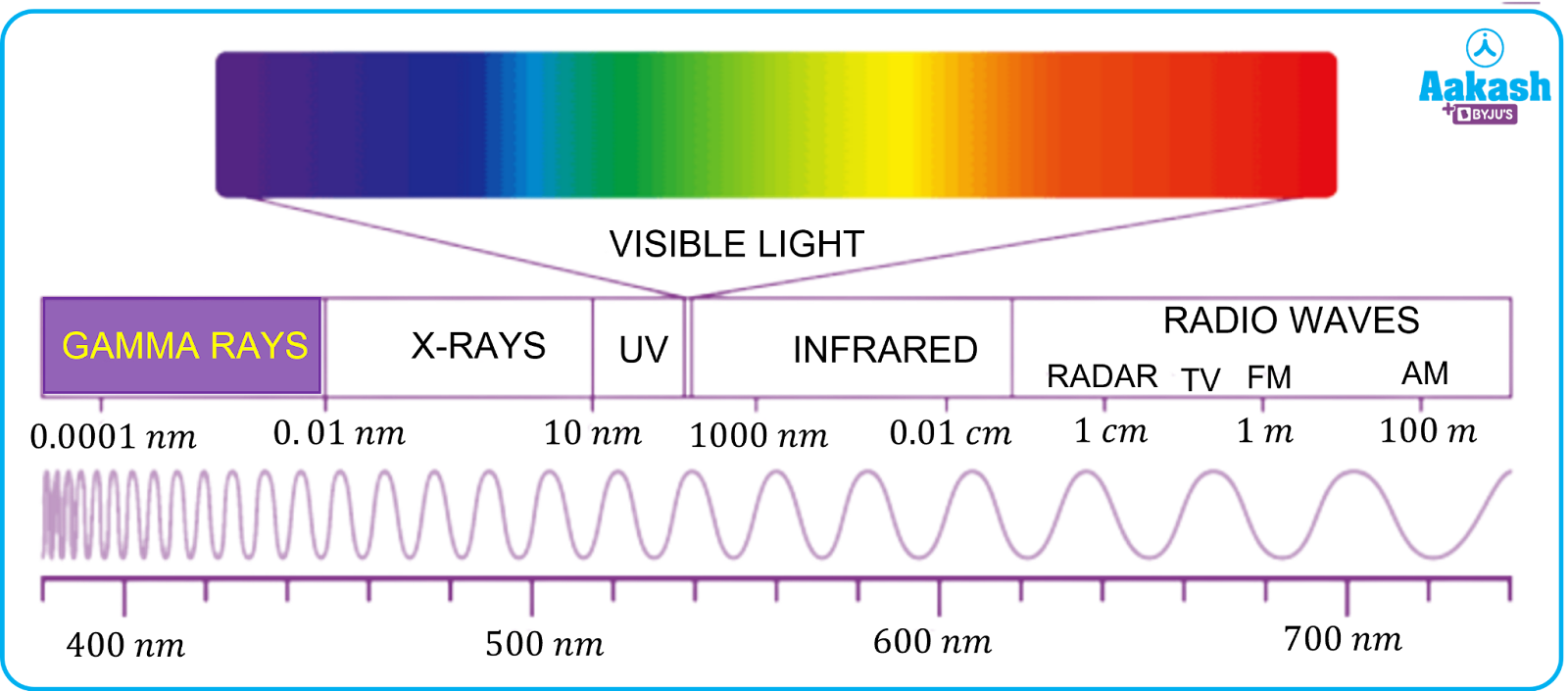
Production of Gamma Rays
Not every atom is stable, as we know. Unstable atoms continually expel energy and mass from their nucleus in an attempt to attain stability, which frequently results in the production of whole new elements. Radioactive decay is the term for this. During the breakdown of unstable nuclei, radiation is the discharge of subatomic particles such as Alpha ( ), Beta (
 ), and Gamma () particles, as well as the energy associated with them. Gamma rays are formed as a result of the disintegration of certain subatomic particles and the breakdown of radioactive atomic nuclei. The universe's hottest and most energetic objects create these strong beams. On Earth, gamma rays are released by a variety of sources, including nuclear explosions, lightning, and radioactive decay. Nuclear processes include fusion, fission, alpha decay, and gamma decay. The mechanism through which the sun and stars obtain their energy is known as nuclear fusion.
Properties of Gamma Rays
- Because gamma rays have no charge, they are considered neutral.
- Gamma rays have a wavelength of less than 10 picometer and an energy of more than 100 keV. As a result, they can't be seen or touched.
- Photographic film, fluorescence, polarisation, and diffraction are all used to detect it.
- They have a strong penetrating ability.
- Detecting gamma rays is difficult due to their strong penetrating strength. As a result, detecting gamma rays requires the use of a specialised detector known as a gamma ray telescope, which detects gamma rays via the Compton Scattering process.
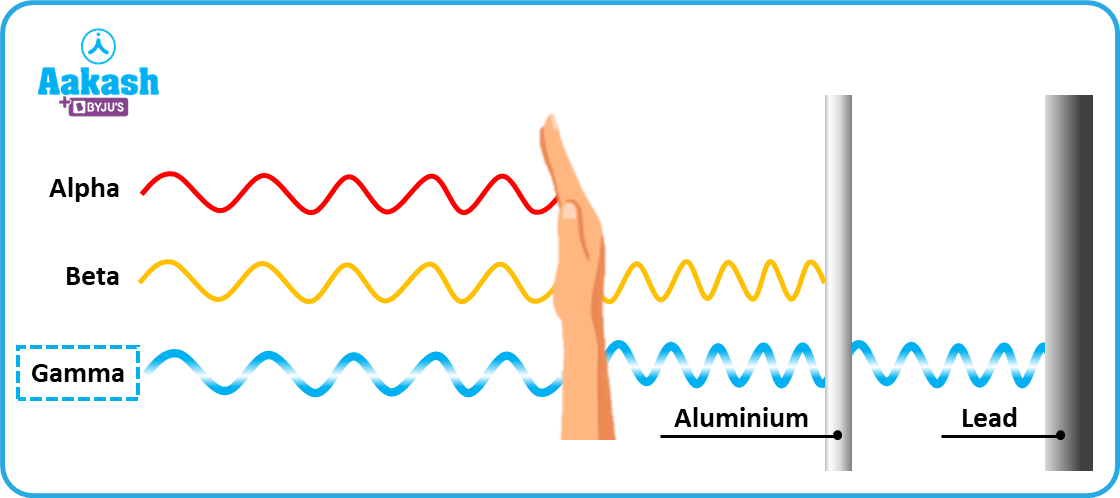
- The strongest form of radiation is a gamma ray. When compared to Alpha and Beta rays, its propagation is given below.
- In comparison to alpha and beta particles, gamma rays have the least ionising power.
Applications of Gamma Rays
Despite their bio-hazardous nature, gamma rays may be controlled and used for a range of important applications:
- It's used to treat cancer that doesn't require surgery. The DNA of the malignant tumour is destroyed by gamma radiation.
- Gamma radiation can change the properties of certain semi-precious stones. It's widely used in the conversion of white topaz to blue topaz.
- Because weak gamma rays can easily eliminate bacteria, we employ them to keep products fresh for a long time.
- To provide useful information about the structure of an atomic nucleus.
- In medicine, gamma rays are used for radiotherapy and sterilisation of medical equipment.
- In the oil business, gamma rays are utilised to check and find weak spots in pipelines.
- In the sphere of science, gamma rays are used in nuclear reactor building.
Practice Problems
Q 1. Which of the following is/are the sources of gamma rays?a
a. Radioactive Decay
b. The Sun
c. Collapsing Stars
d. All of the above
A. (d) Gamma rays are produced during radioactive decay, in nuclear fusion reactions in the Sun, collapsing of stars. So option (d) is correct.
Q 2. Which of the following thing/s gamma rays can penetrate?a
a. Skin
b. Bones
c. Aluminium
d. All of the above
A. (d) Gamma rays have very high penetrating power. So they pass through skin, bone and aluminium. So option (d) is correct.
Q 3. Frequencies of Radio Waves, Gamma Rays and Ultraviolet Rays are  respectively then?
a. 
b. 
c. 
d. 
A. (a) Gamma rays have the highest frequency in electromagnetic radiation then UV rays and radio waves have lowest frequency. So option (a) is correct.
Q 4.  are the speeds of gamma rays, x-rays and microwaves in vacuum then?
a. 
b. 
c. 
d. 
A. (c) Gamma rays, x-rays and microwaves are electromagnetic waves. So they have the same speed equal to the speed of light in vacuum. So option (c) is correct.
FAQs
Q 1. What is the highest frequency component of the electromagnetic spectrum?
A. Gamma rays have the shortest wavelength and the highest frequency.
Q 2. Is it possible to transmit radio/TV/mobile signals using gamma rays?
A. No, gamma rays have a short range of action. Furthermore, they are hazardous and have penetrating force on the stuff with which they contact, and they can hurt live body tissues.
Q 3. Can we deflect gamma rays using electromagnetic fields?
A. Gamma rays are neutral so we can not deflect them using electromagnetic fields.
Q 4. What is the effect of gamma ray emission from a nucleus on the number of protons and neutrons of the atom?
A. No, there is no change in proton number or neutron number after the emission of gamma rays as they do not have any charge or mass.

NEET Related Links
JEE MAIN Related Links
JEE Advanced Related Links
JEE Advanced Eligibility Criteria
JEE Advanced Chemistry Syllabus
JEE Advanced Registration Dates
CUET Related Links
Important Topics
Anemometer : Measurement of Wind Speed
Angular Acceleration Atomic Theory Audible and Inaudible Sound Average Speed and Average Velocity Average Velocity Avogadros Number Avogadros Hypothesis Azimuthal Quantum Number Balanced Force Bar Magnet Biconvex Lens Boyles Law Buoyancy Calorimeter Carnot Engine Celestial Bodies Centripetal And Centrifugal Force Concave and Convex Lenses Concave Convex Mirrors Contact and Non Contact Force Controlled Thermonuclear Fusion Convection Currents Convex Lens Convex Mirror Destructive Interference Difference Between Conduction Convection and Radiation Difference Between Electric Field and Magnetic Field Difference Between Heat And Temperature Difference Between Series And Parallel Circuits Differences Between Acceleration And Velocity Distance and Displacement Distance Time Graph Electrical Force : Electric Forces and Their Types Electromagnetic Waves : Definition, Equation and Properties of Electromagnetic Waves Electromagnetism Electron Spin Fluid Flow : Bernoullis Equation Derivation and Fluid Mechanics Fluid Friction : Types and Factors of Fluid Friction Frames of Reference : Inertial and Non- Inertial Frame of Reference Frequency and Wavelength Frictional Force Importance of Hydrosphere Instantaneous Speed and Velocity Introduction to Motion Kinetic and Potential Energy Difference Law Of Conservation of Energy Layers of the Earth Light Energy Light Sources List of physics scientists and Their inventionsLoudness of Sound
Magnetic Dipole Moment Magnetic Field Non - Contact Force Non - Renewable Energy Ohms Law Optics P Wave Physics Symbols Plane Mirrors Poissons Ratio Projectile Motion Properties of Water : Anomalous Expansion of Water Radius of Gyration Reflection of Light Reflection of Waves Relative Density Resonance Reverberation Rolling Friction Rotation and Revolution Screw Gauge Semiconductors and Insulators Sliding Friction Speed Time Graphs Static Friction Stefan Boltzmann Law Stress Tension Tension Force Thermometer: Clinical Laboratory Thermometer Types of Rocks Types of Waves Uniform Motion and Non Uniform Motion Unit of Voltage Uses of Convex Lens Uses Of Convex Mirror Uses of Electromagnet Uses of Optical Fibre Wave Wavelength of Light What is Scattering of Light Working of Electric Bell Conventional and Non-conventional Sources of Energy Buoyant Force Bulk Modulus of Elasticity Bernoulli’s Principle Angular Momentum Difference Between Speed And Velocity ForceUnit of Heat
Difference between Distance and Displacement Simple Microscope Derivation Of Equation Of Motion Thermometer: Clinical & Laboratory Thermometer Difference between Concave and Convex LensDerivation Of Lens Maker Formula
Unit Of Pressure Velocity Uses of Plane Mirror
Wave Theory of Light
Unit of Density Unit of Light Unit of Force Unit of Magnetic Field Unit of wavelength Unit of Viscosity Uses of Electroplating Young's Modulus
What is the Scattering of Light
Lenz Law Space Wave Propagation Schrodinger Wave Equation Relation between Fahrenheit and Celsius Refractive Index Potentiometer Working Pascal Law Oscillatory Motion Optical Instruments Newton's Laws of Motion - First Law Modulation and Demodulation Magnetic Flux Lens Formula and Magnification Kaleidoscope Faradays Law Epsilon Naught Value Energy Bands Electrostatics Electroscope AC Generator Unit of Current Lithosphere Bending Equation Derivation Difference Between Pound and Kilogram Semiconductor Devices OTEC - Ocean Thermal Energy Conversion Hall Effect Rectilinear Propagation of Light Difference Between Ammeter and Voltmeter Coefficient of Linear Expansion Ampere’s Law Cyclone and Thunderstorm Save The Environment From Pollution Particle Nature of Light Types of DC Motor Uses Of Transistor Derivation of Phase Rule Unit of Humidity

 Call Now
 Let's Chat
 Share
Share