-
Call Now
1800-102-2727


Wien’s Displacement Law - definition and mathematical expression, applications, practice problems, FAQs

Ever wondered how we measure the temperature of distant stars in our solar system? To do so, first you need to have knowledge of a law called Wien’s Displacement Law that describes the relation between the temperature and peak wavelength of radiation emitted. From the radiation emitted we can measure the peak wavelength and then from the Wien’s displacement law we can deduce the temperature of the star or planet.
Table of contents
- Wien’s Displacement Law
- Intensity Vs wavelength variation
- Application of Wein’s displacement law
- Practice problems
- FAQs
Wien’s Displacement Law
Definition: The wavelength of the highest intensity radiation emitted by a blackbody is inversely proportional to the absolute temperature of the emitting body. Its mathematical expression is given as follows:
Where b is a constant known as ‘Wien’s constant’ and its numerical value is 2.89 × 10⁻³ mK
Intensity Vs wavelength variation
From Planck's law, spectral intensity (Is) distribution as a function of wavelength is given by,
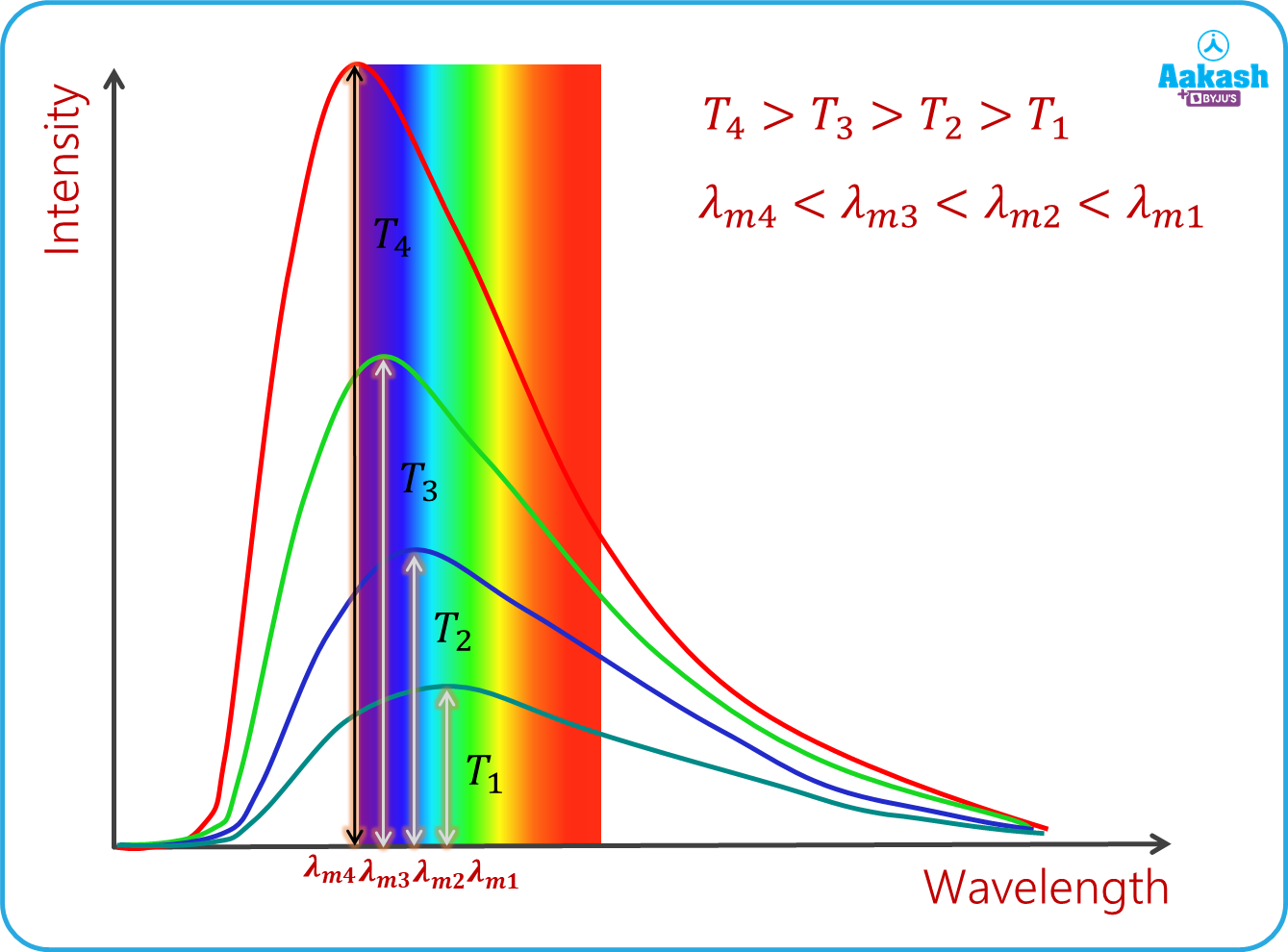
From the (I) vs (λ) plot for a particular radiation emitted from a body, we can deduce that thermal radiation is a group of waves having different wavelengths emitted by a body. With the increase in temperature of the body, the most probable wavelength (λm) in the spectrum shifts towards the shorter wavelength region. Thus, the name displacement law is given since the plot shifts towards the left or right while retaining the shape. The significant contribution to the total radiation is by a small range of wavelengths.
Application of Wein’s displacement law
The law is useful in calculating the temperature of the radiating objects or stars which are at a temperature greatly above their surrounding temperature.
Practice problems
Q. Sun emits solar radiation resembling to that emitted by a black body at a temperature of 6000 K. At a wavelength of about 4800 Å, maximum intensity is emitted . Calculate the wavelength at which the peak intensity would occur, if the sun is cooled down from 6000 K to 3000 K.
A.
Here, T1=6000 K & 1=4800 Å
T2=3000 K, 2=?
According to Wein's law
Q. The wavelength corresponding to maximum energy changes from 0.26 m to 0.13 m when the temperature of a black body is increased. Find the ratio of the emissive powers of the body at the two temperatures.
A.
According to Wien's displacement law,
Thus, we can write that,
Using Stefan's law, emissive power E= T4
Q. Explain the variation of m with T with the help of a graph.
[ m = wavelength corresponding to maximum intensity of radiation & T = absolute temperature.]
A.
According to Wien's displacement law,
Taking logarithm on both sides, we get
Comparing this with
we can conclude that the graph of m vs T is as shown below.

Q. The energy radiated by a black body at 2300 K is found to be of maximum intensity when the wavelength is 1260 nm. Then its emissive power being 8000 W/m2. Find the wavelength at which the intensity of emission is the maximum at the temperature (T K) to which body is cooled down and emissive power was found to decrease to 500 W/m2.
A.
Also, T2=T K
We know that ET4
By Wein's law,
Q. Distribution of intensity of emitted energy as a function of wavelength is shown in the figure. Point of intersection of dotted lines corresponds to the peak wavelength emitted by a body at a certain temperature. What happens to the intensity when the temperature of the body increases?
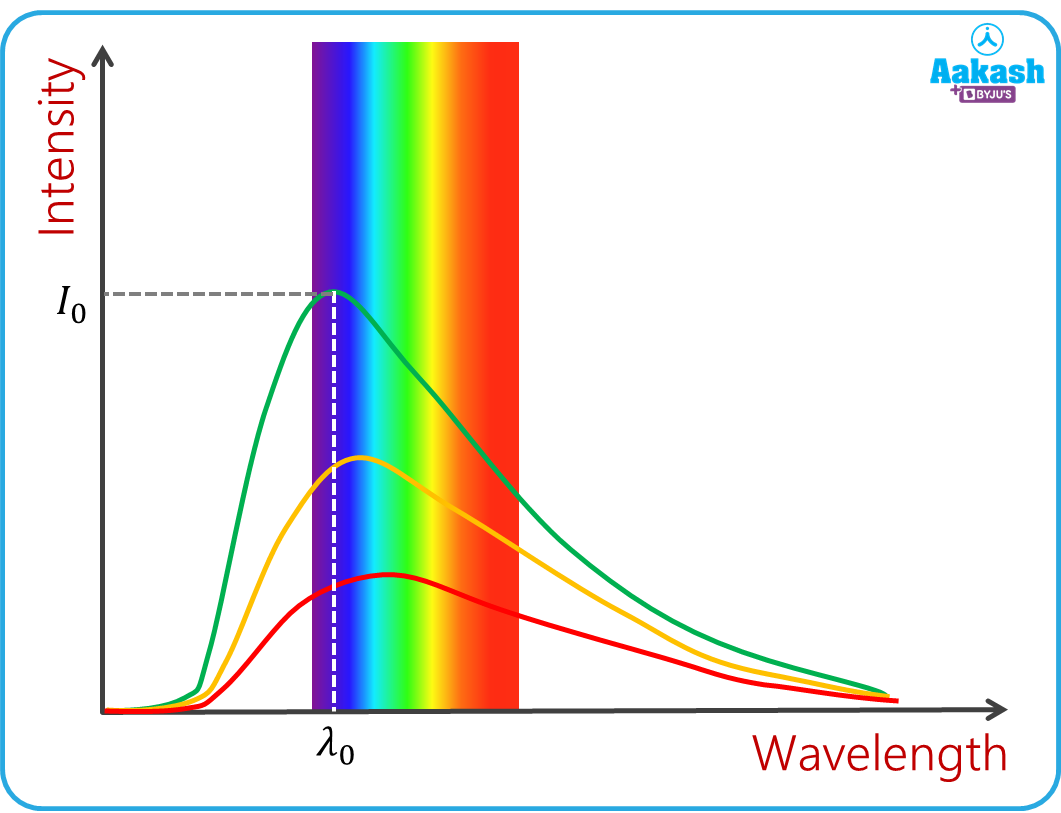
A. We know from Wien's Displacement Law,
𝜆mT = b= constant.
As temperature increases, wavelength decreases.
Also, Intensity,
As wavelength decreases, Intensity increases.
Therefore with increase in temperature, wavelength decreases and intensity increases.
FAQs
Q. Why is Wien's law important?
A. Scientist Wien discovered there is a direct relationship between the wavelength of the radiation at which an object emits most of its radiated energy and the temperature corresponding to that energy of that object.
It allows us to determine the temperature of a star or planet or even a body in general. It is based on the fact that hotter objects have more energy than cooler objects. So the hotter objects emit more radiation at higher frequencies (i.e., lower wavelength) than at lower frequencies.
Q. What are the limitations of Wien's displacement law?
A. The limitation regarding Wien's displacement law is that it fails in case of blackbody radiations with longer wavelengths. As the body's temperature decreases, we can't get a continuous Wein curve of wavelength and temperature.
Q. Which laws are most suited to explain the black-body radiation? Why?
A. Planck’s radiation law, Wien’s displacement law and Stefan-Boltzman law, these are the laws suited for the back body radiation.
From Planck's law, spectral intensity (Is) distribution as a function of wavelength is given by,
Wien’s displacement law: The wavelength of the highest intensity radiation emitted by a blackbody is inversely proportional to the absolute temperature of the emitting body. Its mathematical expression is given as follows:
Stefan-Boltzmann law: The total radiant radiation power emitted from a surface is proportional to the fourth power of its absolute temperature,

 Call Now
 Let's Chat
 Share
Share