-
Call Now
1800-102-2727


Toppling - definitions, practice problems, FAQs

Even adults get into the game Jenga – a game where players try to add to the height of a tower without making it fall. But have you ever noticed how the tower falls? To know why it falls you need to be aware of the toppling and physics behind it. Let’s see about this in this article.
Table of contents
- Point of Application of Force
- Toppling
- Practice problems
- FAQs
Point of Application of Force
The point of application of force is a point about which the torque due to all the forces is zero.
Let us consider three forces, that are acting on a body at points a, b, and c, respectively, in the directions as shown in the figure. Let be the position vectors of these three points.
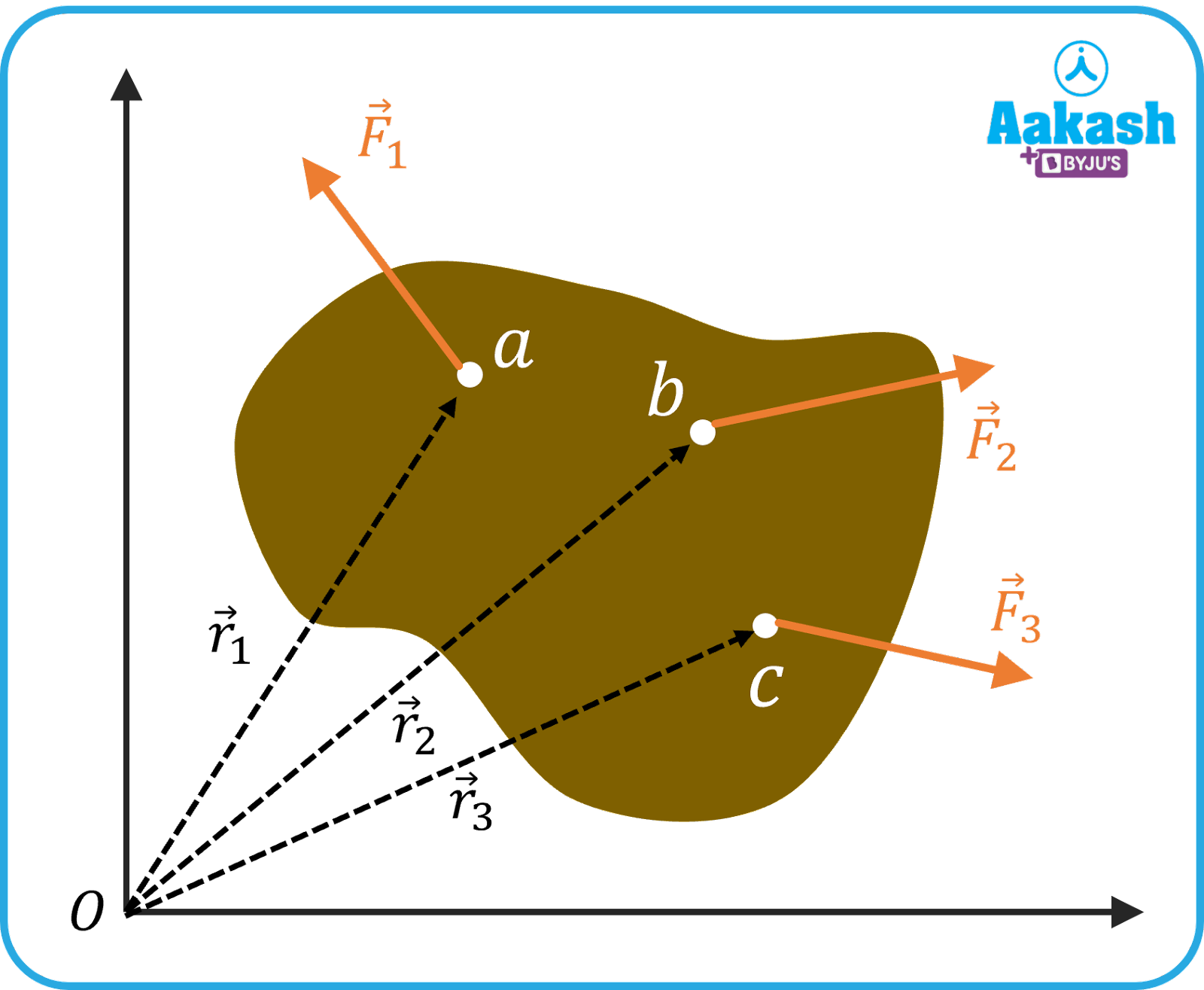
If multiple forces are applied on a point mass, then these multiple forces give translational motion to the body. Since the point of application of force in the case of a rigid body may be different, the combination of applied forces can produce translational as well as rotational motions in the body.
The combination of multiple forces can be represented as a single net force, , which will provide translational and rotational effects in the body.
Let the net force act on the rigid body at point P. Since it is the point of application of net force and the force arm becomes zero at this point, therefore torque due to the applied force about this point will be zero.
We can write the rotational effect of these forces as follows:

Toppling
The object topples over when an object is tilted and the line of action of the force of gravity falls outside its footprint. It occurs when net torque on the body is not zero.

Let force F is applied on a cuboid as shown in figure A.

. There will be four forces acting on the cuboid. They are the following:
- Applied force
- Weight of the cuboid
- Normal reaction from the ground
- Force due to static friction
Here, force F and the weight passes through point O. So, their torque about point O will be zero. As we increase the magnitude of force F, the pressure variation changes uniformly and the normal reaction shifts rightwards as shown in figure B. Here, the torque due to normal reaction and friction balances each other, and the body remains stable. However, the edge of the cuboid is the extreme limit for the shifting of normal reaction. If we apply the force beyond the limit, then the body starts toppling.
Practice problems
Q1. A uniform cube (mass m and side a) rests on a rough horizontal table. At a point directly below the centre of the face at a height above the base, a horizontal force F is applied normally to one of the faces. Calculate the least value of force F for which the cube topples.

Answer.
Let the minimum value of the force be F for which the cube topples. At this instant, the total value of torque about the edge should be greater than zero. Let the critical case where the resultant torque be zero.
As the normal and the friction force at this instant will pass through the edge, they will not produce any torque.

Thus,
Q2. A block with a square base measuring a × a and height h is placed on an inclined plane. The coefficient of friction is 𝜇. The angle of inclination (𝜃) of the plane is gradually increased. Which of the following options correctly depicts the condition of the block?
A. It will topple before sliding if
B. It will topple before sliding if
C. It will slide before toppling if
D. It will slide before toppling if
Answer. (A) & (D)
There are three forces acting on the block. They are the following:
- Weight
- Friction between the block and the inclined surface
- Normal reaction
Draw the FBD and resolve the forces as shown in the figure

Along the direction of inclined surface, we get the following
Substituting the value of N from (i),
Thus the block will slide if the tangent of inclination angle is more than the coefficient of friction i.e.
Consider the toppling condition. The block can topple about point P.
For the critical condition of toppling, torque about point P should be zero.
As we know that for sliding , the body will slide before toppling if
Thus, when , the block will topple before sliding.

Q3. A cone of mass 5 kg, base radius 20 cm and height 40 cm is kept on the ground. If the cone is struck at its vertex(point), find the force necessary to topple the cone. Assume that the cone is of uniform construction and it does slide at first.
Answer.
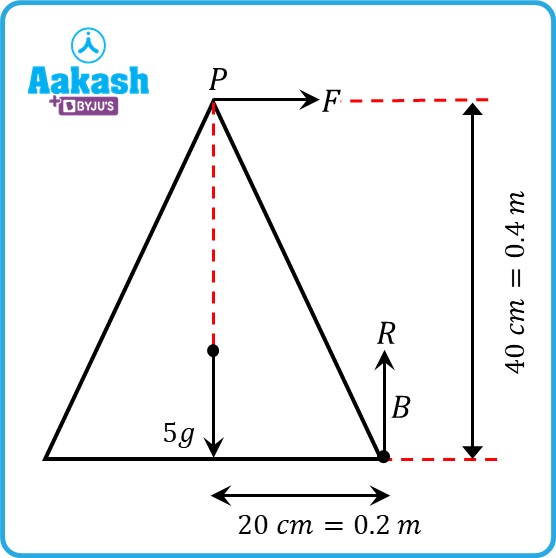
The cone will topple about point B if the torque due to force acting at P is greater than that due to weight of the cone.
0.4F>10
F>25 N
Q4. A block of mass 2 kg is placed on a truck moving at a constant acceleration. The height h of the block is 60 cm and its width w is 15 cm. To prevent slipping, the surface between the block and the truck is made sufficiently rough. Find the minimum acceleration of the truck at which the block topples. (take
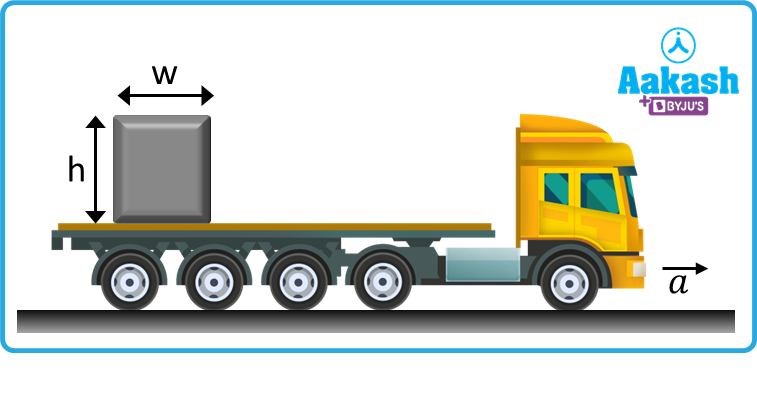
Answer.
Pseudo force acting on the block, Fp=ma
Weight of the block, Fg=mg
When the block is on the verge to topple,
The minimum acceleration of the truck at which the block topples is .
FAQs
Q1. Does the torque due to friction force need to be considered while finding out if the body will topple or not?
Answer. No, since the friction force always passes through the point of contact about which toppling can happen and its torque about that point will be zero.
Q2. What can we say about the state of equilibrium of the body that doesn’t topple?
Answer. The body will be in stable equilibrium since the restoring force on it will be greater than the toppling force.
Q3. Which force is responsible for toppling over a car over sharp turns?Answer. Centrifugal force is responsible for toppling over a car over sharp turns.
Q4. At what point does the normal reaction from the ground act on a body which is on the verge of toppling?
Answer. A. The normal reaction from the ground acts on a body at the point of contact about which the body is about to topple.

 Call Now
 Let's Chat
 Share
Share