-
Call Now
1800-102-2727


Solenoid - Construction, Diagram, Equations, Practice problems,FAQs

Hrithika took an iron rod and wound a coil over it. She ensured that the coil was tightly wound many times with very little space between the windings. She connects the ends of the coil to a DC battery and observes that after some time, the rod behaves as a magnet. How is this possible?
Table of contents
- What is a solenoid?
- Ampere’s circuital law
- Derivation of expression for magnetic field of a solenoid
- Magnetic field at different points on a solenoid
- Practice problems
- FAQs
What is a solenoid?
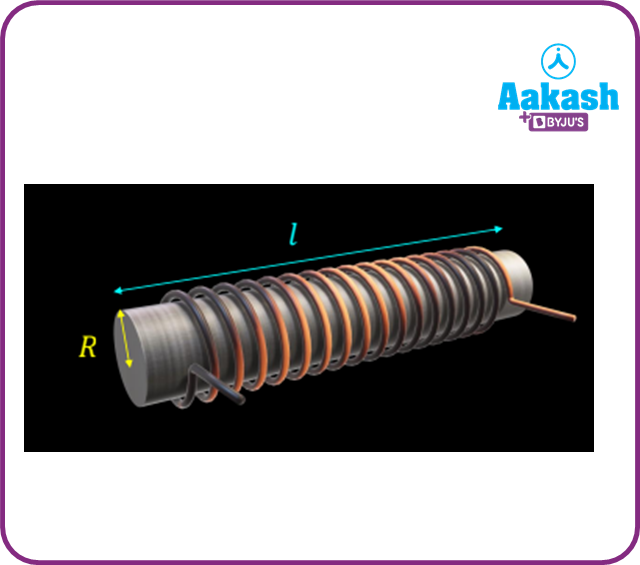
A solenoid is a long coil which is wound in the form of a helix. It consists of a large number of windings. When a current is passed through them,a magnetic field is produced in the interior of the windings. If the length of the solenoid is much greater than its radius (l>>R), then the magnetic lines of force can be represented by the following diagram.
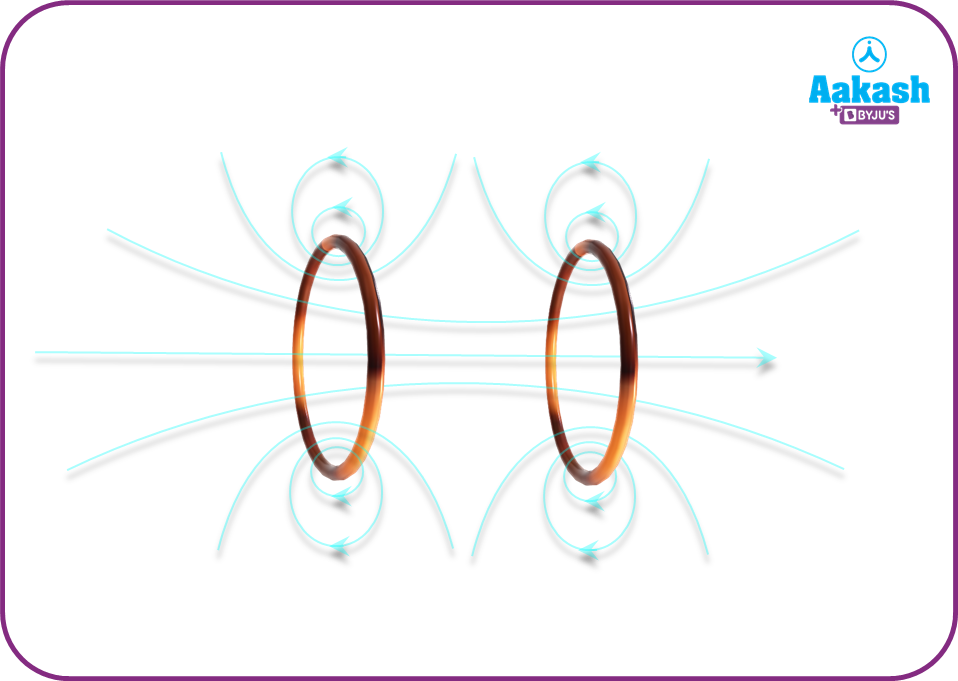
A solenoid has polarity–when a magnetic field is produced, one end develops North polarity and the other end develops South polarity. The magnetic field outside the solenoid is zero.
Ampere’s circuital law
It states that the line integral of the magnetic field around a closed path(an imaginary surface called the Amperian loop) is equal to times the total current enclosed by the loop()
Let be an infinitesimally small region in the Amperian loop and be the magnetic field due to the current enclosed by the Amperian loop. Then,
Derivation of expression for magnetic field of a solenoid
Let us consider a solenoid having length l, N number of turns, and carrying a current i.
To find the magnetic field created by a solenoid, let us assume a square Amperian loop of length l.
The net magnetic field along the closed path ABCDA can be calculated as,
since it lies outside the Amperian loop
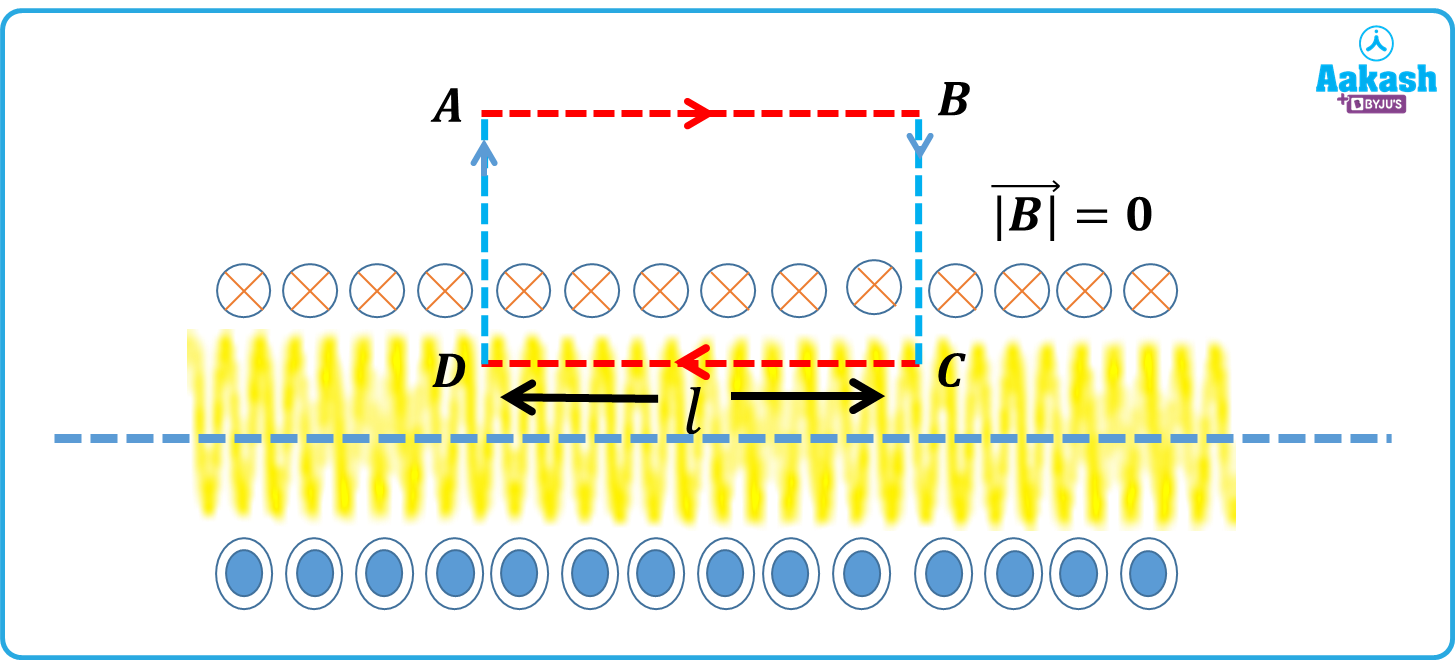
Hence, magnetic field due to the solenoid,
(Ni- net current enclosed by the solenoid)
N=nl, n- number of turns per unit length of the solenoid.
Magnetic field at different points of a solenoid
Let us consider an elemental ring in the solenoid. The thickness of the concerned element is dx.
The magnetic field at a point P which is located at the center of the solenoid as shown can be calculated as follows:
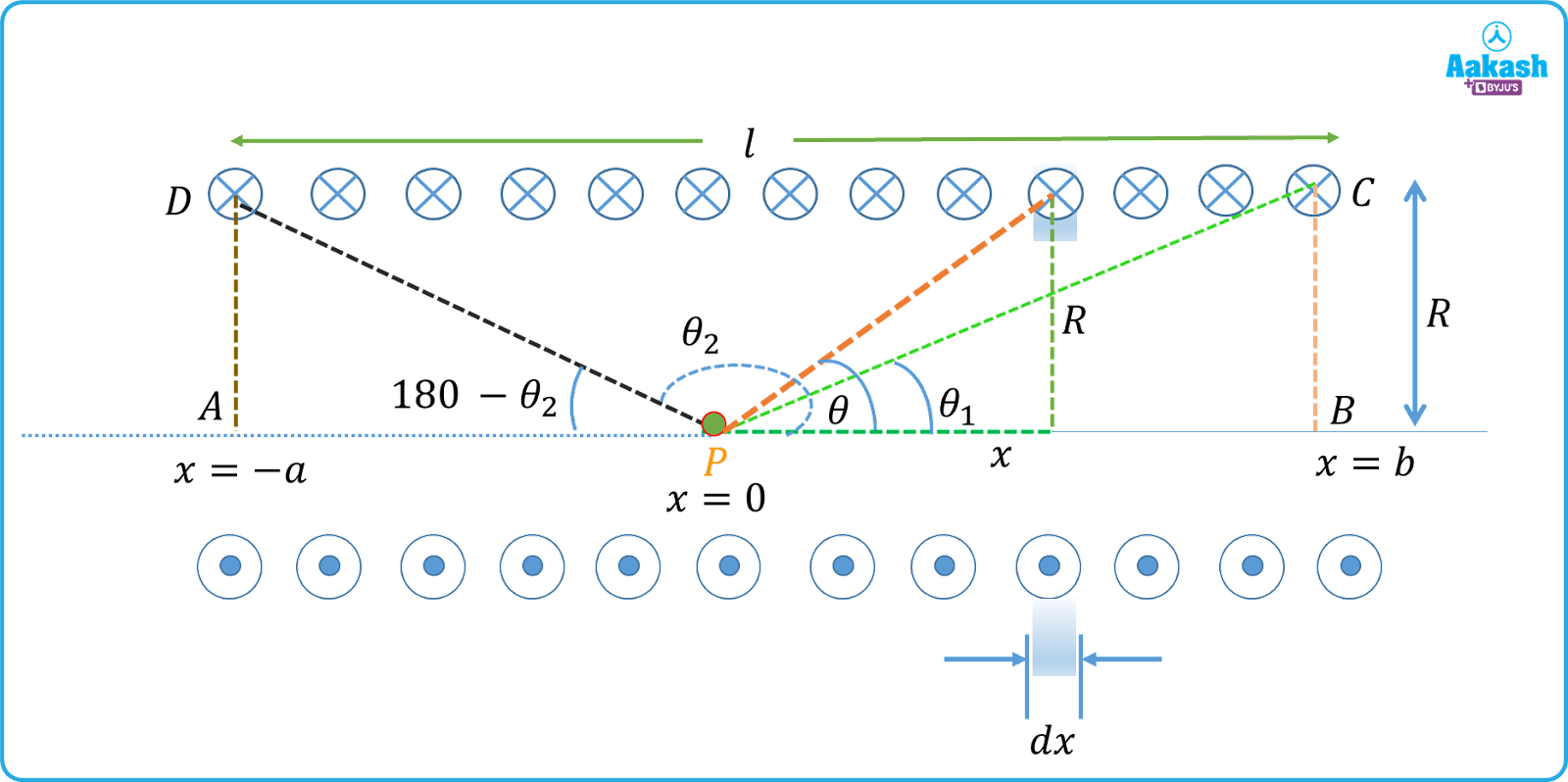
The number of turns in dx length of the solenoid=
The current flowing through this portion dx=nidx.
The magnetic field dB at the point P can be written as,
dB=
The net magnetic field at the point P can be calculated as,
When
When
Magnetic field at different points on a solenoid
At the edges of the coil, and
For an ideal solenoid i.e one that is infinitely long, and
A solenoid often suffers from magnetic flux losses. In order to prevent this, we insert a soft iron core having high relative permeability () inside the coil. The magnetic field would then become,
Practice problems
Q1. The magnetic field at the axis of a solenoid is to be 0.025 T. If a soft iron core having relative permeability 3000 is inserted between the windings, the new magnetic field would be (in T)
(a)75 (b)35
(c)40 (d)120
Answer.a
Given, B=0.025 T.
Now,
When a soft iron core is inserted between the coils, then
Q2.A copper wire having resistance 0.01 Ω in each meter is used to wind 400 turn solenoid of radius 1.0 cm and length 20 cm. Find the emf of a battery which when connected across the solenoid will cause a magnetic field of near the center of the solenoid.
Answer. Given, resistance per unit length
The number of turns in the solenoid, N=400
Let Rt indicate the total resistance of the solenoid. Then,
e=1 V
Q3.The current flowing in a solenoid is 3 A. The number of turns per unit length is . Find the magnetic field at the end points of the solenoid.
Answer.
Q4.Two solenoids (having the same length) have total number of turns 300 and 100 and the currents flowing in them are in the ratio 1:3. The ratio of the magnetic fields created by the two solenoids would be
(a) 3:2 (b)2:1
(c) 6:1 (d)1:1
Answer. d
Given,
and
FAQs
Q1.Give two differences between solenoid and toroid.
Answer.The magnetic field is produced outside a solenoid, while on a toroid, it is produced on the surface. Additionally, solenoids have a cylindrical shape, while toroids have a circular shape.
Q2.How fast can a solenoid operate?
Answer.Valves, which produce minute magnetic fields through solenoids for opening and closing, are of two types. The directly operated valves have a response time of 30 ms. On the other hand, the pilot operated valves have a response time of typically 15 to 150 milliseconds.
Q3.What are some common problems associated with solenoids?
Answer. Improper internal windings, excessive noise and valves getting stuck are some common problems associated with solenoids. They commonly occur due to improper flux linkage between the windings.
Q4.Why do solenoids get hot?
Answer.When a solenoid is first energized, it takes in a huge amount of current.If the plunger is not closed, the current continues to surge through, which causes the solenoid to heat up.

 Call Now
 Let's Chat
 Share
Share