-
Call Now
1800-102-2727


Semiconductors Diodes- Practice Problems, FAQs

Have you ever wondered what the key component of a rectifier is? Actually it is the diode using which we convert alternating current into dc current. This is because semiconductor diodes allow flow of current in one direction. There are different types of semiconductor diodes having a variety of applications in the field of electronics. In this article we will study about diodes in detail.
Table of Contents
- Semiconductor diode
- Characteristics of semiconductor diode
- Types of semiconductor diode
- Applications of semiconductor diode
- Practice problems
- FAQs
Semiconductor diode
A diode is a two-terminal electrical component that allows current to flow in one direction while restricting it in the other because it has low resistance to the flow of current in that direction. P-N junctions and metallic contacts are found at the two ends of semiconductor diodes, which are two-terminal electronic components.
A semiconductor diode is used extensively in our daily lives. It is basically a p-n junction with metallic contacts provided at the ends. It is used with the application of an external voltage which can alter the barrier potential.
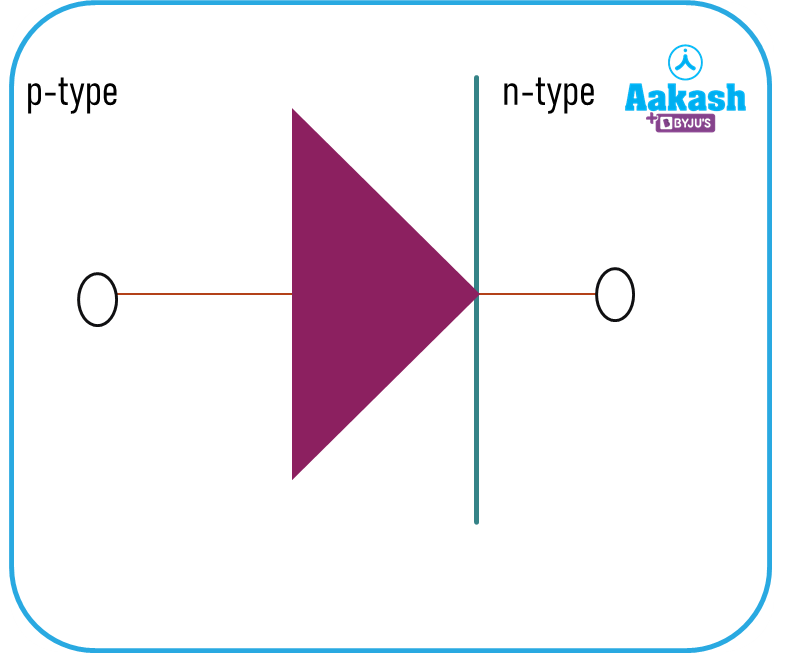
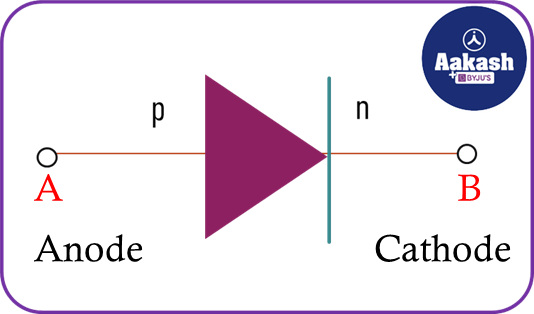
A p-n junction diode is a semiconductor diode. It is a two-terminal device with a single-direction current flow. The p-n junction diode, which signifies the current's direction, is shown as a symbol in the image above.
Characteristics of semiconductor diode
Forward Bias
A p-n junction is said to be forward biassed if the positive terminal of the battery is connected to the p-side and the negative terminal to the n-side of the p-n junction. The external potential difference applied by the battery reduces the potential barrier inside the p-n junction as both are opposite to each other. As a result, the electric field opposing the flow of charge decreases and hence, the depletion region shrinks. Due to this, more and more majority charge carriers can cross the depletion region and thus, the diffusion current increases. The net current flows from the p-side to the n-side.
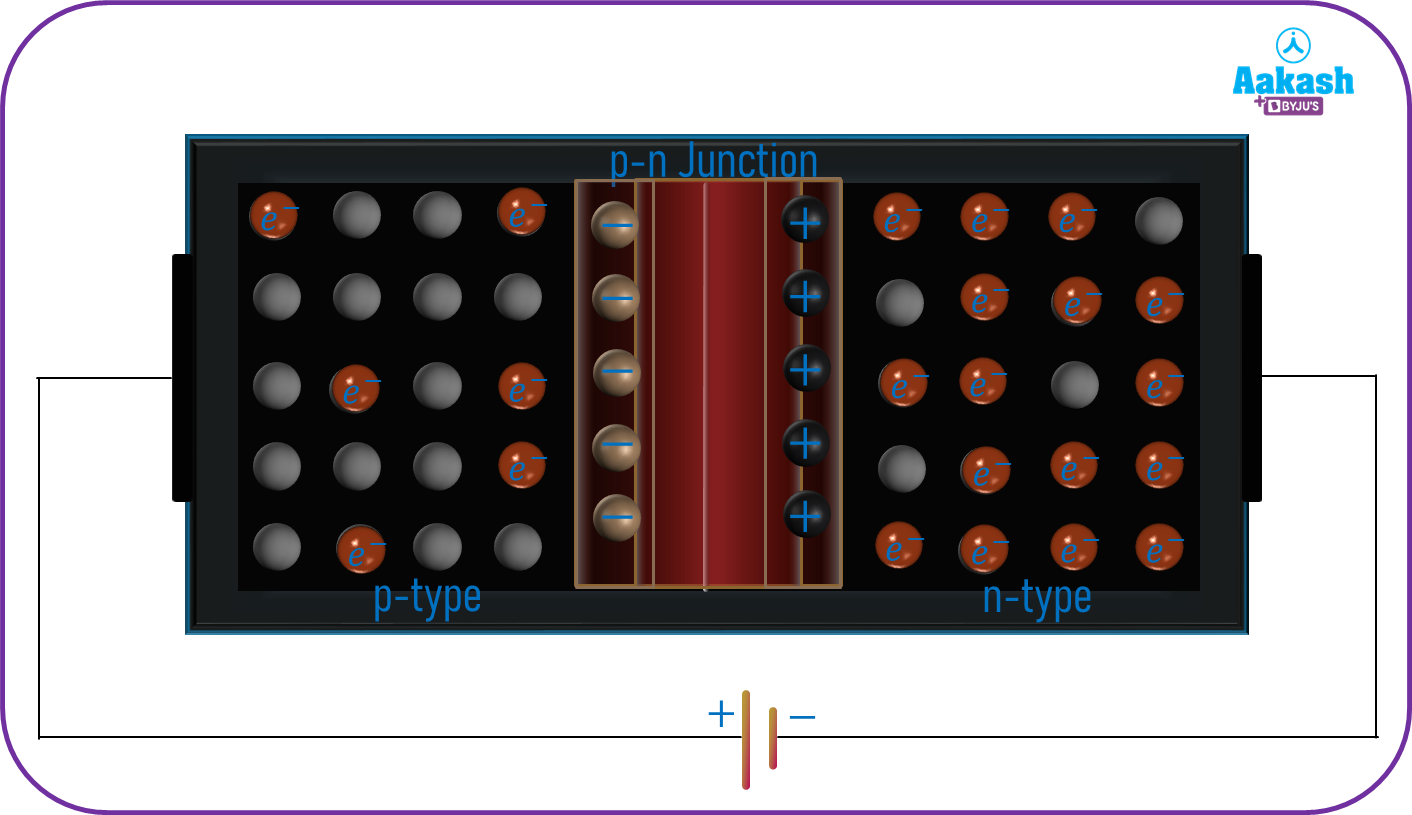
Initially, on increasing the external voltage, the current is very small. But, after a certain value of voltage applied, called the cut in voltage or the threshold voltage or knee voltage, even for a small increase in voltage the current increases drastically. Because at cut in voltage, the potential barrier becomes zero and now, a majority of the charge carriers can diffuse to the other side.
Reverse Bias
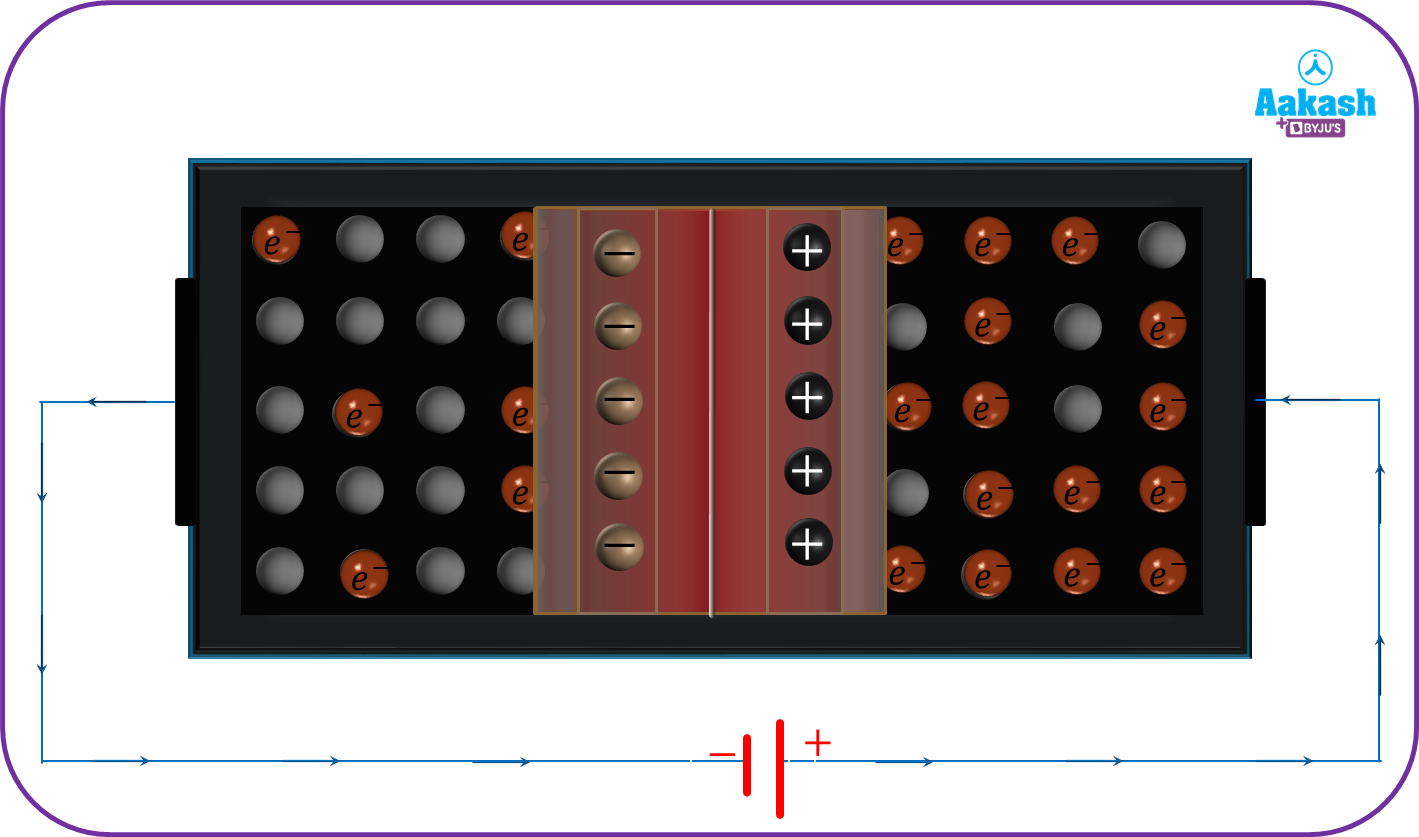
A p-n junction is said to be reverse biassed if the positive terminal of the battery is connected to the n-side and the negative terminal to the p-side of the p-n junction. The external potential difference applied by the battery increases the potential barrier inside the p-n junction. As a result, the electric field increases and hence, the depletion region expands. The magnitude of diffusion current is still very low . But, even if the electric field supports the migration of the minority charge carriers, the drift current is almost constant. This is due to very less concentration of minority charge carriers. Also, the magnitude of current in reverse bias is very low of the order of μA.
Initially, with increase in voltage, the current is very low and is almost constant. But, at breakdown voltage, the current increases sharply due to the avalanche effect.
I-V Characteristics
Semiconductors do not follow Ohm’s law. We define dynamic resistance as . For forward bias, the dynamic resistance is low whereas for reverse bias, the dynamic resistance is very high.
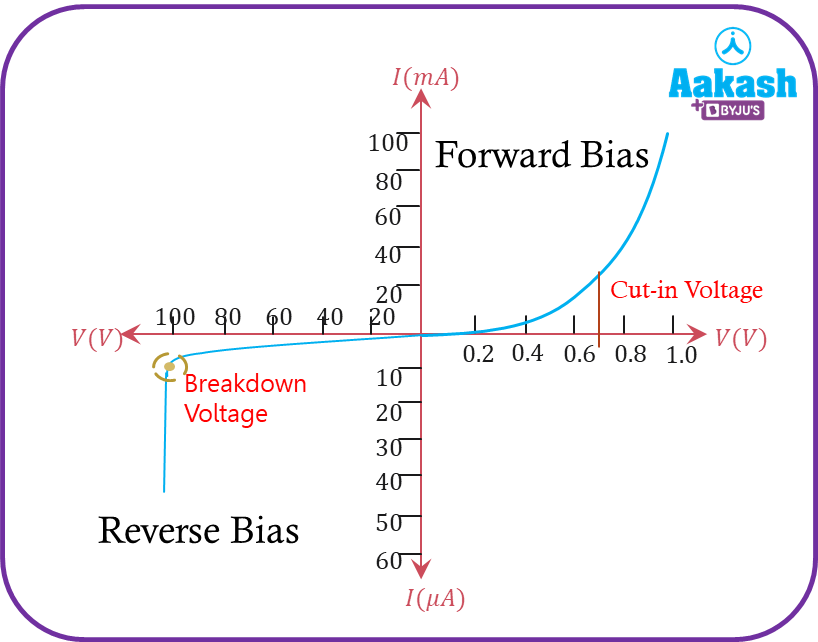
Therefore, it can be said that the diode is conducting in forward bias and non-conducting in reverse bias.
Types of semiconductor diode
There are different types of semiconductor according to their doping concentration of P-N junction. Following are the types of diodes that we generally come across in electronics circuits.
- Light emitting diode (LED)
- Zener diode
- Photodiode
- Tunnel diode
- Switching diode
- Gunn diode
- Variable capacitance diode
Applications of semiconductor diode
Semiconductor diodes are used vastly in the field of electronics. These electronic devices we use on a daily basis. Here are some of the important diode applications.
- Photodiodes are used as photo-detectors.
- In electronic systems, zener diodes are employed to stabilise current and voltage.
- Switching diode that is utilised for quick switching needs.
- When a voltage is applied in a reverse biassed condition, a variable capacitance diode is utilised.
- In order to emit an infrared light spectrum, IR LEDs are utilised.
- A unique type of diode employed in the region of negative dynamic resistance is called a tunnel diode.
- One of the parts of high-frequency electronics is the gunn diode.
Practice problems
Q1. Which of the following circuits will not show current in the Ammeter?
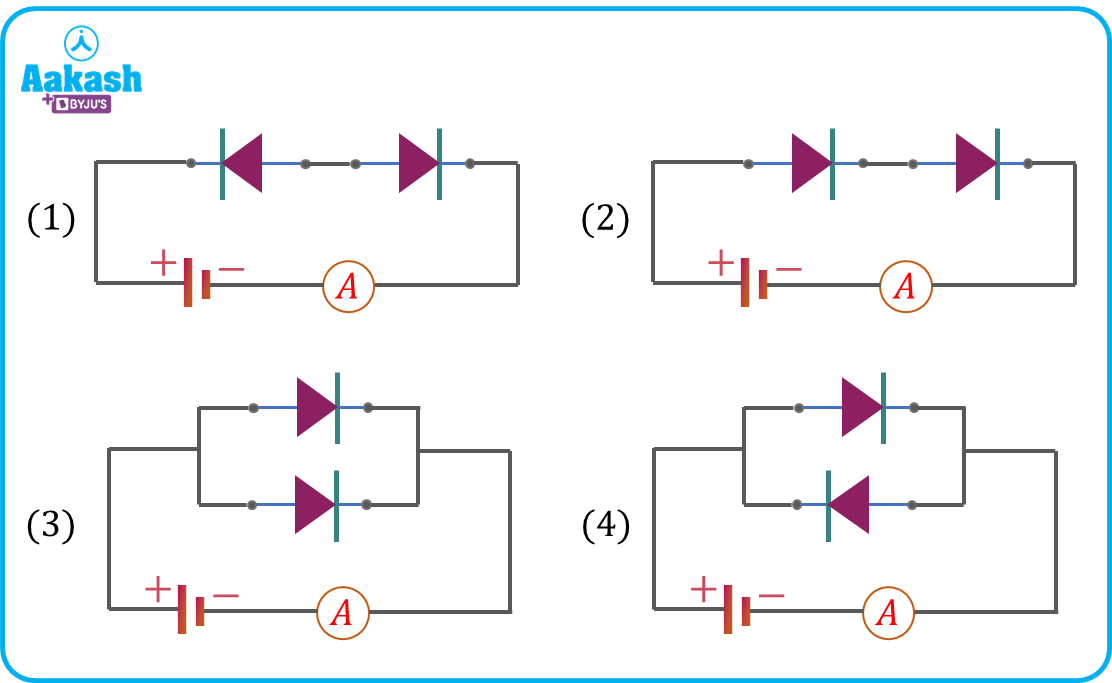
A. Diode is a unidirectional device. It allows the flow of current in the direction in which it is placed. In figure (2) both diodes are in series with similar polarity which is the same as the direction of current flow. In figure (3) both diodes are parallel with similar polarity in the direction of current flow. In the figure (4) diodes are parallel so the upper diode will be responsible for the flow of current. So in figure (2), (3), (4) Ammeter will show some reading because of the flow of current. In case of figure (1) both diodes are in series with opposite polarity. So there will not be any current flow. In this case, ammeter reading will be zero. Option (1) is correct.
Q2. In the diagram shown below find the value of current flowing through 300 Ohm resistance.

A. In the given circuit the anode of the diode is at lower potential as compared to the cathode of the diode. So the diode is in reverse bias. It will not carry any current through the resistor. So the answer is (d) 0 mA.
Q3. Which of the following diodes is forward biassed?
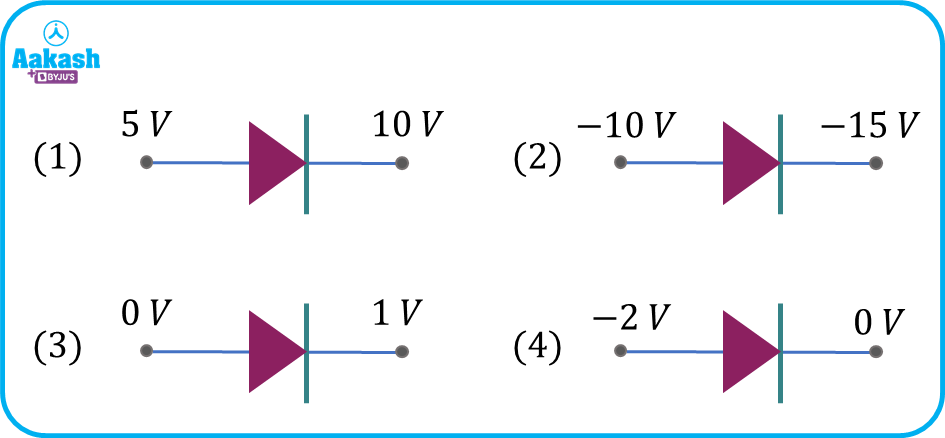
A. For the diodes (1), (3), (4) anode voltage is less than cathode voltage (VA < VC) so they are in reverse bias. But for diode (2) VA = -10 V and VC = -15 V. Therefore VA > VC That means the diode is forward biassed. So option (2) is correct.
Q4. Let VA and VB denotes the potentials at A and B respectively. Then the equivalent resistance between points A and B in the following circuit,
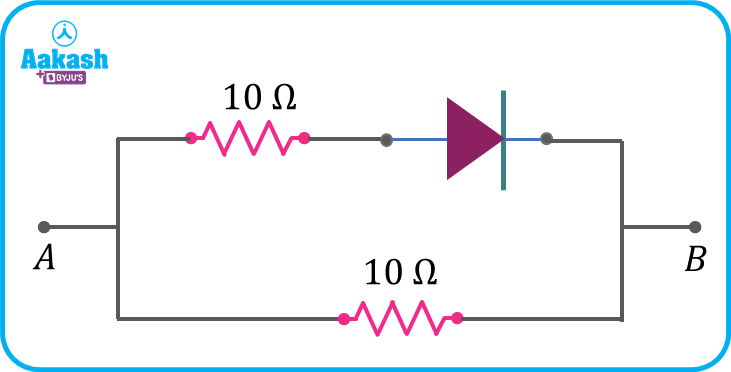
- 10 Ohm if VA > VB
- 5 Ohm if VA > VB
- 10 Ohm if VA < VB
- 5 Ohm if VA < VB
A. If VA > VB
In this case the diode will be forward biassed and behave as a short circuit. So both the resistances will be in parallel. The equivalent resistance between A and B will be
If VA < VB
In this case the diode will be in reverse bias and will act as an open circuit. So the equivalent resistance between A and B will be,
R=10 Ohm
So option (b) and (c) are correct.
FAQs
Q1. What is the main use of zener diodes?
A. Zener diodes are mainly used as voltage regulators by operating it in reverse bias. In reverse bias operation the zener diode has constant voltage across it called as zener voltage. This voltage is used in voltage regulators to get constant output voltage.
Q2. Where can we see the use of photodiodes in our day to day life?
A. Photodiodes have different uses and applications in our daily life. One of the important uses of photodiodes is in the smoke detectors which are installed in industrial or residential buildings. Alarm system is designed using photodiodes to prevent potential fire hazards.
Q3. Can we apply Ohm’s law to semiconductor diodes?
A. Materials which follow Ohm’s laws are called ohmic material. Generally conductors obey Ohm’s law. But the semiconductor does not obey Ohm’s law so we can not apply Ohm’s law to it.
Q4. What is meant by an ideal diode?
A. In the case of an ideal diode there is zero voltage drop in forward bias condition. Resistance offered by the diode in forward bias is also zero. In reverse bias condition the ideal diode works as open circuit and does not allow any current flow, which means it has infinite resistance in reverse bias.

 Call Now
 Let's Chat
 Share
Share