-
Call Now
1800-102-2727


Satellite, types of satellites, uses, applications, FAQs

“The moon”- in our childhood, we all have heard many stories about it, then many of us thought about the question “What is the moon?” and “where is it actually?”.
Often we wonder how google maps work or how we communicate with people using phones.
Earth
To answer all these questions we need to have an insight into instruments that are placed on some man-made objects that revolve around the Earth.
Table of contents
- Definition of satellite and its purpose
- Understanding Orbital Velocity
- Orbit of a satellite
- Earth’s satellites and their types
- What keeps a satellite in its orbit?
- Practice Problems
- FAQs
Definition of Satellite and its purpose
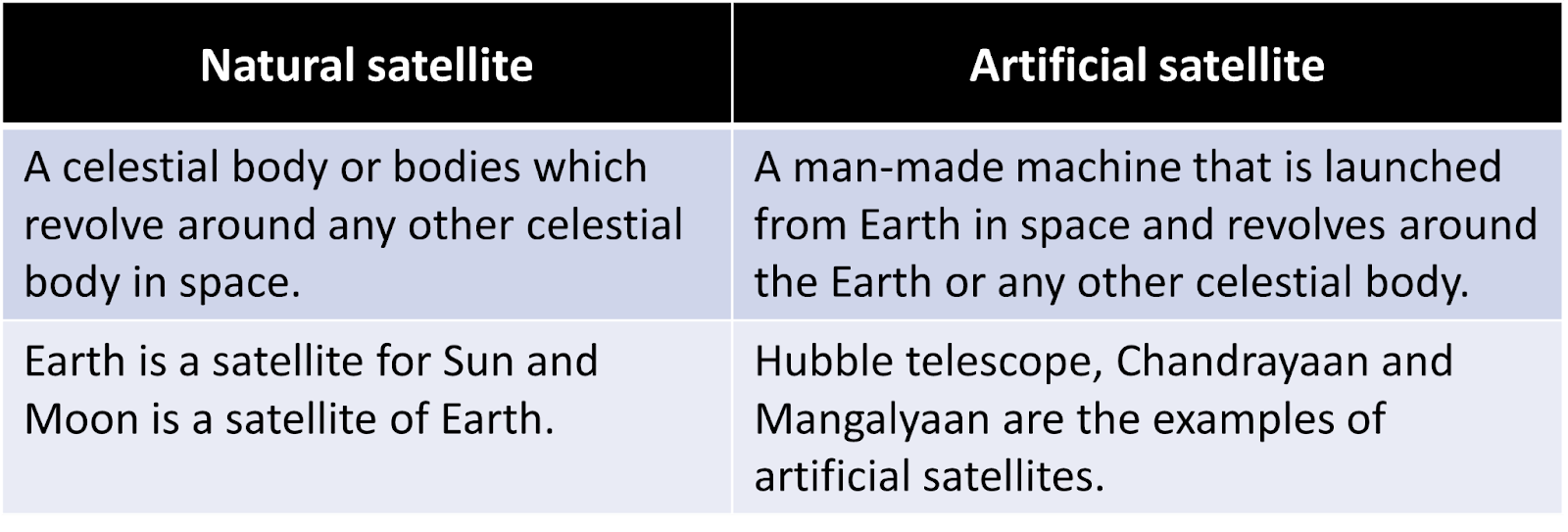
A satellite is an object in space that revolves on a certain curved path called orbit around any other object under the effect of gravity. The word “satellite” usually refers to a man-made object that is launched from the Earth into space and revolves around the Earth or other objects (mostly planets) in space.
Satellites are majorly divided into two categories, Natural satellites and Artificial satellites.
Purpose of the satellite:
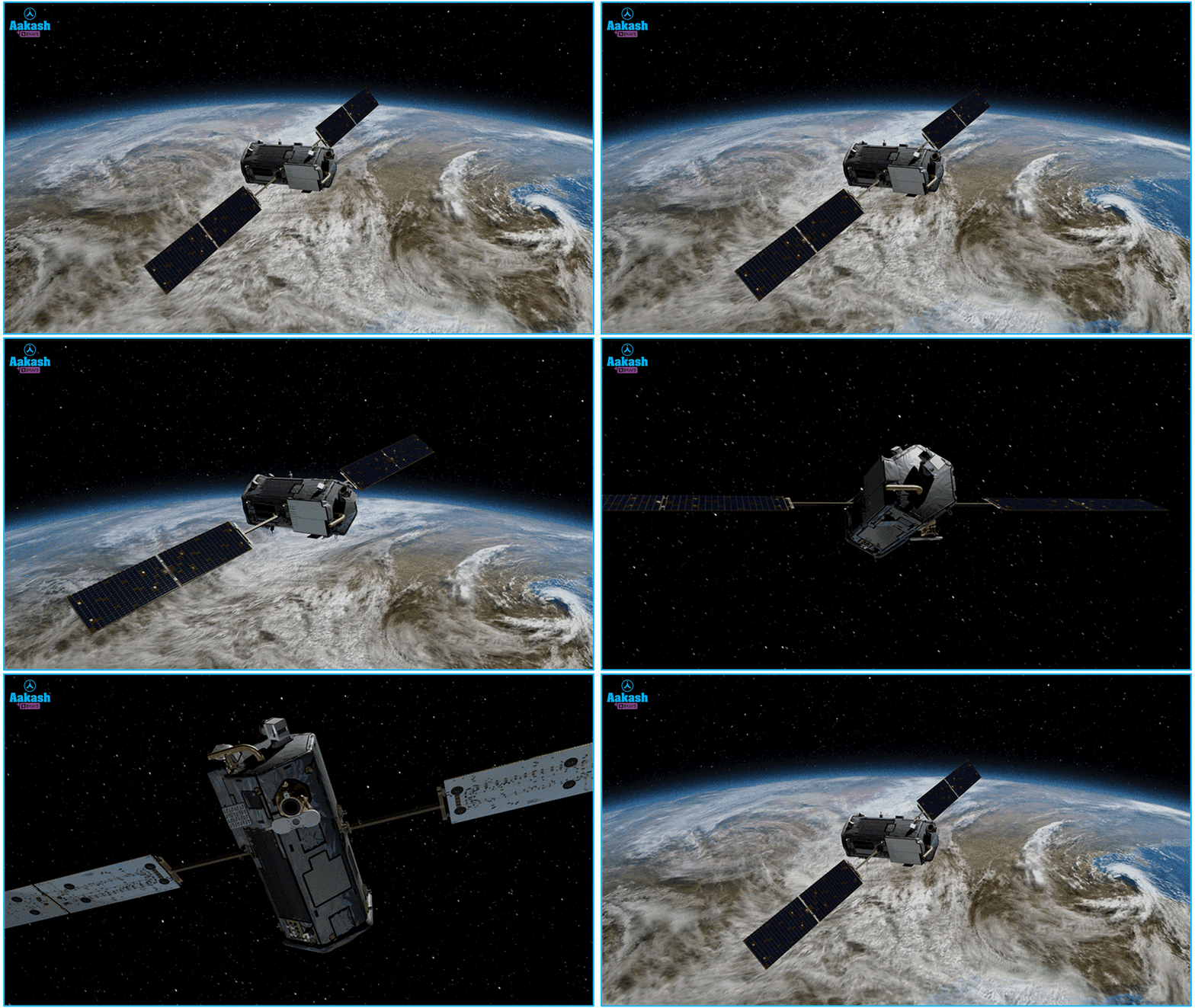
- The Earth has various satellites that revolve around it. Each of them has a specific task to do. For example, some are used for taking pictures of stars and planets that are far from Earth (Hubble Telescope) or even taking the picture of the Earth itself while some satellites are used for information gathering (weather prediction, mapping, scientific research etc) and for communication (Radio, phones, etc).
- Each of these satellites is constructed and launched from Earth with specific objectives and has a limited working life. The satellites are placed in a pre-calculated place in space (called the orbit) where it revolves around the Earth or other planet and does their specific tasks.
- Since they have a very large field of view, they can collect data a lot faster than instruments that can be used at ground level. Since satellites revolve at very high altitudes above the Earth, in space, the Earth will not be completely blocked by clouds, dust and any other obscurities. This gives the satellite a clear and more effective view from space than a telescope on Earth.
Understanding Orbital Velocity:
Consider a hypothetical situation in which a long tower, let’s say it has a height of about 400 km. Now consider an object kept on the top of the tower at a point P and it is projected from it with an initial horizontal velocity.
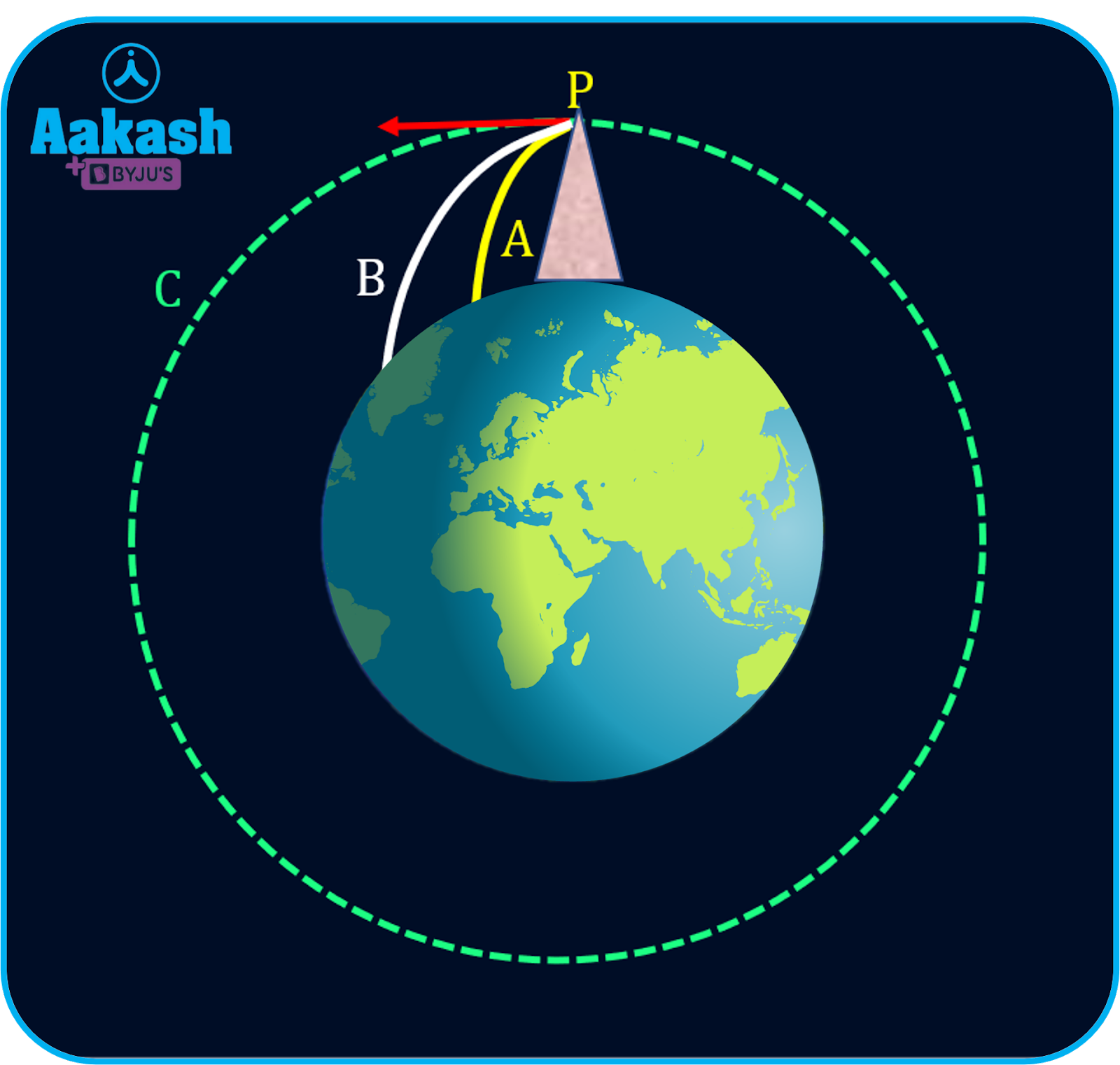
- For path A, when the object is thrown with some initial horizontal velocity from point P but it will fall on the Earth under the effect of gravity. It means that this velocity is not enough to balance the effect of gravity.
- For path B, now the velocity is slightly increased but again the object falls farther away on the Earth than in the previous case. It means that still, this velocity is not enough to balance the effect of gravity.
- Now for path C, the object is given an initial horizontal velocity greater than in the previous cases, it will revolve in a curved path called its orbit. It means that the velocity is just enough to balance the gravity effect. This velocity is called the orbital velocity.
Orbit of a satellite
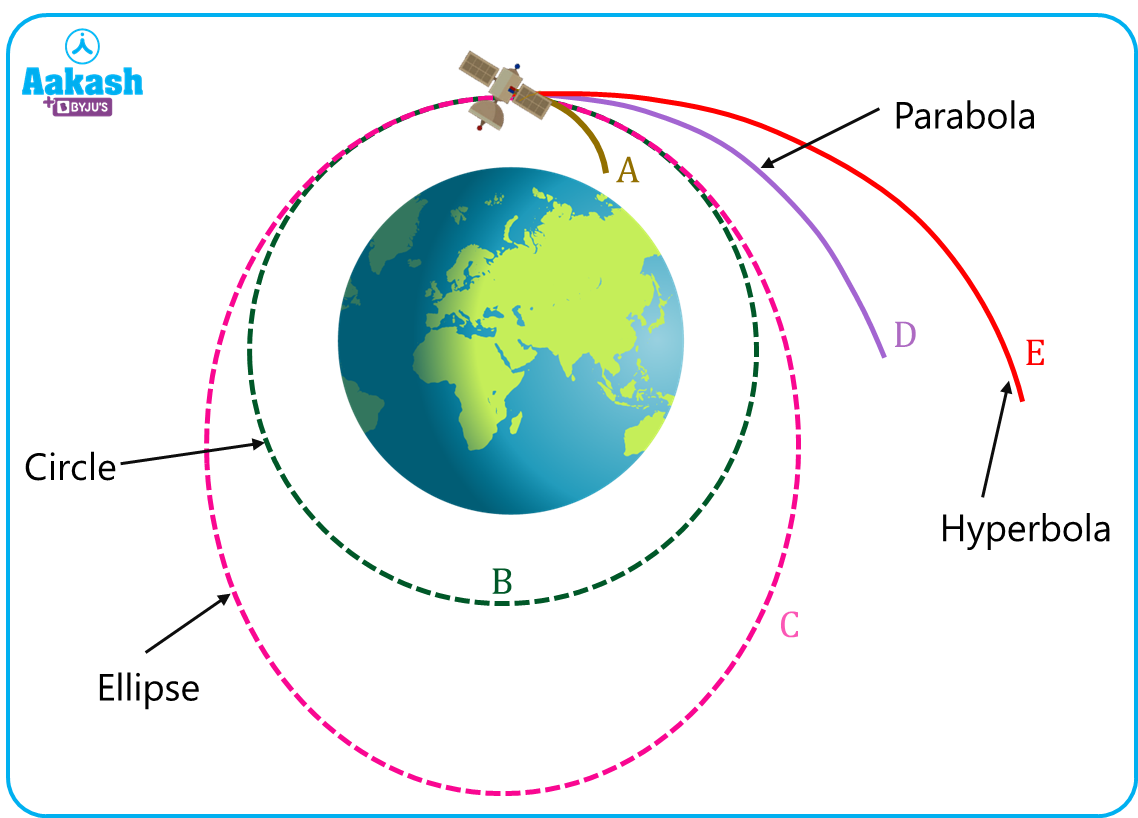
The path on which a satellite revolves around another object is called an orbit of the satellite. The orbit depends on the speed at which the satellite is projected. When the velocity of projection of a space vehicle is equal to or higher than the escape velocity, it results in an open orbit extending to infinity, i.e., a parabolic orbit or a hyperbolic orbit. Similarly, if the velocity of the projection of space vehicles is less than the escape velocity which results in closed elliptical orbits.
Earth’s satellites and their types
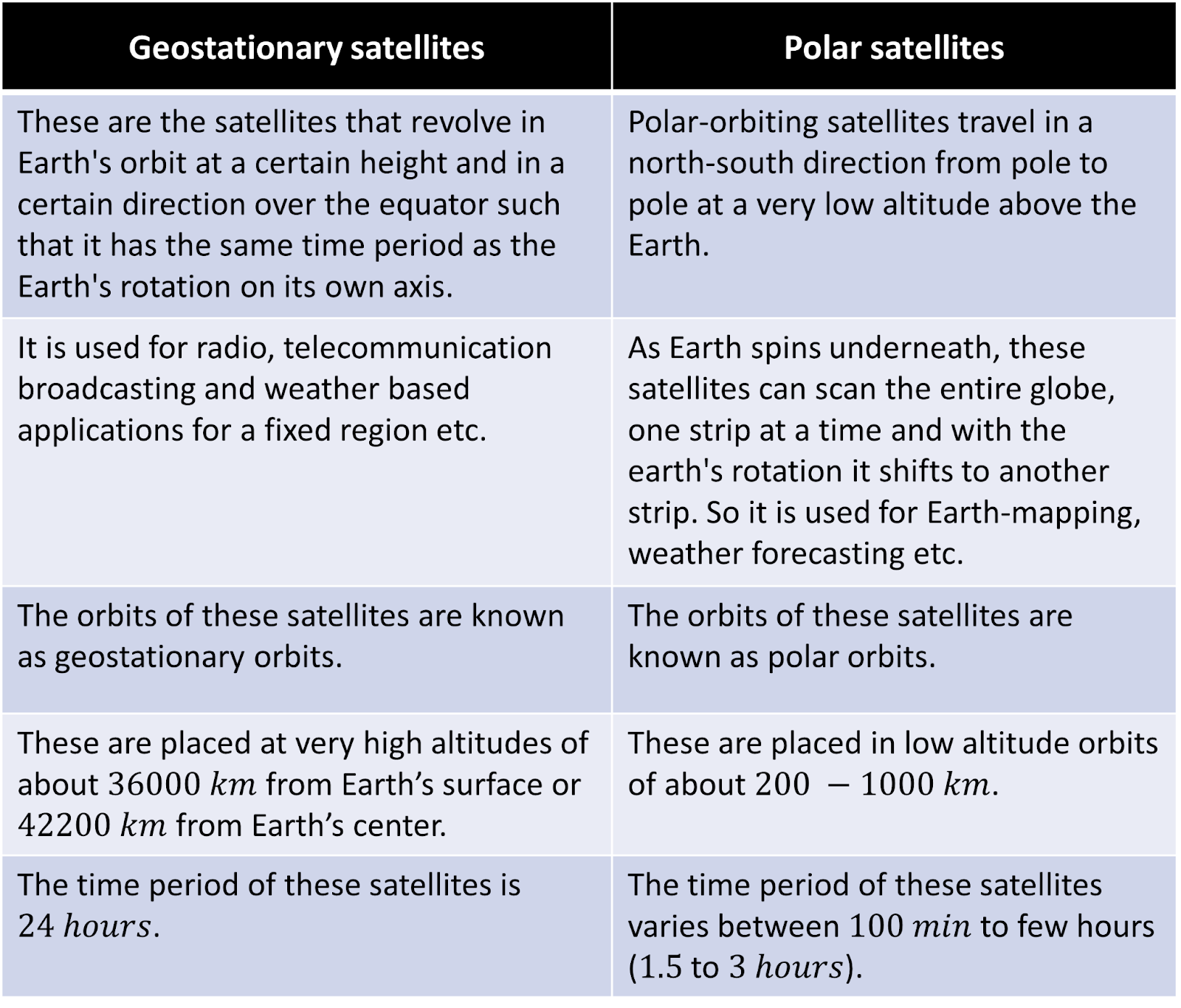
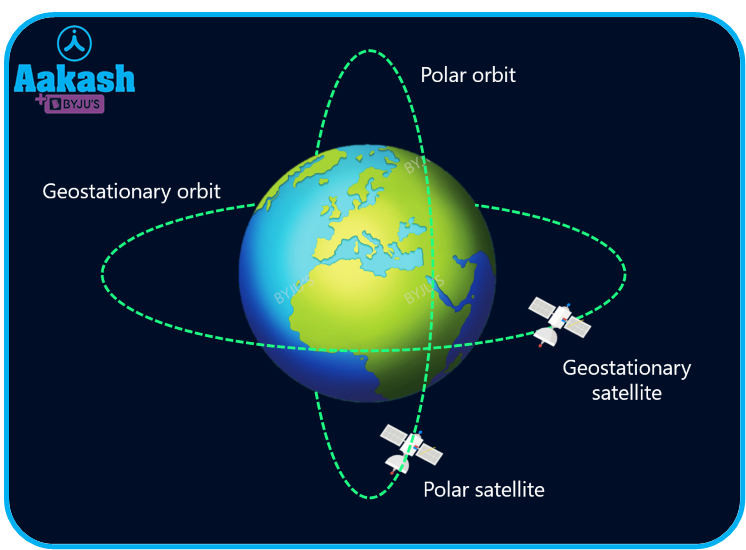
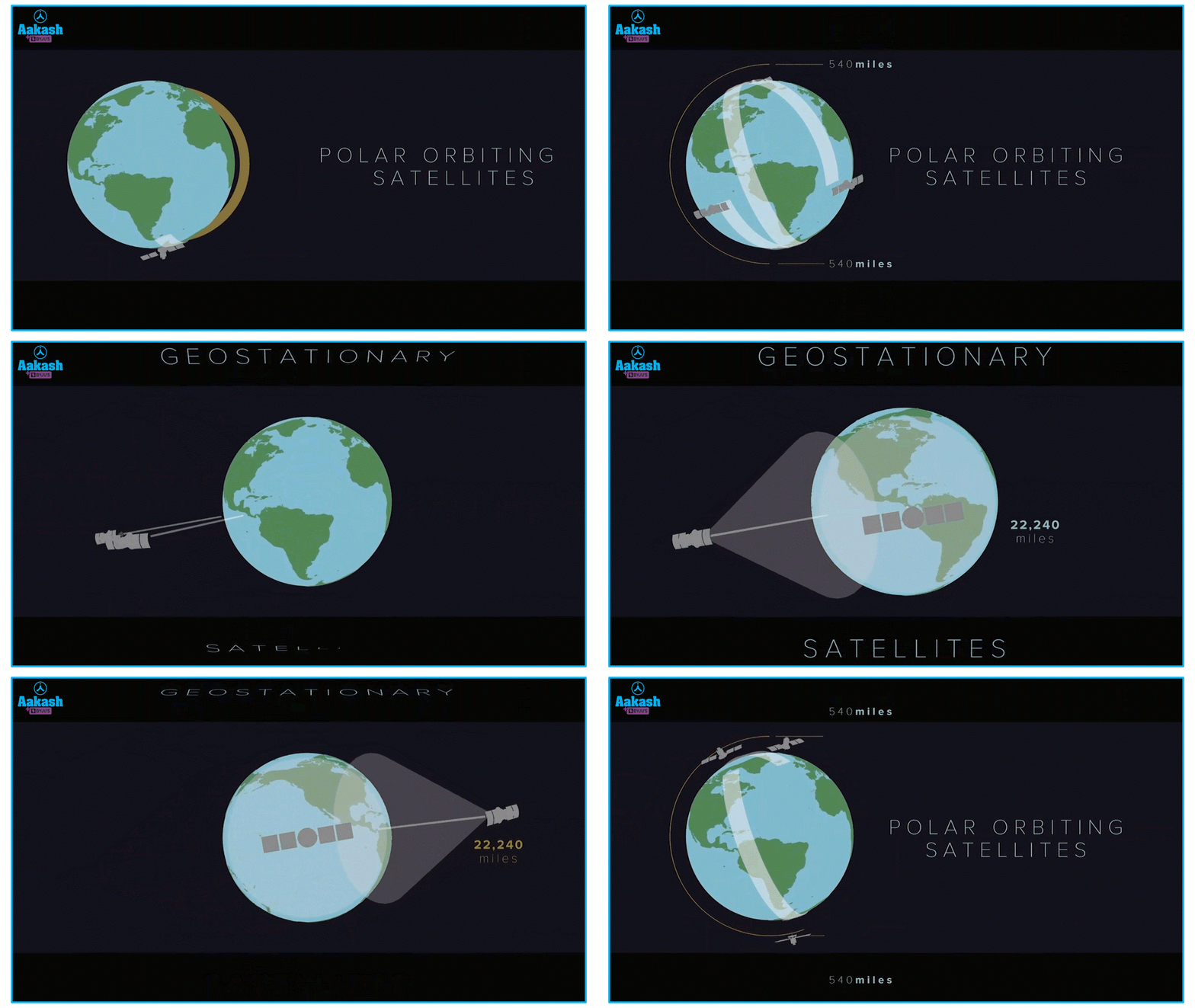
The satellites which revolve around the Earth in various orbits are known as Earth’s satellites. Based on their purpose, artificial satellites are categorised into two types, geostationary satellites and polar satellites.
What keeps a satellite in its orbit?
- A satellite is a projectile that moves under the action of gravity. Hence gravity’s force is the only thing that affects a satellite once it is launched into orbit.
- If an object attains an adequate speed (also known as orbital speed), it starts orbiting the Earth. The adequate speed is such that, at a particular height due to that speed it is able to balance the centripetal force by the gravity at that height.
- The satellites travelling nearer to the Earth have more risk of falling due to friction or drag of atmospheric molecules which can slow a satellite down.
Practice problems
Q1: What are LEO, MEO and GEO?
A:
i) LEO (Lower Earth Orbits): The orbits of satellites that are very near to the Earth are known as lower Earth orbits and varies in the range of 200 km-2000 km. The time period of the satellites revolving in these orbits is about 1.5 hrs to 3 hrs.
ii) MEO (Middle Earth Orbits): Orbits that are in the range of altitudes of about 2000 km to 36000 km (majorly near 20000 km) are known as middle Earth orbits. The time period of satellites revolving in these orbits is about 12 hrs.
iii) GEO (Geostationary Earth Orbit): The orbits which are at about 36000 km or higher are known as geostationary Earth orbits. The time period of satellites revolving in these orbits is around 24 hrs. They are also known as High Earth Orbit.
Q2: What stops different satellites from crashing into each other?
A: When a satellite is launched, it is placed into an orbit designed to avoid crashing with other satellites. Low orbit satellites crash can be avoided by taking the advantage of atmospheric drag by exposing the contact area to the atmosphere that can change the orbit of the satellite. For medium and high altitude satellites crashes can be avoided by use of an auxiliary propulsion system to change the satellite’s orbit.
Q3: Why do satellites orbiting very close to Earth, are at greater risk of crashing on the Earth's surface as compared to those orbiting at greater altitudes?
A: Since the atmospheric drag will be larger near the Earth’s surface which can very much slow down the satellites when they are orbiting in lower orbits and the satellite can eventually fall on the Earth.
Q4: What makes a satellite move in its orbit?
A: The gravity effect of the central body (i.e., the Earth) is the key source which is responsible for the motion of a satellite in its orbit. It is the gravitational force that provides the necessary centripetal force that makes the satellite revolve around the Earth.
Therefore to move a satellite in the curved path in its orbit,
Gravity force = Centripetal force
FAQs
Q1. How does a satellite get power to operate in its orbit?
A. A satellite usually gets power from the radiation coming from the Sun to operate in its orbit. Solar panels are installed to the satellites which are retractable and can be moved so that the surface area of the solar panel can be exposed to the Sun when the satellite moves in its orbit. Also if there is a need to change satellite’s speed or there is a need to change the satellite's orbit, the satellite is filled with some amount of auxiliary fuel that can be used for this purpose.
Q2: What is the altitude of geostationary satellites and polar satellites?
A: The geostationary satellites revolve in an orbit at an altitude of 36000 km (4.22104 km from Earth’s centre) or even more and the polar satellite's orbit at an altitude of around 200 -1000 km.
Q3: What is the time period of geostationary satellites and polar satellites?
A: The time period of a geostationary satellite is 24 hours and the time period of a polar satellite varies from 100 min to a few hours(1.5 to 3 hours).
Q4. Why do satellites have a lifespan?
A. The lifespan of a satellite depends on the benefits that are to be taken from the devices installed on it. The devices present on the satellite have a certain life up to which they can work and this life is estimated during the research process before constructing the satellite. Also, auxiliary fuel is present in the satellite in a very limited amount which is used for changing the orbit of the satellite according to the operational requirements. When the satellite is considered to be not in use, it is slowed down by the use of auxiliary fuel so that it will lose its orbital speed and eventually it can fall on the Earth.

NEET Related Links
JEE MAIN Related Links
JEE Advanced Related Links
JEE Advanced Eligibility Criteria
JEE Advanced Chemistry Syllabus
JEE Advanced Registration Dates
CUET Related Links
Important Topics
Anemometer : Measurement of Wind Speed
Angular Acceleration Atomic Theory Audible and Inaudible Sound Average Speed and Average Velocity Average Velocity Avogadros Number Avogadros Hypothesis Azimuthal Quantum Number Balanced Force Bar Magnet Biconvex Lens Boyles Law Buoyancy Calorimeter Carnot Engine Celestial Bodies Centripetal And Centrifugal Force Concave and Convex Lenses Concave Convex Mirrors Contact and Non Contact Force Controlled Thermonuclear Fusion Convection Currents Convex Lens Convex Mirror Destructive Interference Difference Between Conduction Convection and Radiation Difference Between Electric Field and Magnetic Field Difference Between Heat And Temperature Difference Between Series And Parallel Circuits Differences Between Acceleration And Velocity Distance and Displacement Distance Time Graph Electrical Force : Electric Forces and Their Types Electromagnetic Waves : Definition, Equation and Properties of Electromagnetic Waves Electromagnetism Electron Spin Fluid Flow : Bernoullis Equation Derivation and Fluid Mechanics Fluid Friction : Types and Factors of Fluid Friction Frames of Reference : Inertial and Non- Inertial Frame of Reference Frequency and Wavelength Frictional Force Importance of Hydrosphere Instantaneous Speed and Velocity Introduction to Motion Kinetic and Potential Energy Difference Law Of Conservation of Energy Layers of the Earth Light Energy Light Sources List of physics scientists and Their inventionsLoudness of Sound
Magnetic Dipole Moment Magnetic Field Non - Contact Force Non - Renewable Energy Ohms Law Optics P Wave Physics Symbols Plane Mirrors Poissons Ratio Projectile Motion Properties of Water : Anomalous Expansion of Water Radius of Gyration Reflection of Light Reflection of Waves Relative Density Resonance Reverberation Rolling Friction Rotation and Revolution Screw Gauge Semiconductors and Insulators Sliding Friction Speed Time Graphs Static Friction Stefan Boltzmann Law Stress Tension Tension Force Thermometer: Clinical Laboratory Thermometer Types of Rocks Types of Waves Uniform Motion and Non Uniform Motion Unit of Voltage Uses of Convex Lens Uses Of Convex Mirror Uses of Electromagnet Uses of Optical Fibre Wave Wavelength of Light What is Scattering of Light Working of Electric Bell Conventional and Non-conventional Sources of Energy Buoyant Force Bulk Modulus of Elasticity Bernoulli’s Principle Angular Momentum Difference Between Speed And Velocity ForceUnit of Heat
Difference between Distance and Displacement Simple Microscope Derivation Of Equation Of Motion Thermometer: Clinical & Laboratory Thermometer Difference between Concave and Convex LensDerivation Of Lens Maker Formula
Unit Of Pressure Velocity Uses of Plane Mirror
Wave Theory of Light
Unit of Density Unit of Light Unit of Force Unit of Magnetic Field Unit of wavelength Unit of Viscosity Uses of Electroplating Young's Modulus
What is the Scattering of Light
Lenz Law Space Wave Propagation Schrodinger Wave Equation Relation between Fahrenheit and Celsius Refractive Index Potentiometer Working Pascal Law Oscillatory Motion Optical Instruments Newton's Laws of Motion - First Law Modulation and Demodulation Magnetic Flux Lens Formula and Magnification Kaleidoscope Faradays Law Epsilon Naught Value Energy Bands Electrostatics Electroscope AC Generator Unit of Current Lithosphere Bending Equation Derivation Difference Between Pound and Kilogram Semiconductor Devices OTEC - Ocean Thermal Energy Conversion Hall Effect Rectilinear Propagation of Light Difference Between Ammeter and Voltmeter Coefficient of Linear Expansion Ampere’s Law Cyclone and Thunderstorm Save The Environment From Pollution Particle Nature of Light Types of DC Motor Uses Of Transistor Derivation of Phase Rule Unit of Humidity

 Call Now
 Let's Chat
 Share
Share