-
Call Now
1800-102-2727


Propagation of Light and Laws of Reflection | Ray Optics Notes for NEET & JEE

Propagation Of Light And Laws Of Reflection
Propagation of light and the laws of reflection are fundamental concepts in ray optics. They help us understand how light travels and how it behaves when it strikes reflecting surfaces such as mirrors. These laws can be applied in design and help us understand how the visibility of objects works in relation to the surface of the object and the source of light. To understand this, we will observe light primarily travelling through air and use objects that are bigger than the wavelength of light. To understand the laws of reflection, we will use smooth surfaces that are plane and have no other curvature.
Definition of Propagation Of Light
Propagation of light is defined as the direction in which light travels. Observe this for yourself. Take a torchlight and observe how it travels through a tiny hole. You will notice the ray of light travelling in a straight line. Now observe how that ray reflects against a polished surface, such as a plane mirror. You will again notice that the reflected ray bouncing off the surface moves in a straight line. This is the propagation of light in a straight line, also known as ‘rectilinear propagation’.
Rectilinear propagation is valid when the dimensions of the obstacle or aperture are much larger than the wavelength of light. When the dimensions become comparable to the wavelength, diffraction occurs.
Light is considered a wave and a particle. Here, light is treated using the ray model, which is valid when the size of obstacles is much larger than the wavelength of light.
When the object is smaller, light is observed to bend around the object and is known as the diffraction of light.
Light and Objects
This is how light moves in real life among objects. The sun illuminates everything on earth. The light we see on objects makes the objects visible. When light falls on an object, three phenomena may occur: reflection, absorption, and transmission. Opaque objects reflect and absorb light. Transparent objects transmit most of the light while partially reflecting it. The reflected light enables us to see objects.
Applications of Rectilinear Propagation
This characteristic of light is used in many devices and scenarios as follows:
- This concept is used in making pinhole cameras.
- While aligning optical instruments, the propagation of light is taken into account.
- It is used to accurately calculate the direction of laser beams.
- It is also used in predicting the view of an eclipse in the sky.
- Formation of sharp shadows and eclipses is explained using rectilinear propagation.
Laws Of Reflection Of Light
When a ray of light falls on a smooth reflecting surface such as a plane mirror, it gets reflected in a definite direction. The behaviour of the reflected ray is governed by two fundamental laws, known as the ‘Laws of Reflection’.
These laws are valid for all reflecting surfaces, whether plane or curved, provided the reflection is regular.
Important Terms
We must understand the following terms first:
- Incident Ray - The ray of light that strikes the reflecting surface.
- Point of Incidence - The point at which the incident ray strikes the mirror.
- Normal - An imaginary line drawn perpendicular to the surface at the point of incidence.
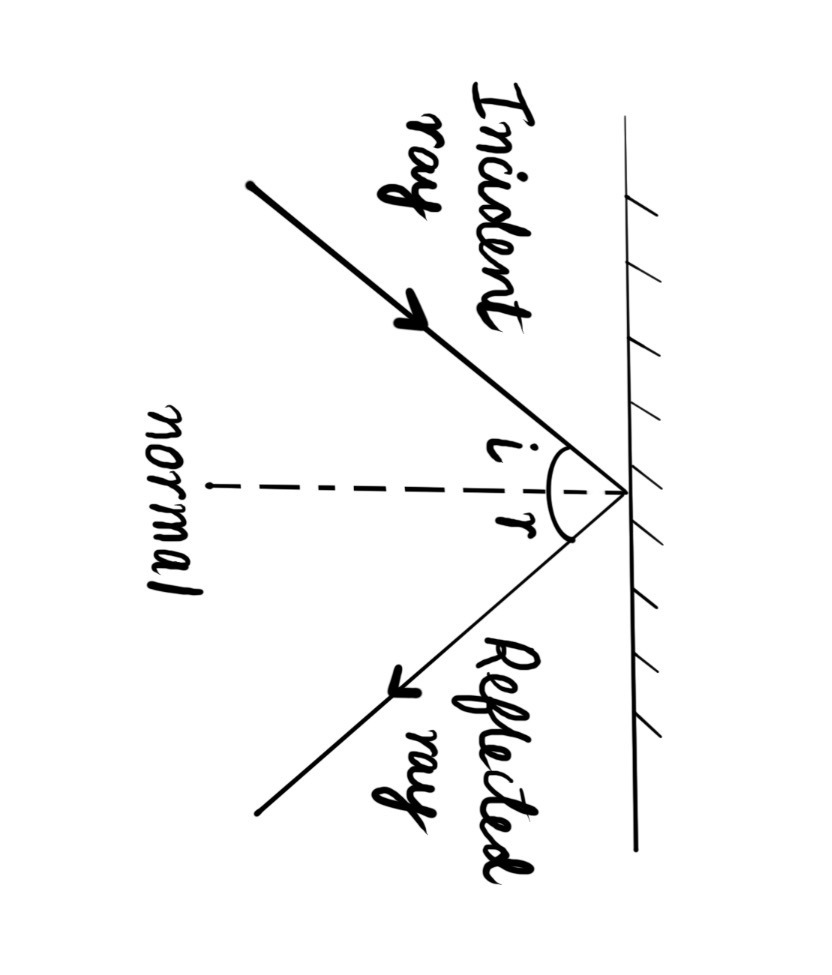
- Angle of Incidence (i) - The angle between the incident ray and the normal.
- Angle of Reflection (r) - The angle between the reflected ray and the normal.
Note: Angles are always measured with respect to the normal, not the surface.
First Law of Reflection
The angle of incidence is equal to the angle of reflection.
Mathematically,
i=r
This means that if the incident ray makes an angle iii with the normal, the reflected ray will make the same angle rrr with the normal.
The angle of incidence is equal to the angle of reflection
Let's observe a ray of light shining on a plane mirror. Every time you shine in a different direction, the angle of incidence of the light changes. Note down the angle of incidence and the angle of reflection in each case. You would note that during each scenario, the reflected ray also changes direction. But, if you compare the different angles in each case, you would see that the angle of reflection also changes, but is always equal to the change in the angle of incidence.
Therefore, we can say that the first law of reflection of light is that, the angle of incidence is equal to the angle of reflection.
Second Law of Reflection
The incident ray, the reflected ray, and the normal at the point of incidence all lie in the same plane.
This means reflection is a two-dimensional phenomenon in a single plane.
The incident ray, the normal to the mirror at the point of incidence and the reflected ray, all lie in the same plane.
Take a plane mirror, the same as the above setup, and shine a ray of light on it. You would observe the reflected ray and mark the normal at the site of incidence. Now try to move the mirror around at different angles, or move the light in a circle. You would still notice that the reflected ray moves similarly to the incident ray, and every time the normal is in the same plane as both the rays and is always perpendicular to the mirror.
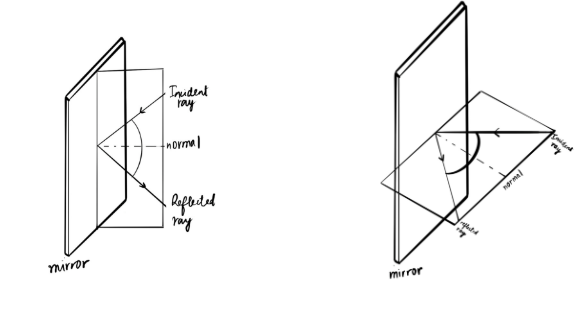
In the above diagram, you can clearly see them all being in the same plane. Therefore, the second law of reflection of light is that the incident ray, the normal to the mirror at the point of incidence, and the reflected ray all lie in the same plane.
Regular and Diffuse Reflection
Regular Reflection - Occurs from smooth surfaces. Parallel incident rays remain parallel after reflection. Clear images are formed.
Diffuse Reflection - Occurs from rough surfaces. Reflected rays scatter in different directions. No clear image is formed.
Both obey the laws of reflection.
Applications of Laws of Reflection
The laws of reflection are used in:
- Plane mirrors
- Periscopes
- Kaleidoscopes
- Reflecting telescopes
- Rear-view mirrors
- Solar concentrators
- Road reflectors and safety devices
Key Points for NEET/JEE
- Laws of reflection are valid for both plane and curved mirrors.
- Angles are always measured from the normal.
- Reflection occurs at the boundary between two media.
- Reflection obeys the principle of reversibility of light.
(The principle of reversibility is very important in ray optics.)
Concept Check
1. If the angle of incidence is 35°, find the angle of reflection.
According to the first law of reflection:
i=r
If the angle of incidence (i) = 35°
Then the angle of reflection (r) = 35°
2. Can the angle of reflection ever be greater than 90°?
Yes. If the angle of incidence is greater than 90° (measured with respect to the normal), then the angle of reflection will also be greater than 90°, since i=r.
However, in practical mirror problems, angles are usually between 0° and 90° because we measure angles between the incident ray and the normal.
3. Why are images not formed on rough surfaces?
On rough surfaces, reflection is diffuse. The surface irregularities cause the reflected rays to scatter in different directions. Since reflected rays do not remain parallel, they do not converge at a single point. Therefore, no clear image is formed.
Conclusion
Propagation of light and the laws of reflection form the foundation of ray optics. In a homogeneous medium, light travels in straight lines, a phenomenon known as rectilinear propagation. When light encounters a reflecting surface, it obeys two simple but powerful laws: the angle of incidence equals the angle of reflection, and all related rays lie in the same plane.
These principles are not limited to mirrors alone. They apply to all reflecting surfaces and form the basis of optical instruments such as periscopes, telescopes, and safety reflectors. A clear understanding of these laws is essential for solving numerical and conceptual problems in NEET and JEE.
FAQs
Q1. Does light travel in a straight line?
In a homogeneous medium, light travels in a straight line. This is called rectilinear propagation of light. However, light can bend when passing through different media or when diffraction occurs.
Q2. Why are plane mirrors used to observe light?
Plane mirrors provide regular reflection because their surfaces are smooth at the microscopic level. This ensures predictable reflection that obeys the laws accurately, unlike rough surfaces which cause diffuse reflection.
Q3. Does light bounce off transparent objects?
Such objects partially reflect and partially transmit light. The amount of reflection depends on the refractive index of the material and the angle of incidence.

 Call Now
 Let's Chat
 Share
Share