-
Call Now
1800-102-2727


Photon, definition, properties, flux, force exerted, practice problems, FAQs

Do you know that while you are reading this article a force is acting on you due the light falling upon you? Yes the light exerts a force due to its particle nature. If you want to know more about this force, first knowledge of photons that constitutes the light is necessary.
Table of contents
- Photon
- Properties of photon
- Photon count
- Photon flux
- Force exerted by the photons
- Practice questions
- FAQs
Photon
Photons are the smallest possible packets of electromagnetic energy. Light was known to have wave-like properties until Albert Einstein proved through the photoelectric effect that light consists of discrete bundles of energy called photons.
Properties of photon
- The rest mass of photons is zero.
- Photons do not carry any charge.
- The number of photons may not be conserved. They can be destroyed or created due to radiation.
- Photons travel with the speed of light.
- Energy of a photon, 𝐸 = ℎ𝑣 (where h is Planck constant and 𝑣 is frequency).
- Though photon doesn’t have any mass, its momentum is given by,
Photon count
Photon count(𝑛): No. of photons emitted per second by a source.
Power of the source, 
Since intensity of light, 

Photon count, 
Photon flux
The number of photons incident normally on a surface per second per unit area is known as photon flux. It is denoted by
Force exerted by the photons
Although photons don't have rest mass, they have momentum and thus undergo a change in momentum when interacting with a surface. Hence it is evident that they exert some force and pressure on the surface also known as radiation pressure (P). The force and radiation pressure depends whether the photon gets absorbed, reflected or both.
Complete absorption
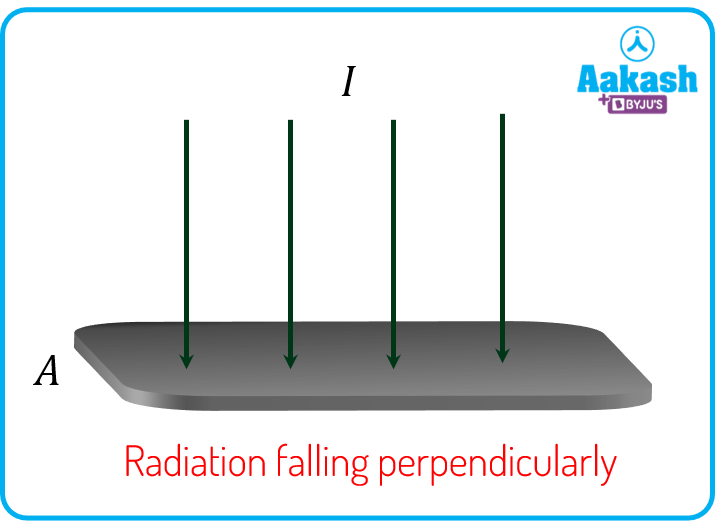
Initial momentum of each photon,
Where, λ= wavelength of light
As the photon is completely absorbed, the final momentum of each photon will be zero.
The change in momentum of each photon,
Let n be the no. of photons incident per second
Force acting on the surface = Net change in momentum per second,
Since intensity,
Therefore net force,
Radiation pressure,
In case if radiation is falling inclined to the normal at an angle , then we need to take effective area and that will be A
Complete reflection
Assumption:- The collision of photons with the surface is elastic
Initial momentum of each photon,
Where, λ= wavelength of light
As the photon is completely reflected and the collision is elastic, therefore the final momentum of each photon will be the same in magnitude and opposite in direction.
Final momentum of each photon, 
The change in momentum of each photon, 
Force acting on surface = Net change in momentum per second, 
Since intensity, 
Therefore net force, 
Radiation pressure, 
Partial absorption and partial reflection

Here, 𝑎 = absorption coefficient and, 𝑟 = reflection coefficient
𝑎+𝑟=1 ⇒ 𝑎=1−𝑟
If n be the no. of photons incident per second
Then, number of photons absorbed per second, = a × n
and, number of photons reflected per second, = r × n
Radiation pressure due to absorption, 
Radiation pressure due to reflection, 
Net radiation pressure, 

For complete reflection, 
For complete absorption, 
Practice questions
Q. A parallel beam of monochromatic light is incident normally on a perfectly reflecting surface. The incident radiation has the power as 2.138710-27 W. Find the force exerted by the light beam on the surface by each photon. (Take ℎ=6.626×10⁻³⁴ 𝐽𝑠)
A.
For a perfectly reflecting surface, force exerted by a radiation is,
Power of source, p=IA
Q. Explain the variation of energy Vs momentum of the photon with a graph.
A.
Energy of a photon is,
E = pc
Where p= momentum, and c= speed of light in vacuum.
∴ E = pc, is similar to y = mx
Where, E is on y-axis and p on the x-axis.
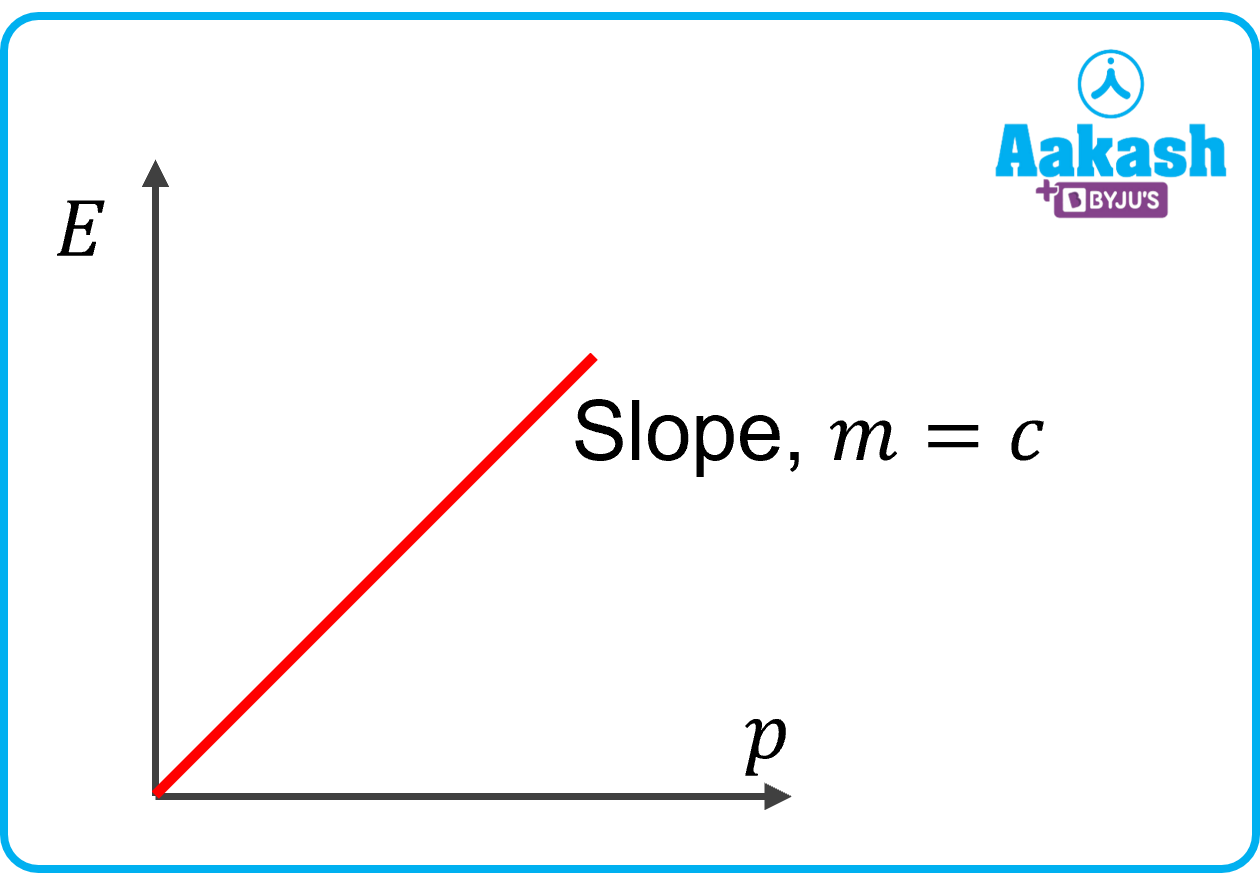
And, slope is, m=c = 3 108 m/s
Q. If a light of intensity 60 W falls normally on an area of 1 m2. If the reflectivity of the surface is 75%, find the force experienced by the surface.
A.


As,  photons are reflected while 25 % are absorbed.
Force due to absorbed photons, 

Force due to reflected photons 

The total force experienced is, 

Q. A metal (surface area 1 m2) is having perfectly absorbing surface on which a light having intensity 3 W/m2 is incident at an angle of 45o with the normal. If photons exert a force n10-9 N, what will be the value n?
A.
Effective area on which the light falls, 
Force exerted on the surface, 
Therefore, value of n is 7.07.
FAQs
Q. How does the intensity of light get increased?
A.
We know that, the intensity of light is given by,
So, intensity increases when the number of photons emitted per unit time increases, frequency of light increases or more energetic photons are emitted.
Q. Why does the tail of a comet always point in the direction away from the sun?
A. As the comet approaches the sun while moving in an elliptical orbit, the dust particles from its surface start to lose contact with the surface, forming the tail of the comet.
Due to radiation pressure of solar radiations, the dust particles deflect away from the sun i.e. they move in the direction of incident solar radiation.
Q. Can we increase the intensity of light without changing the wavelength?
A.
Since intensity,
To increase the intensity, the number of photons incident per second can increase.
Q. Does electric field or magnetic field affect the motion of photons?
A. Photons do not carry any charge and therefore do not get affected by the electric field or magnetic field.

 Call Now
 Let's Chat
 Share
Share