-
Call Now
1800-102-2727


Newton's law of gravitation, gravity, practice problems, FAQs

Have you ever thought about why a ball released from the height always falls on the earth? Also the fruits and leaves broken from the tree reach to earth. The reason behind these physical phenomena is gravity. Gravity or Gravitational force is a force which attracts two objects. A scientist named Sir Isaac Newton discovered it and gave a law known as Newton's law of gravitation. Let's discuss what gravity is and what is the law given by Newton for it!

Table of content
- What is gravity?
- Newton’s law of gravitation
- Mathematical formulation of Newton's law of gravitation
- Characteristics of Newton's law of gravitation
- Practice problems
- FAQs
What is gravity?
Gravity is the force that pulls an object towards the centre of the earth or any other mass- containing object. It is a mutual force that means it acts on both the objects, equal in magnitude and opposite in direction. It is a non-contact force since there is no requirement for physical contact between the thing exerting the force and the object being forced.
We can observe gravity in our daily life. Gravity attracts us towards the earth, objects fall on the earth due to gravity, the atmosphere on the earth is possible due to gravity are examples of gravity.

In 1687 a scientist Sir Isaac Newton discovered it by observing an apple falling from the tree. By this observation he explains the motions of the planets and moons and gives his famous law called “Newton’s law of gravitation”.
Newton’s law of gravitation
According to Newton’s law of gravitation, every mass in the universe attracts every other mass in the universe by some force, known as gravitational force, which is directly proportional to the product of the masses of the objects and inversely proportional to the square of the distance between them.
It applies to all physical bodies, regardless of size. It holds true for both very little objects like balls and pens as well as astronomical bodies like planets and stars.
Mathematical formulation of Newton's law of gravitation
Consider that two point objects of masses m1 and m2 are placed in space, and the distance between the objects is r as shown in the figure.
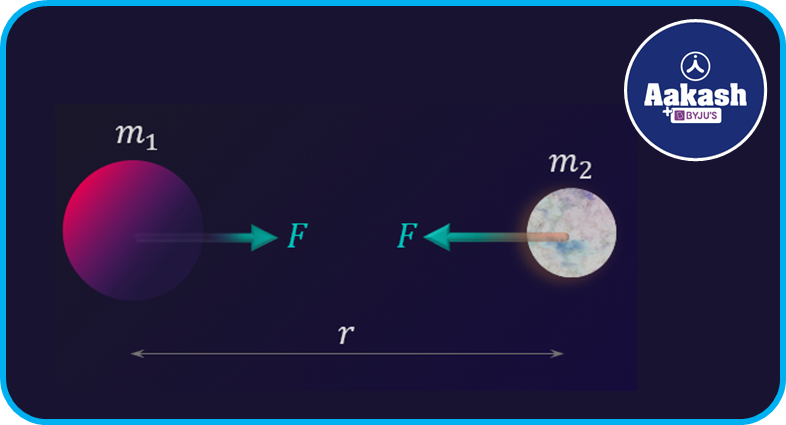
Now according to the newton's law of gravitation, the gravitational force (F) is directly proportional to the multiplication of the masses
Also the gravitational force (F) is inversely proportional to the square of the distance between the masses.
Taking both the equations together
Where G = Universal gravitational constant = 6.67 × 10– 11 Nm2kg– 2
This is the magnitude of the gravitational force and the direction is along the line joining the objects.
Let r21 is the unit position vector of mass m2 with respect to m1 . Then gravitation force on m2 due to m1
Similarly, if r12 is the unit position vector of mass m1 with respect to m2 . Then gravitation force on m1 due to m2
Minus sign indicate the force is of attraction type
Characteristics of Newton's law of gravitation
Some of the characteristic of Newton's law of gravitation :
- The gravitational force that exists between two bodies creates an action-reaction pair, which implies that if the first body attracts the second body with a force F, the second body will also pull the first body towards it with a force F.
- The gravitational force between the two masses is unaffected by the material separating them.
- We can claim that the gravitational force is conservative since the work it does is independent of the path between the initial and final positions.
Practice problems
Q. If two masses of 40 kg each are put at a distance of 4 m from one another, calculate the gravitational force.
A. Given M1=40 kg and M2=40 kg
The distance between them, r=4 m
The Universal gravitational constant G = 6.67 × 10– 11 Nm2kg– 2
Using Newton's law of gravitation
Hence gravitational force is 6.67 × 10⁻⁹ N.
Q. A 65 kg physics student is standing at sea level, 6.38 106 m from the centre of the earth. What is the gravitational attraction between the earth (m = 5.98 1024 kg) and the student?
A. Given M1= 5.98 1024 kg and M2=65 kg
r=6.38 106 m
The Universal gravitational constant G = 6.67 × 10– 11 Nm2kg– 2
The gravitational force can be calculated as
F=637 N
The gravitational force between the earth and the student is 637 N.
Q. Two mass m1=120 kg and m2= 100 kg are placed in space at a distance 10 m. The position vector along the line joining the mass from m1 to m2 is r21=3i-2j-k. Find the force on the mass m2 due to m1. The universal gravitational constant is 6.67 × 10– 11 Nm2kg– 2
A. Given m1=120 kg and m2= 100 kg
r=10 m
G = 6.67 × 10– 11 Nm2kg– 2
The force on the mass m2 due to m1 is given as,
Q. Calculate the gravitational force between two objects with masses of 70 kg and 170 kg that are located 6 m apart.
A. Given M1=70 kg and M2=170 kg
The distance between them, r=6 m
The universal gravitational constant G = 6.67 × 10– 11 Nm2kg– 2
Using Newton's law of gravitation
The gravitational force between them is 2.204 × 10⁻⁸ N
FAQs
Q. Does gravity exert a pull or a push?
A. Because it always attracts an object towards the centre of the earth or any other mass-containing object, gravity is a pull force.
Q. What is the use of Newton's law of gravitation when it is applied to planets?
A. The law of gravitation is used to ascertain the motion of the planets around the sun as well as the force of attraction that planets exert on other bodies.
Q. What is the SI unit and dimension of Universal gravitational constant G?
A. The formula for the gravitational force is
The unit of G is ,
The dimension of G is , [M1L1T-2][M0L1T0]2[M1L0T0][M1L0T0]=[M-1L3T-2]
Q. What is the acceleration due to gravity of earth?
A. Due to the gravitational force of the earth every object attracts towards the earth with an acceleration 9.81 m/s2. Gravitational acceleration due to earth is independent of the mass of the object.

 Call Now
 Let's Chat
 Share
Share