-
Call Now
1800-102-2727


Mutual induction-Definition,Equations, Diagram,Practice problems,FAQs

Pooja, a postgraduate physics student, is conducting an experiment with inductors in the lab – she takes two solenoids, each having many turns, and places them coaxially with each other. She makes sure to insert an iron core so that magnetic losses would be minimised. In order to confirm that inductors oppose the growth of current, she connects an ammeter to both coils. Pooja then connects coil 1 to an AC source. She notices that at time t = 0, there is no deflection in coil 1. This is not surprising; since inductors oppose the growth of current in them. On the other hand, no deflection was observed in the coil 2 as well. However, after some time, the coil 1 starts showing deflection, meaning that the inductor has finally allowed current to flow through it. Not only coil 1, Pooja observes deflection in the second coil as well. So how did coil 2 develop an induced current when current in coil 1 was varied?
Table of contents
- What is mutual induction?
- Derivation of equation for mutual induction
- Factors affecting mutual induction
- Reciprocity theorem
- Coefficient of coupling
- Practice problems
- FAQs
What is mutual induction?
When changing current in one coil produces emf in the second coil, such a phenomenon is called mutual induction.
Derivation of equation for mutual induction
Consider two coils C1 and C2 having number of turns N1 and N2 respectively. Let  2 be the flux linked with the second coil and i1 be the current flowing in the first coil. Then,
 [
[

The emf induced in the second coil,


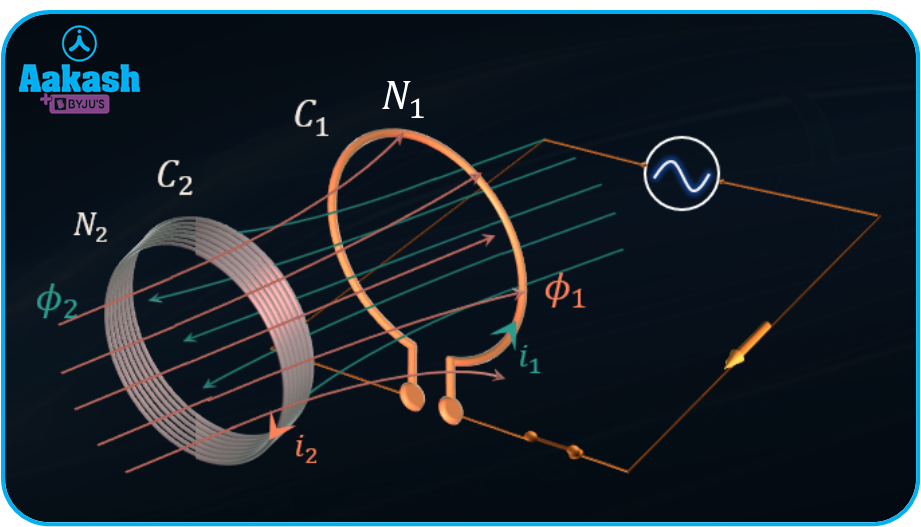
The magnetic field produced in the first solenoid, 


 where
where
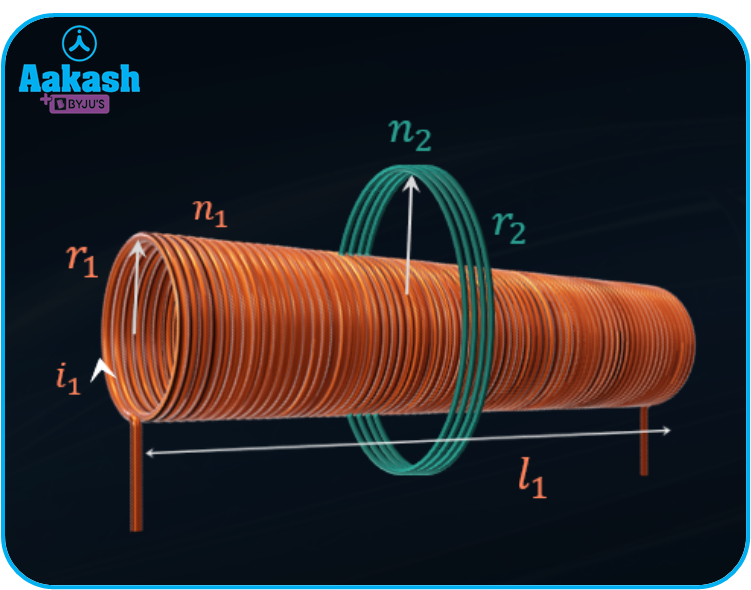
Also, . Equating the above two equations, we get
Now the magnetic field in the second coil,
Also, flux
Equating, we get
Which is the same as equation (ii)
Here r denotes the radius of the coils.
Factors affecting mutual induction
Mutual inductance depends upon the following factors:
- Geometry of the circuits
- Orientation of the circuits
- Number of turns in the circuits
- Space between the circuits
Reciprocity theorem
Let M12 be the mutual inductance of coil 1 due to coil 2. Similarly, M21 indicates the mutual inductance of coil 2 because of coil 1. Then according to reciprocity theorem,
.
Coefficient of coupling
The coefficient of coupling K between the coils having self inductances L1 and L2 is given by the relation,
When K = 0, the coupling between the coils is poor.
When 0 < K < 1 then the coils are loosely coupled.
When K = 1 then the coils are properly coupled.
Practice Problems
Q1. A solenoid of length 20 cm, area of cross-section 4.0 cm2 and having 4000 turns is placed inside another solenoid of 2000 turns having a cross-sectional area 8.0 cm2 and length 10 cm. Find the mutual inductance between the solenoids.
(a) 0.02 H
(b) 0.2 H
(c) 0.04 H
(d) 0.01 H
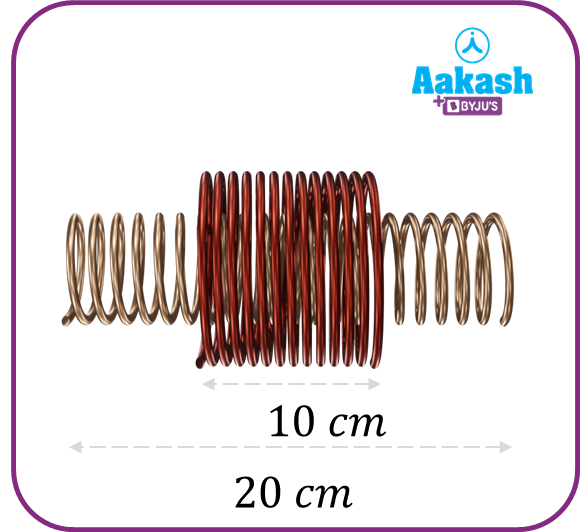
A. a
Given,
N2 = 2000, N1 = 4000;
A2 = 8 cm2, l2 = 10 cm
A1 = 4 cm2, l1 = 20 cm
Q2. Two conducting circular loops of radii R1 and R2 are placed in the same plane with their centres coinciding. Find the mutual inductance between them. Assume that R2 << R1.
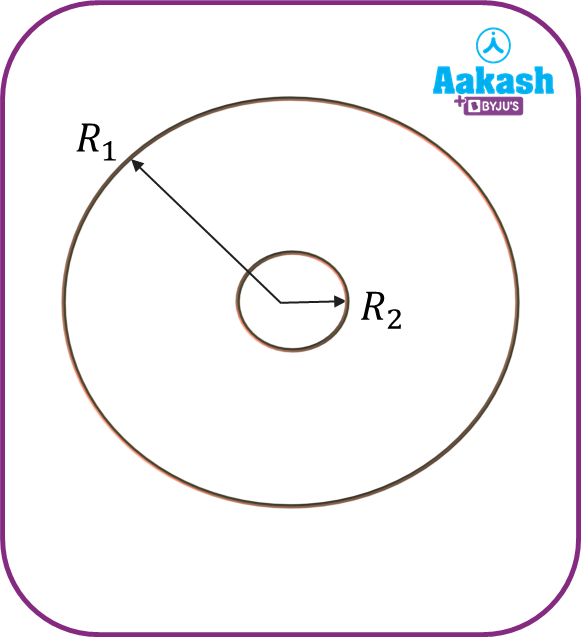
A. The magnetic field supplied by the first coil due to current i flowing in it,
Now flux linked with the second coil,
The coefficient of mutual induction,
Q3. A solenoid has 50 turns per cm in the primary coil and 200 turns in the secondary coil. The area of cross section of the coil is 4 cm2. Calculate its coefficient of mutual inductance?
(a) 0.15 m H
(b) 0.25 m H
(c) 0.75 m H
(d) 0.5 m H
A.d
Given,
Q4. Two solenoids having different radii but same lengths are wound one over the other. The coefficient of mutual induction between them is 5 mH. The current in the first coil varies according to the relation i=2 t3. Calculate the emf induced in the second coil at time t=2 s?
A. Given, i = 2 t3, M = 5 mH 2 = ?
FAQs
Q1. How is self induction different from mutual induction?
A. Self induction involves only one coil. On the other hand, mutual induction involves two coils.
Self inductance is the magnetic effect inside a coil which opposes the change in current through it. Mutual inductance is the inductance of a coil because of the magnetic flux change in another coil linked to it.
Q2. What is the principle of mutual induction?
A. The principle of mutual induction can be traced to Faraday's law of electromagnetic induction and Lenz's law. Change in current in one coil induces an emf in the other coil in the proximity. This is because the change in current in a coil induces a magnetic flux in it which induces another linked coil. The induced magnetic flux also changes with time which creates an emf in the later coil.
Q3. Which devices use mutual induction?
A. Transformers, generators, motors use the principle of mutual induction. They have two coils which are wound close to each other, helping to induce emf. One of them is called the primary winding which causes a flux change in another coil linked to it, is called the secondary winding. Input is given to the primary winding and output is taken from the secondary one.
Q4. How can mutual inductance be avoided?
A. One way to avoid mutual induction is to counter wind the coils so that the magnetic field from one coil cancels out the other. Let's say that in the conducting coil we have, the wires are wound in such a way (counter rotating sense) so that the magnetic effect due to the current in a coil cancels out by its counterpart.

 Call Now
 Let's Chat
 Share
Share