-
Call Now
1800-102-2727


Moving coil galvanometer - Construction, Working principle, Practice problems, FAQs

Rick is a mad physicist who is obsessed with conducting experiments. He takes two bulbs and notices that one of them is capable of withstanding up to 1 A and the other up to 2 A. In order to ensure that the bulbs don’t fuse, Rick needs to have an idea about the amount of current that can be safely passed through the circuit without damaging the bulbs. So he decides to build a galvanometer; a device used to detect the presence of small currents. A pointer attached on the galvanometer shows deflection whenever a current is passed through it. Additionally, he also needs the knowledge about how sensitive the device is. In order to do that, Rick keeps a close eye on the angle through which the needle is deflected when a unit current is passed through it. He can do this with the help of a galvanometer. In this article, let’s explore the moving coil galvanometer in detail!
Table of contents
- Construction of a moving coil galvanometer
- Principle of a moving coil galvanometer
- Current sensitivity
- Voltage sensitivity
- Practice problems
- Types of Moving Coil Galvanometers
- Why Does This Matter in Everyday Life
- FAQs
Construction of a moving coil galvanometer
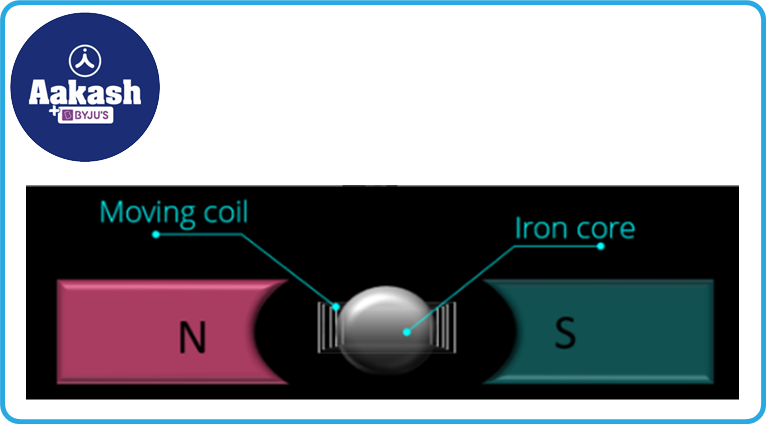
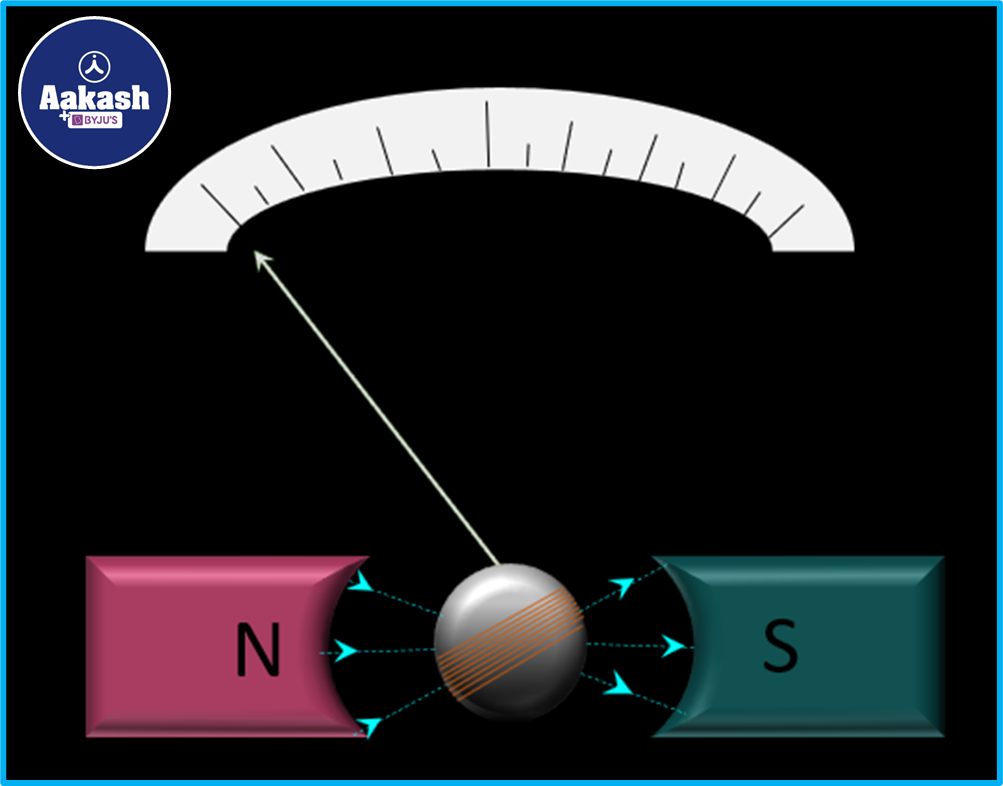
A moving coil galvanometer is a device used to detect and measure small currents. It consists of a rectangular coil with many turns made of insulated copper wires having a thin cross section. The coil is suspended between two horseshoe magnets by means of a fine phosphor bronze strip. The horse shoe magnets provide a radial magnetic field to ensure that the plane of the coil is parallel to the magnetic field at all times. In other words, the normal drawn to the coil is perpendicular to the magnetic field provided by the horseshoe magnets.
Principle of a moving coil galvanometer
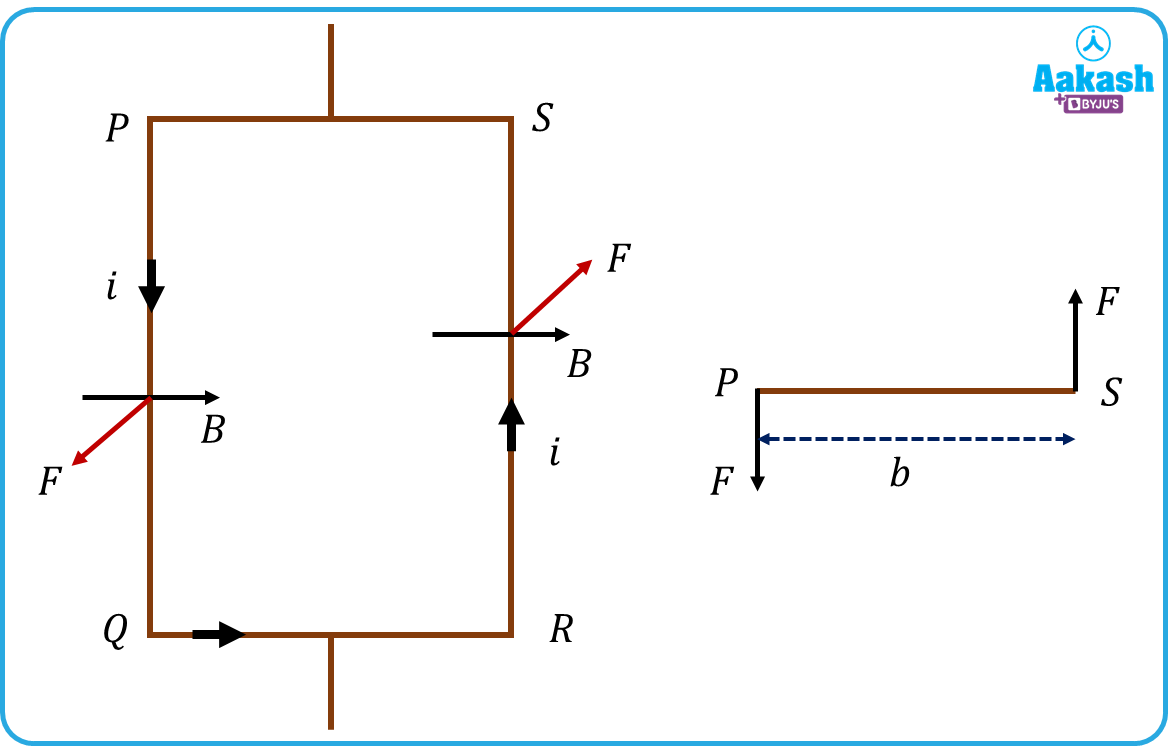
Let PQRS be a rectangular coil of the galvanometer with a current i flowing through it. In a radial magnetic field, the sides QR and SP are always parallel to the magnetic field. However, the sides PQ and RS are perpendicular to the field. They experience an equal and opposite force=Bil, where B is the magnetic field and SR=PQ=l. Applying Fleming’s Left hand Rule, the force on PQ acts out of the plane of the paper and the force on SR acts into the plane of the paper. Two equal and opposite forces constitute a torque; more precisely, a deflecting torque which tries to turn the coil and bring the plane of the coil out of the plane of the page.
Magnitude of the deflecting torque= force perpendicular distance=BilPS=Bilb=BiA (here, A=lb is the area of the coil)
If there are N turns in the coil, the deflecting torque=NBiA
To balance this, a restoring torque=C tries to bring the coil back to its original position.
So, deflecting torque = restoring torque
NBiA=C
where, - angle of twist, C- torsional constant.
i=CNBA--(i)
i ∝
So, greater the current, greater the deflection.
Current sensitivity
Current sensitivity is defined as the deflection of the coil(or pointer) produced per unit current passed through it. From equation (i), we get
i=NABC--(ii)
Voltage sensitivity
Voltage sensitivity is defined as the deflection of the pointer (or coil) produced per unit voltage difference across the coil in the galvanometer.
From equation (ii), we get
V/R=NABC, V=NABCR---(iii)
Where R denotes the galvanometer resistance.
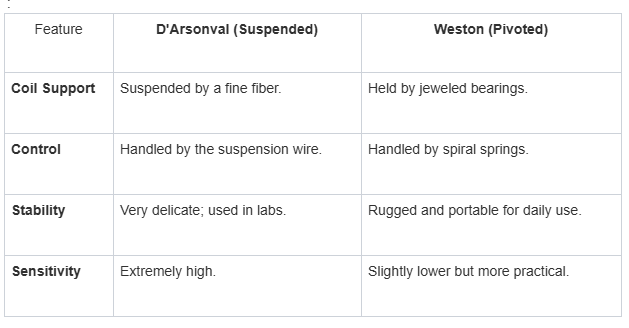
Types of Moving Coil Galvanometers
Depending on how the coil is held, there are two main types used in the moving coil galvanometer
Why Does This Matter in Everyday Life?
You might think this is just a lab toy, but the moving coil galvanometer is the grandfather of almost all electrical meters!
1. Ammeter Conversion: By adding a small wire called a shunt in parallel, we turn it into an ammeter to measure large currents.
2. Voltmeter Conversion: By adding a high resistance in series, it becomes a voltmeter to measure battery power.
3. Circuit Safety: It helps technicians detect "leakage" currents in home appliances, ensuring your gadgets are safe to touch.
Practice problems
Q. If the number of turns in a moving coil galvanometer is doubled, then the current sensitivity and the voltage sensitivity will respectively be,
(a)same, same (b) double, same (c) same, double (d) double, double
A.b
Current sensitivity,
i=NABC
When the number of turns is doubled, i.e N is doubled, it is clear that the current sensitivity also becomes double.
Voltage sensitivity,
V=NABCR=2NAB2CR=NABCR
when N is doubled, resistance R is also doubled
So, doubling the number of turns has no effect on voltage sensitivity.
Hence, option b is the correct answer.
Q.Two moving coil galvanometers having same area of coils are in the same magnetic
field. Their coils have turns 20 and 30 and their resistances are 8 Ω and 16 Ω respectively. Find the ratio of current sensitivity and voltage sensitivity of both the galvanometers.
(a)1.33 , 0.67
(b)0.67 , 1.33
(c) 1.5 , 0.75
(d) 0.75 , 1.5
A.b
Given,
N1 = 20 , R1 = 8 Ω , B1 = B , A1=A
N2 = 30 , R2 = 16 Ω , B2 = B , A2=A
i=NABC2i2=N2A2B2C
1i1=N1A1B1C=20ABC--(i)
2i2=N2A2B2C=30ABC--(ii)
Dividing (i) by (ii), we get
1i12i2=20ABC30ABC=23=0.67
Voltage sensitivity,
V=NABCR
1V12V2=20AB8C30AB16C=43=1.33
Q. Current sensitivity of a moving coil galvanometer is 5 div/mA and its voltage
sensitivity (angular deflection per unit voltage applied) is 20 div/V . The resistance of
the galvanometer is
(a)40
(b)25
(c) 250
(d) 500
A.c
Given,
Current sensitivity,
i=NABC=5 div/mA
Voltage sensitivity,
V=NABCR=20 div/V
Resistance of the galvanometer,
R=iV=5 div/mA20 div/V=500020=250
Q.The coil of a moving coil galvanometer has an area of cross section 510-2 m2. It is suspended in a magnetic field of 210-2 Wbm-2. If the torsional constant of the coil is k=410-9Nm deg-1 , calculate its current sensitivity (in degree per microampere).
A. Given, N=1, A=510-2 m2, B=210-2 Wbm-2, k=410-9 Nm deg-1.
Current sensitivity,
i=NABC=510-21210-2 410-9=0.25106 deg A-1
=0.25 deg A-1
FAQs
Q. What is the significance of the word “moving” in a moving coil galvanometer?
A. The deflection and restoring torque are purely concerned with the movement of the coil. Hence, it is called a moving coil galvanometer.
Q. What type of magnet is used in galvanometers?
A. A concave magnet is used in a galvanometer to supply a radial magnetic field.
Q. Why is a mirror used in a galvanometer?
A.The mirror is used to reflect light from a lamp positioned behind the galvanometer scale. We all know that when a light is incident on a mirror and if the mirror rotates by an angle , the reflected ray rotates by 2. So we can get a better accuracy while measuring how much angle the coil rotated.
Q.Who discovered the galvanometer?
A.John Schweigger invented the galvanometer.
Q.Can we use a galvanometer to measure AC?
No, a moving coil galvanometer cannot measure Alternating Current (AC). Because AC changes direction rapidly, the torque on the coil also reverses constantly. This causes the needle to oscillate or stay at zero rather than giving a steady reading.
Q.What does "dead-beat" mean in a galvanometer?
A "dead-beat" galvanometer is one where the needle stops quickly at the correct reading without swinging back and forth. This is achieved through eddy current damping in the metallic frame, which prevents unnecessary oscillations.

 Call Now
 Let's Chat
 Share
Share