-
Call Now
1800-102-2727


Motion of centre of mass - displacement, velocity, acceleration, practice problems, FAQs

When we are studying the kinematics of the motion of the system of a particle as a whole, then we need not bother about the kinematics of individual particles of the system. But only focus on the kinematics of a unique point corresponding to that system. This point is the centre of mass of the system.
You might have witnessed a firecracker being launched in the sky. After reaching a particular height, an explosion takes place and the particles disintegrate and start moving into different directions. But have you ever wondered why the particles after an explosion disintegrate in a similar pattern ? Well there is a reason for this pattern and for that you should first have the knowledge of the centre of mass of the system.
Table of contents
- Motion of centre of mass
- Practice problems
- FAQs
Motion of centre of mass
Velocity and acceleration of centre of mass
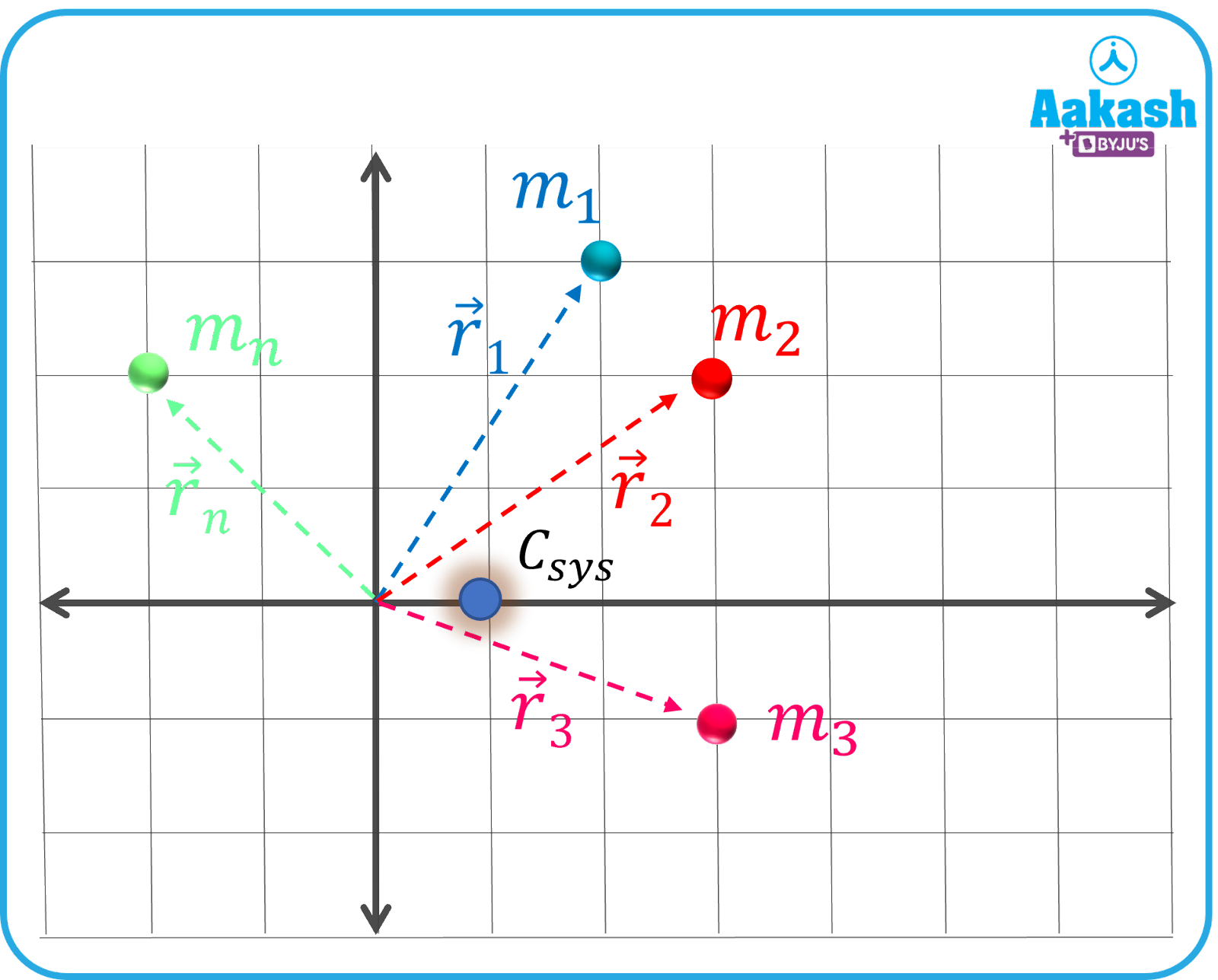
For a system of n point masses m1, m2,......., mn with the position vectors r1, r2,......., rn, respectively, the position vector of the centre of mass is given as follows:
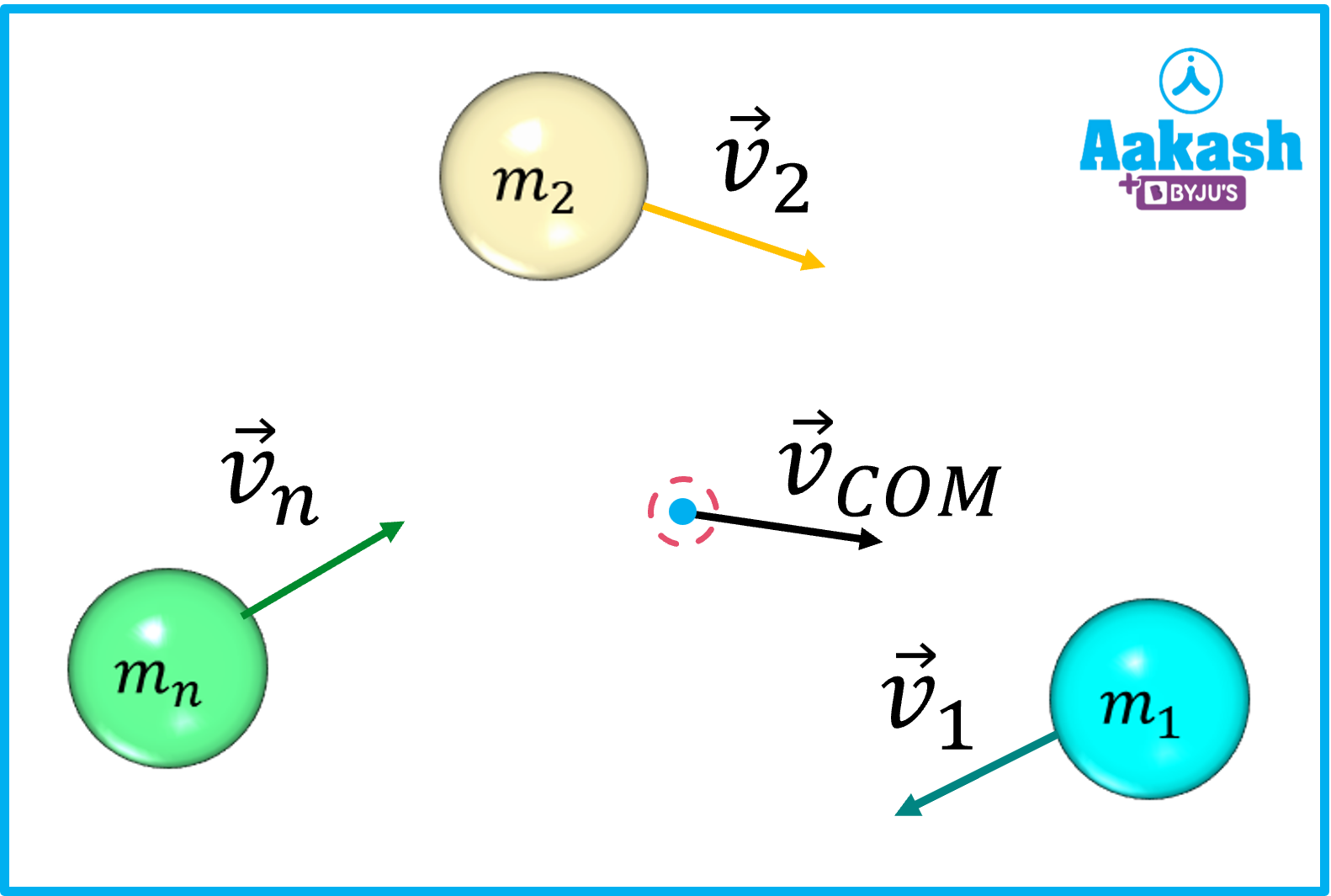
When the system is moving, let vcomand acom be the velocity and acceleration of the centre of mass of the system.
By differentiating with respect to time t, we get the following:
- If the algebraic sum of the momentum of particles of the system is zero, the velocity of the centre of mass will be zero.
This implies even though the particles are under motion, their centre of mass remains at rest.
- Similarly, the centre of mass of the system of particles moves at constant velocity if the algebraic sum of momentum of the particles remains constant.
Similarly,
By differentiating with respect to time t, we get the following:
Let the forces acting on the particles produce acceleration as shown in the image below.
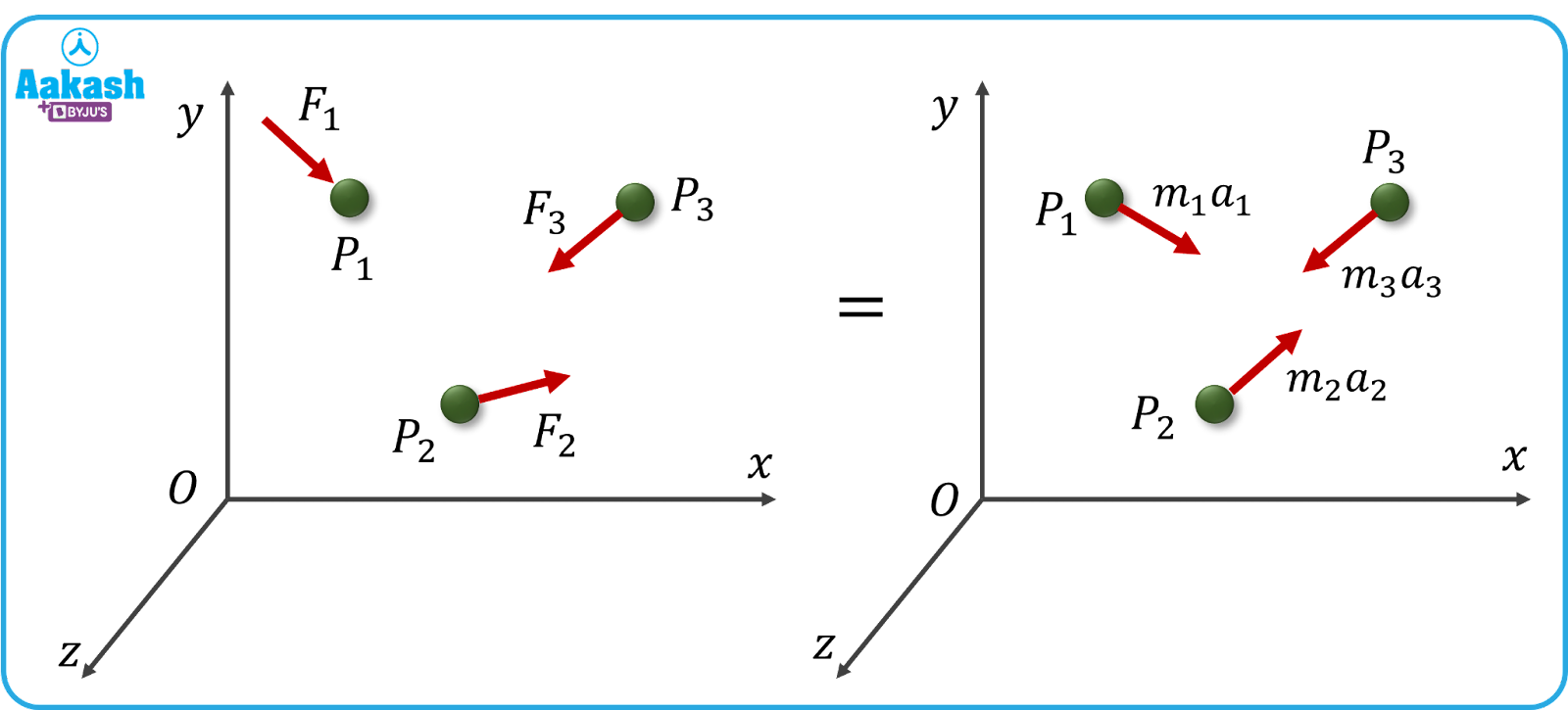
Net external force on the system, Newton’s second law of motion
Using equation (i),
Thus, if
If
Therefore, if the summation of forces is zero, acceleration of centre of mass will be zero and velocity of centre of mass remains constant.
Displacement of centre of mass
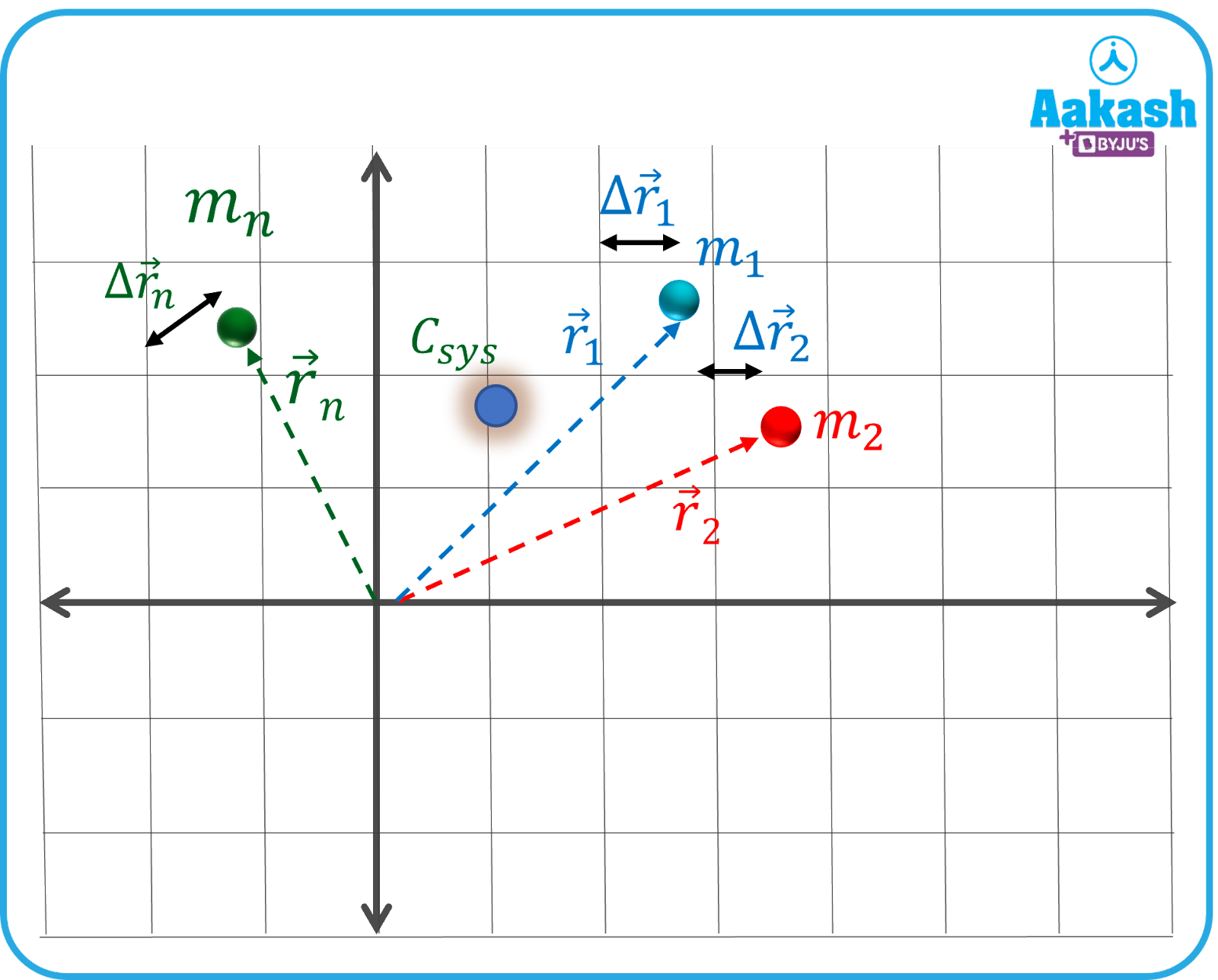
For a system of n point masses m1, m2,......., mn displaced by r1, r2,......., rn, respectively, the change in the position vector of the centre of mass is given as follows:
Practice problems
Q. Two bodies are moving towards each other due to mutual force of attraction and having masses of 2 kg and 4 kg with velocities 20 ms-1 and 10 ms-1, respectively. Determine the velocity of their centre of mass.
(A) 6 ms-1
(B) 5 ms-1
(C) 8 ms-1
(D) 0 ms-1
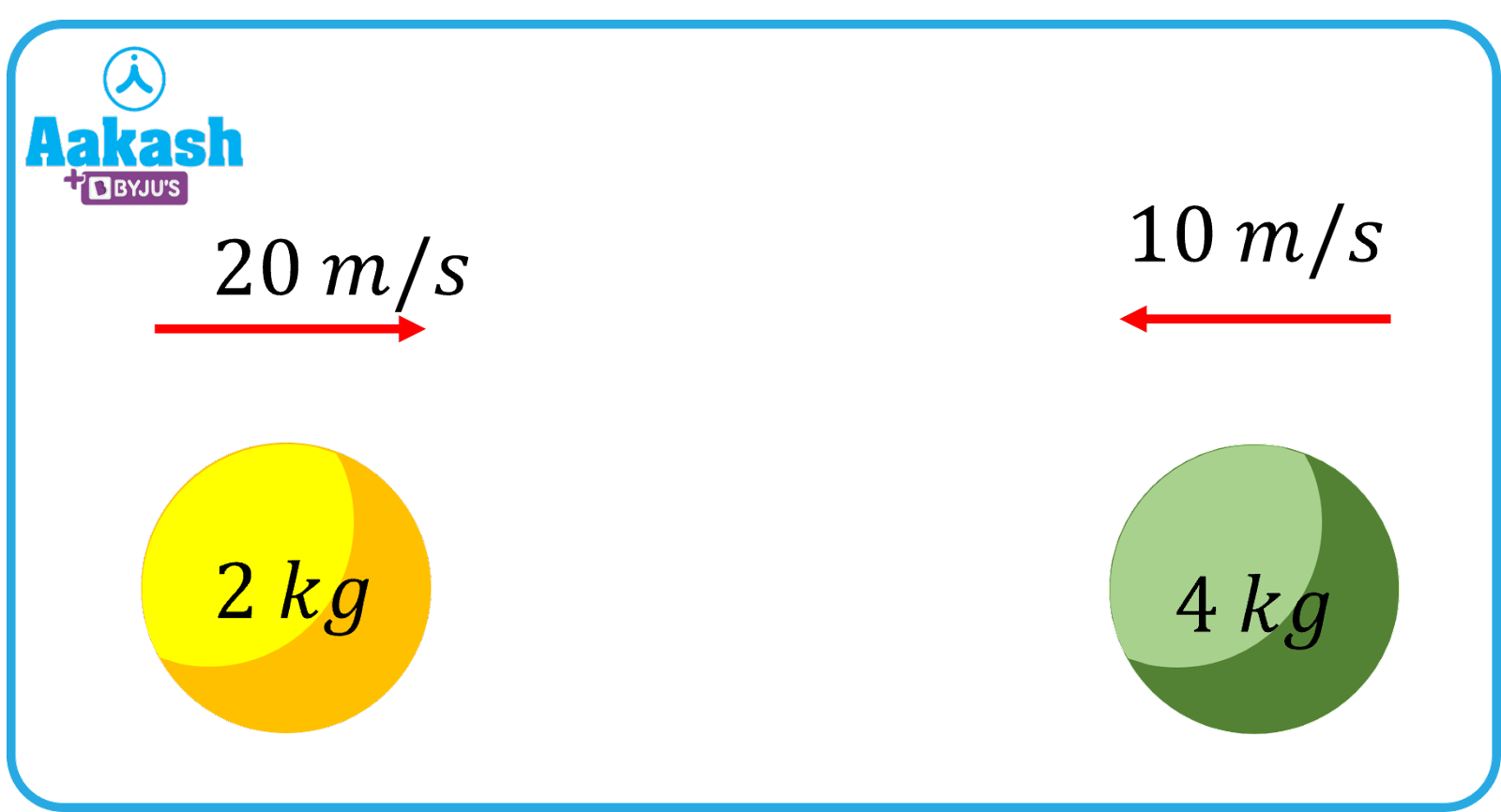
A. Given,
Mass of the smaller ball, m1 = 2 kg
Velocity of the smaller ball, v1 = 20 ms-1
Mass of the larger ball, m2 = 4 kg
Velocity of the larger ball, v2 = 10 ms-1
Velocity of the centre of mass of the system will be:
Thus, option (D) is the correct answer.
Q. The figure shows that two blocks of masses 5 kg and 2 kg are placed on a frictionless surface and are connected with a spring. An external kick gives a velocity of 14 ms-1 to the heavier block towards the lighter one. Deduce the velocity gained by the centre of mass at that instant.
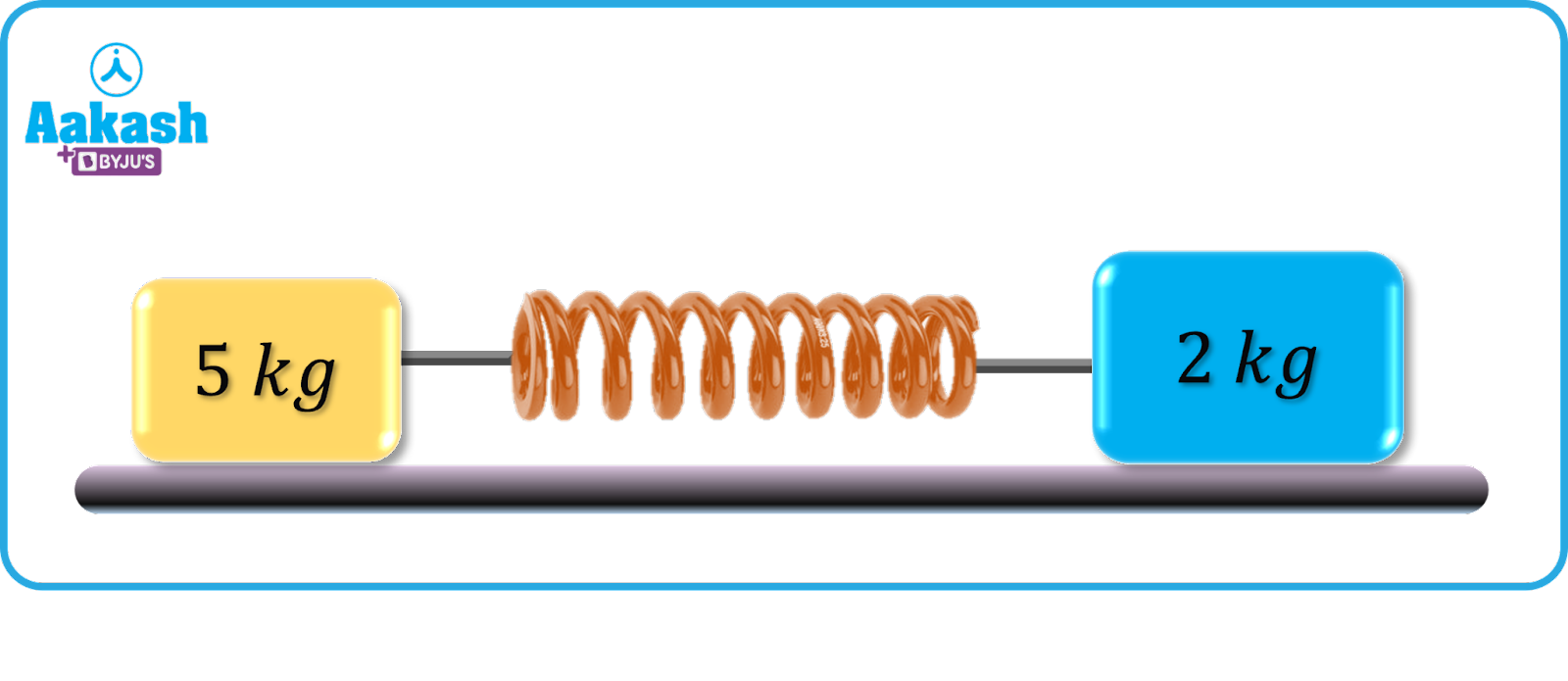
A. Given,
Mass of the smaller block, m1 = 2 kg
Mass of the larger block, m2 = 5 kg
Velocity of the larger block, v2 = 14 ms-1
At the instant, the larger block is given a velocity, the smaller block is at rest. Thus, the velocity of the smaller block is 0 ms-1.
Velocity of the centre of mass of the system will be
Q. An axe thrown in air with an initial velocity u at an angle 𝜃 with the horizontal. Find the maximum height reached by the centre of mass of the axe.
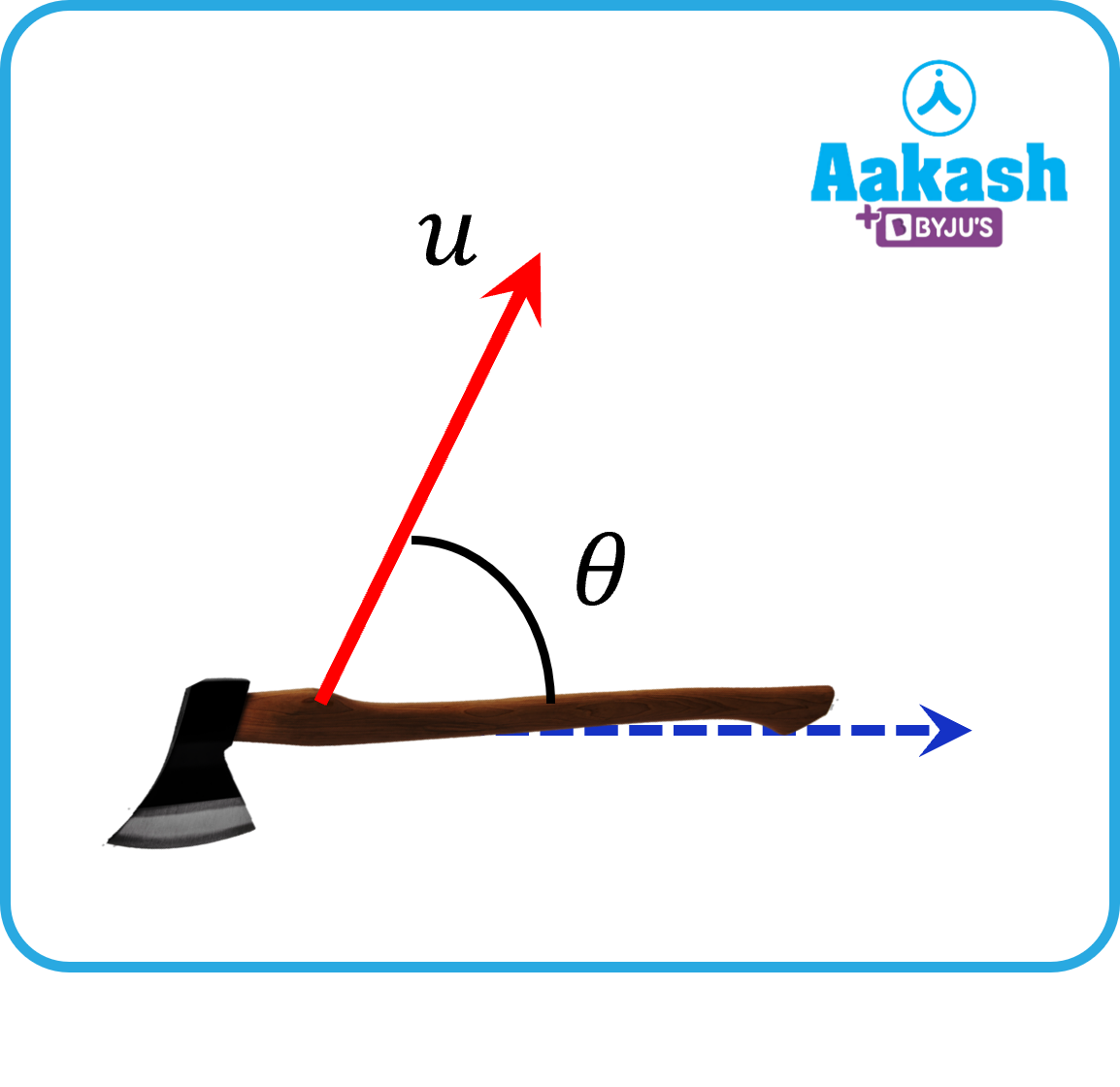
A. Given,
Initial velocity of the axe = u
Angle with the horizontal = 𝜃
Let Hmax be the maximum height reached by the centre of mass of the axe as shown in the figure.
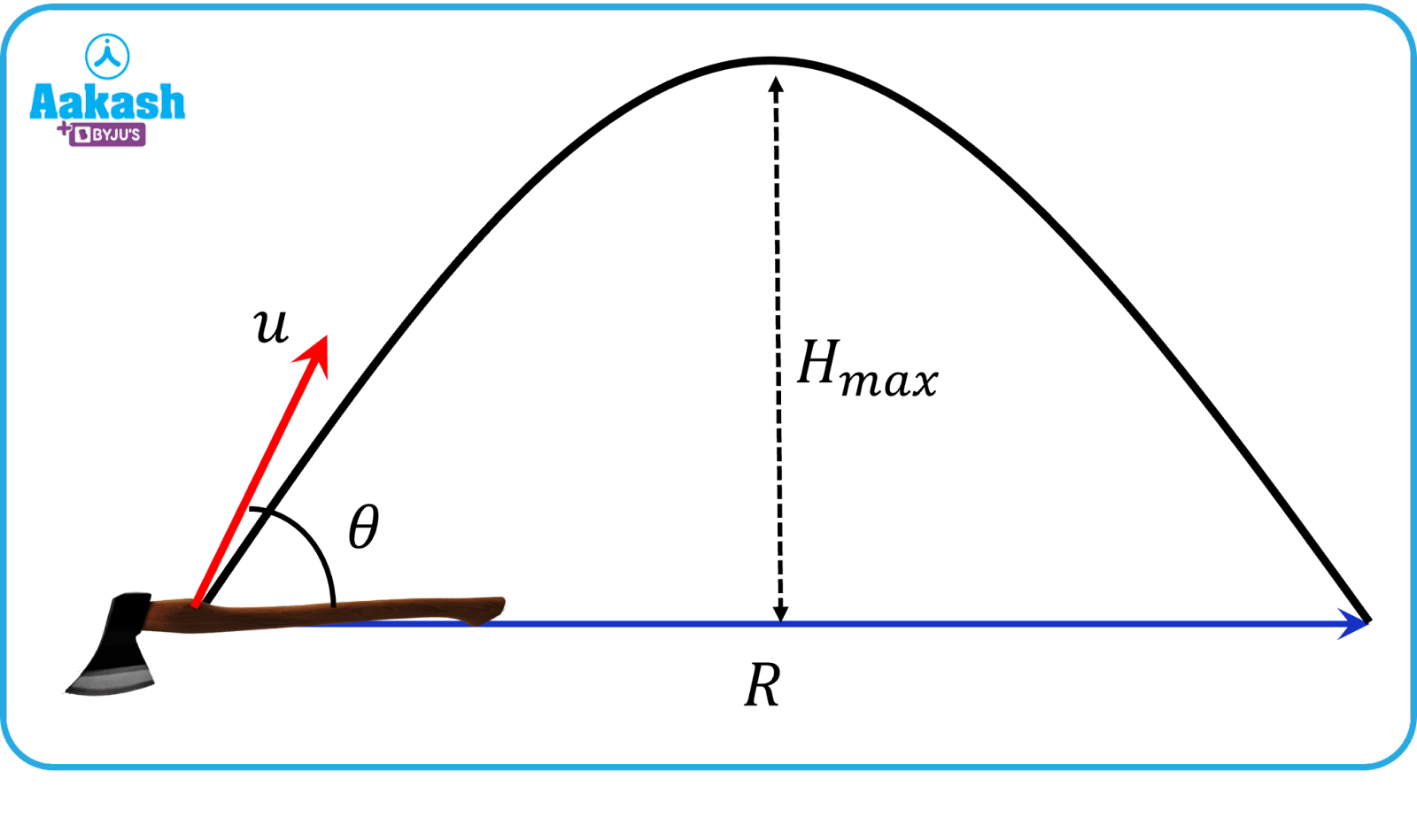
The centre of mass of the axe follows a parabolic path that is equivalent to a projectile thrown with the same speed at the same angle.
Thus, the maximum height reached by the centre of mass of the axe is as follows:
Q. Two particles are having same mass say m. One particle is projected up with a velocity of 10 m/s while the other particle is dropped from a height of 10 m Find the maximum height reached by their COM, if they collide at some height inelastically. [Take g=10 m/s2]
A. Assume upward motion as positive.
Given, initial velocity of second particle, v2=10 m/s upwards
Initial velocity of first particle v1=0 m/s downwards
Let m be the mass of both particles.
Acceleration of second particle a2=-g downwards
Acceleration of first particle a1=-g downwards
Then, velocity of COM,
upwards
Acceleration of COM
We can use
{Here v1=vcom}
Here, speed of COM at maximum height, v2=0
s = 1.25 m
Hence the maximum height attained by the COM of the two particle system is 1.25 m.
Q. Three particles (of same mass) are kept at the three vertices of an equilateral triangle. Each particle begins moving in anticlockwise order from one vertex to the other vertex next to it with the same speed. Find the displacement of COM after t sec.
A.
The particles are at points A, B and C initially.
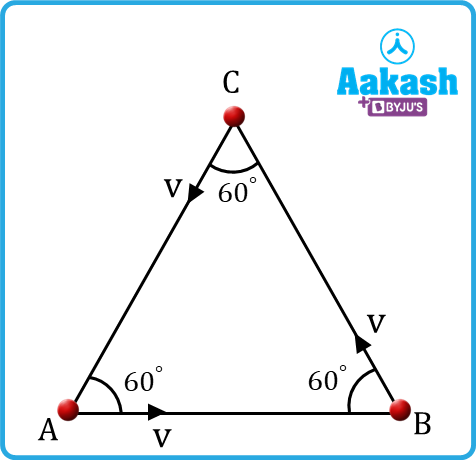
Let the positions after t sec be as shown:
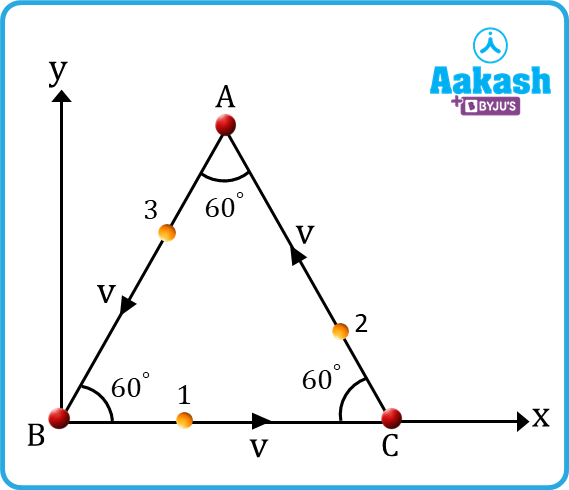
(Assuming the x and y direction given as positive)
For m1,v1x=v , v1y=0
For m2, v2x=-v60o , v2y=v30o
For m3, v3x=-v60o , v3y=-v30o
After t sec,
Hence, vcom is zero, so displacement of COM will be zero, even after t sec.
FAQs
Q. A man (of mass m) suspended in the air is holding the rope of a stationary balloon of mass M. The man starts climbing up the rope, then which option correctly depicts the movement of the balloon?
1. Move upward
2. Move downward
3. Remain stationary
4. Cannot say
A. Initially man and balloon are stationary. Therefore, net external force is zero and the centre of mass of the system is initially at rest. When man moves up, the normal force from ground becomes zero, so net force in upward direction reduces. So, the balloon should move downwards.
Q. A child is sitting at one end of a long trolley placed on a smooth horizontal track. If the child starts running towards the other end of the trolley with a speed u (w.r.t. trolley), what will be the velocity of the centre of mass of the system?
A. Velocity of centre of mass will remain 0 as no external force acts on the system.
Q. What is the relation between the velocity of the centre of mass of a body under pure translation with other particles of the body?
A. For a pure translational motion, the velocity of the centre of mass and the velocity of other points in that body are the same.
Q. Does internal forces in an object affect the velocity of the centre of mass?
A. No, only external forces are responsible for the change in acceleration or velocity

 Call Now
 Let's Chat
 Share
Share