-
Call Now
1800-102-2727


Moment of Inertia of a Uniform Solid Sphere, mathematical derivation, practice problems, FAQs

We often encounter problems which deal with objects that resemble the shape of a solid sphere such as balls, planets etc. Thus, it becomes significant to know all the properties of a sphere. One such important property is the moment of inertia which plays an important role in the analysis of such objects.
Table of contents
- Moment of Inertia of a Uniform Solid Sphere
- Practice Problems
- FAQs
Moment of Inertia of a Uniform Solid Sphere
Moment of inertia of a uniform solid sphere of mass M and radius R about the centroidal axis is
calculated as follows. The entire mass of the sphere is distributed uniformly over the entire volume. So, the mass per unit volume will be,
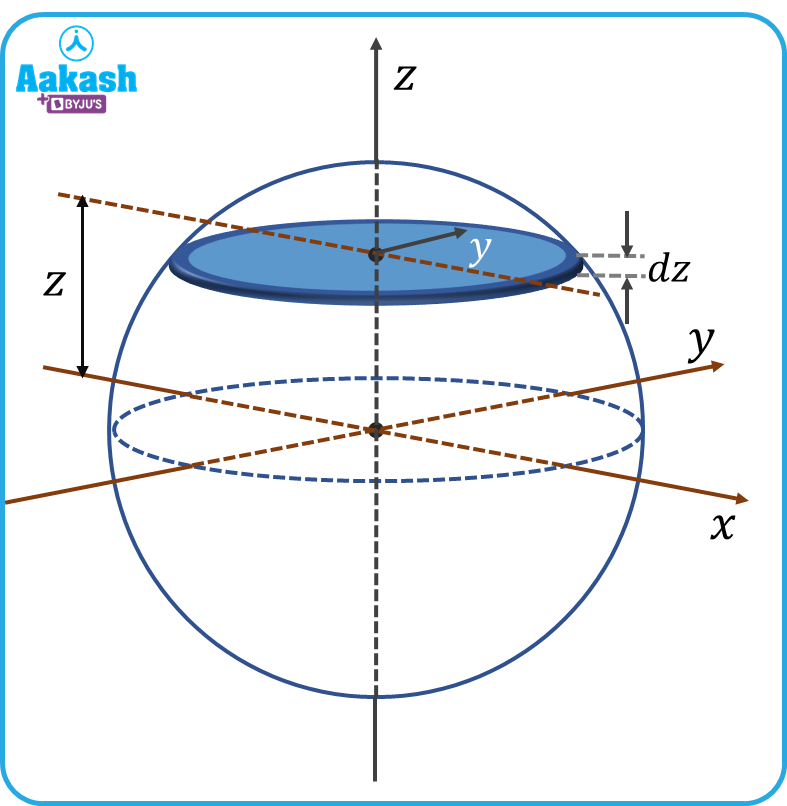
We are to calculate the moment of inertia of the solid sphere about an axis passing through its centre. Here we calculate the moment of inertia about the z axis.
The mass per unit volume is
We consider a disc element of small elementary thickness dz at a distance z from the xy plane.
The radius of the disc is y
The mass of the disc element dm= dV
The small volume of the dsc element, dV=y2 dz
The moment of inertia of the disc element about its centroidal axis i.e. the z axis is,
From the geometry we can understand that z ranges from -R to +R
So, the moment of inertia of the sphere about the z axis,
Putting the value of we can get,
Practice Problems
Q. The MOI of a solid sphere is is 0.4 kg m2 about an axis passing through its centre. If the density of the sphere is increased eight times but the mass of the sphere is kept the same, what will be the new moment of inertia of the sphere about the same axis?
A. We know,
Volume
Since mass is kept same and density is increased 8 times, therefore
New density,
New radius, r'=r2
We know moment of inertia of solid sphere (of radius R and mass M) about an axis passing through its centre of mass,
New Moment of inertia,
Therefore,
Q. Density of a solid sphere is given by the expression where x is the distance from the centre of the sphere and 0xR, R is the radius of the solid sphere. Calculate the moment of inertia of the solid sphere about an axis passing through its centre. (Given, o is a constant)
A. Consider a small elemental hollow sphere of radius x and thickness dx. Since solid sphere can be thought of as being made up of concentric hollow spheres, with limits of x from 0 R
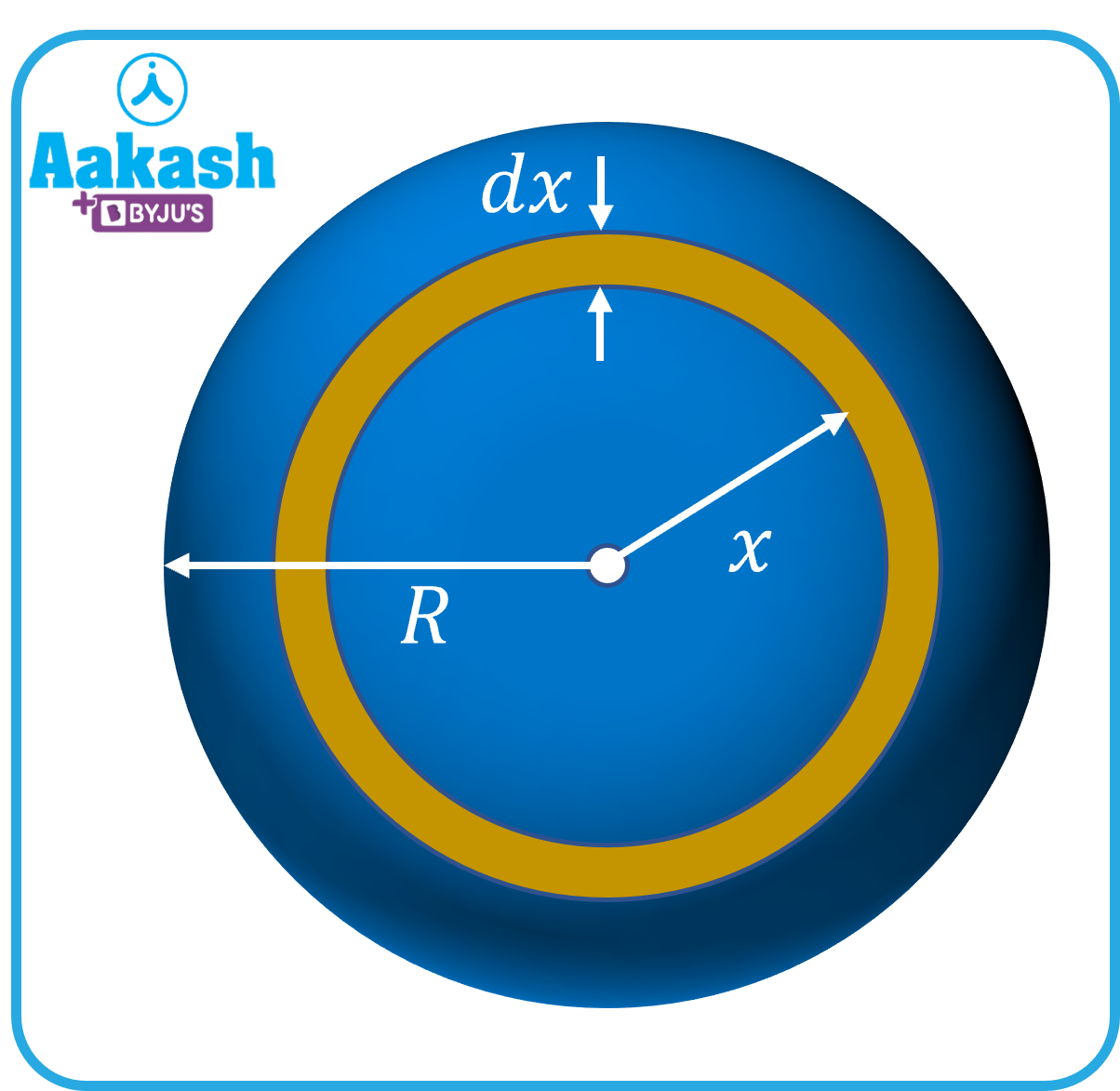
For the elemental hollow sphere, moment of inertia about axis through centre,
where dm is the mass of elemental hollow sphere given as,
dm=dV ............(ii)
Where = density of the sphere
dV = Volume of elemental hollow sphere
dV= surface area of element thickness
Therefore dV=(4 x2) dx .............(iii)
And
From eq. (ii) & (iii),
Substituting the value of dm in eq. (i) we get,
Q. A solid sphere of mass 2 kg and radius 1 m is performing combined rotational and translational motion as shown in figure. What will be the total kinetic energy of the solid sphere?
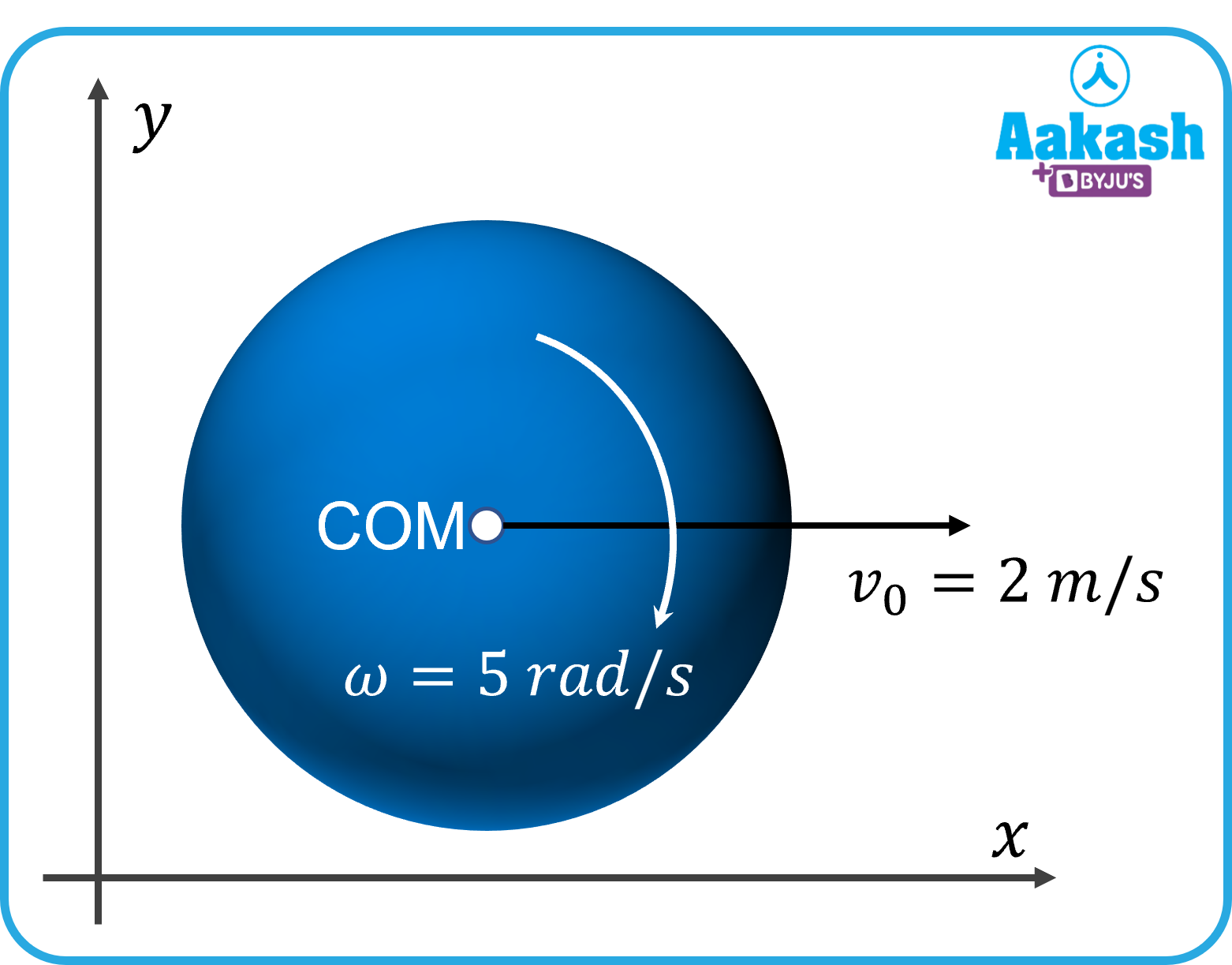
A. In combined rotational and translational motion,
KEtotal=KEtranslational+KErotation
Moment of inertia of solid sphere,
Putting in Eq (i), we get
Therefore KEtotal=4+10=14 J
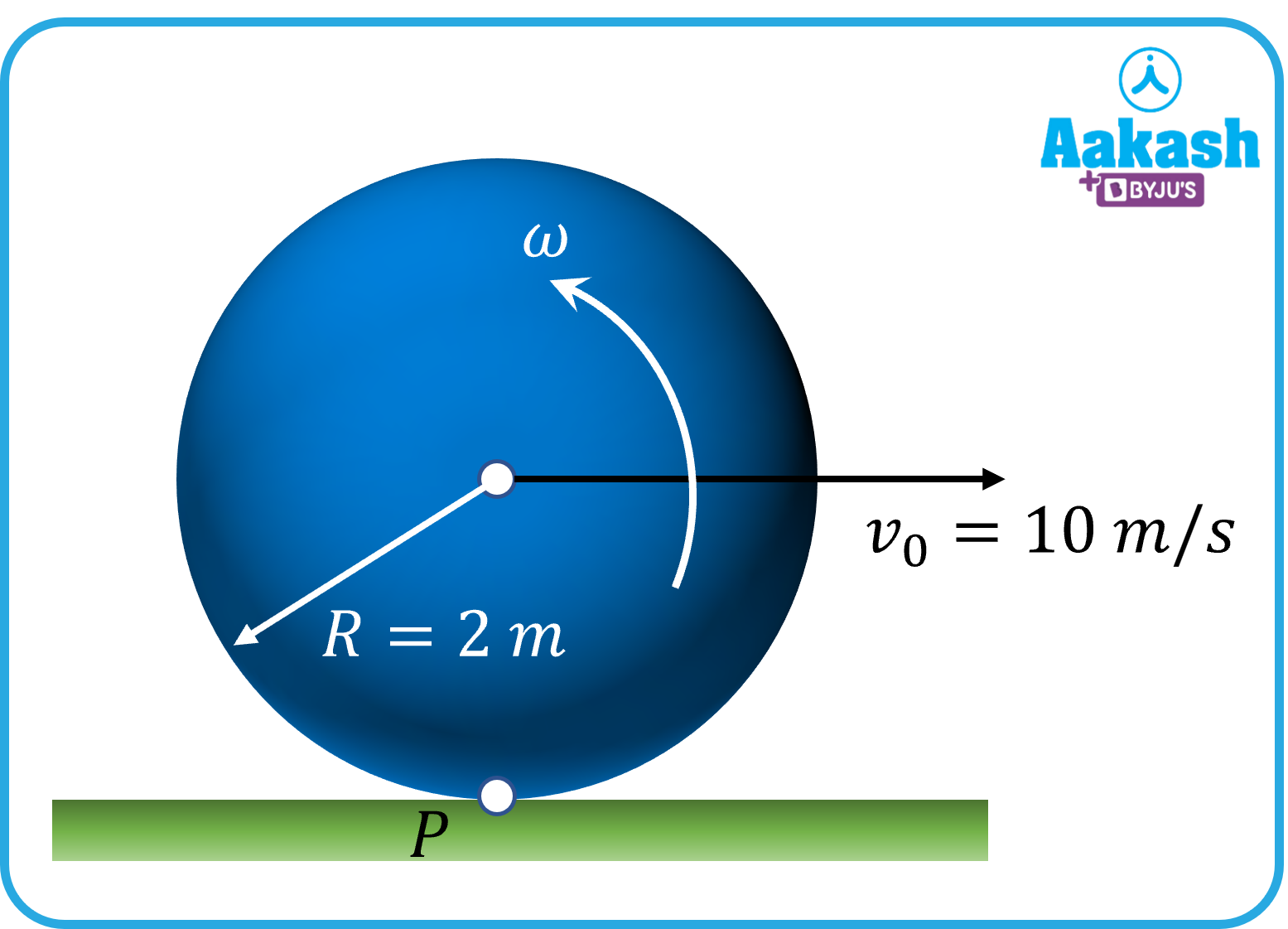
Q. A solid sphere of mass 2 kg is set to rotate in the anticlockwise direction, on a smooth horizontal surface with a linear speed 10 m/s and an angular speed 5 rad/s as shown in figure. At the moment when the sphere starts rotating, calculate its total kinetic energy.
A.
Vo=10 m/s =5 rad/s R=2 m
This is because of the smooth surface, the sphere can spin in the opposite direction of the sliding.
The total energy is the sum of sliding kinetic energy and the rotational kinetic energy.
The sliding kinetic energy is KEtranslational=0.5 m v02=0.5 2102=100 J
The rotational kinetic energy is
So the total kinetic energy = 100 + 40 = 140 J
FAQs
Q. On what factors given below, the moment of inertia of a continuous body depends upon?
- Axis of rotation
- Density of material of body
- Shape and size of the body
- All of the above
A. (d)
Moment of inertia depends on the mass and how the mass is distributed about the axis of rotation. So it also depends on the shape and size of the body. The more the mass i.e., heavier the body the more is the moment of inertia. So, it also depends on the density of the material of the body. Further the mass distribution from the axis of rotation, more is the inertia.
Q. What is the physical significance of the moment of inertia?
A. The moment of inertia is the physical property of a solid body which signifies how much effort an external torque has to put in to get more angular acceleration. The inertia also tells about the mass distribution about the axis of rotation. More is the distance of the mass from the axis more is the moment of inertia.
For an external torque acting,
Where, I is the moment of inertia and is the angular acceleration in the body.
Q. Why does a hollow sphere have more moment of inertia than a solid sphere of same mass?
A. We can understand this by understanding the moment of inertia itself. The moment of inertia is the physical property of a solid body which signifies how much effort an external torque has to put in order to get more angular acceleration. The inertia also tells about the mass distribution about the axis of rotation. More is the distance of the mass from the axis more is the moment of inertia.
When a hollow and a solid sphere of same mass and radius is taken into consideration, we can say that the mass is more concentrated around the periphery for the hollow sphere than the solid sphere. That is why the moment of inertia is more for the hollow sphere.
Q. What is the radius of gyration of a solid sphere?
A. The radius of gyration is concerned with the rotational dynamics of a body. The radius of gyration about an axis of rotation can be defined as the radial distance of a point which would have the same moment of inertia as the body's actual distribution of mass, if the total mass of the body is assumed to be concentrated there.
The moment of inertia for a solid sphere of radius R and mass
If the radius of gyration be k,

 Call Now
 Let's Chat
 Share
Share