-
Call Now
1800-102-2727


Misconceptions

Pawan is solving a vector expression. He tries a number of times, but every time he gets the wrong answer. When he reviews his solution and finds he is confused in the cross product and performing the cross product of a scalar quantity to a vector quantity. Hence getting the wrong answer every time. Similarly there are many confusion and misconceptions in the vector that need to be clear in order to not only just apply them to solve numericals but also understand in our day to day use. In this page we will focus on these types of misconceptions.
Table of content
- What is Vector?
- Common Misconceptions in vector
- Practice problems
- FAQs
What is Vector?
A vector is the representation of those physical quantities which have both magnitude and direction to define itself. While representing a vector quantity, the length of the vector represents its magnitude and the direction is represented by the arrow of the vector.
We denote a vector as  where A is the tail of the vector and B is the head of the vector. The arrow
  represent the direction of the vector.
We can represent a vector in two ways: graphically and analytically. The graphical representation of a vector is done by a line headed by an arrow. The graphical representation of the vector, is shown in figure below.
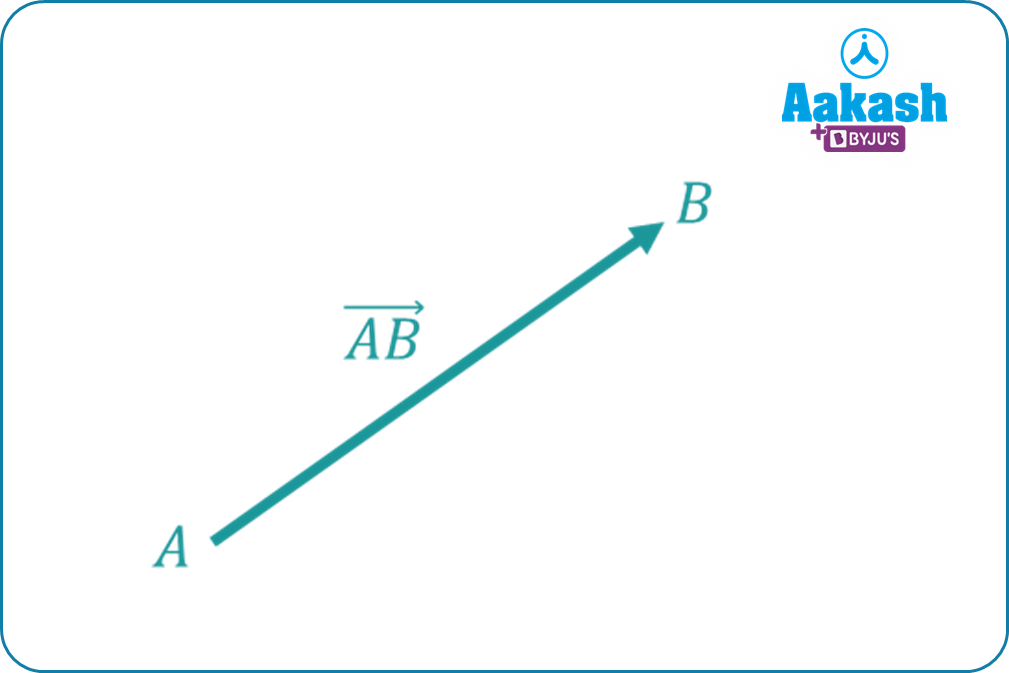
The magnitude is given by the length of the line and the direction is given by the arrow.
The vector is represented analytically as a sum of its component vector along the coordinate axis.
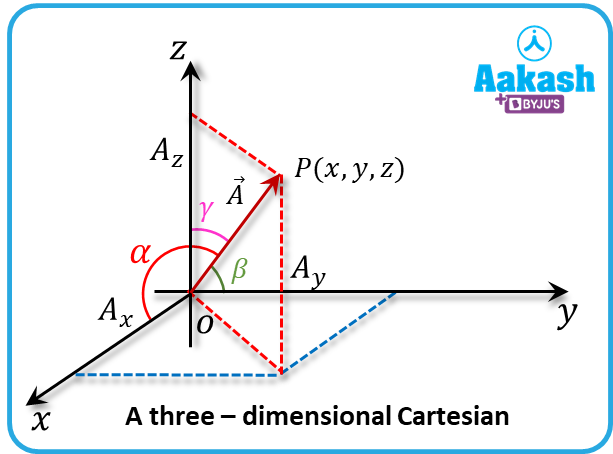
Let a vector  in the coordinate space, if Ax , Ay and Az are the magnitude of projections of the vector along the three coordinate axes viz. x , y and z respectively and
  ,
,  and
and  are the unit vector along the x , y and z - axis respectively. Then vector can be represented as,
Common Misconceptions in vector
There are few misconception regarding the vector which are as follow-
- Placing Two vectors tail to tail or tail to head or head to head while finding the resultant of a vector : It is quite often a misconception among the students how to put two vectors together for finding the resultant of a vector. All the ways are right, let's understand this!
Suppose we have two vector and  (Figure 1) then if we put these vector tail to tail then the resultant will be given by a vector
  which is initiated from the tail of both the vectors (Figure 2). Now if we put these vectors such that the tail of vector coincide with the head of the vector then the resultant of two vector is given by a vector whose tail is coincide with tail of vector and head is coincide with the head of vector (Figure 3). Similarly if we put and head to had then the resultant vector will be given by whose head coincides with the heads of two vectors (Figure 4).Suppose we have two vector and (Figure 1) then if we put these vector tail to tail then the resultant will be given by a vector
  which is initiated from the tail of both the vectors (Figure 2). Now if we put these vectors such that the tail of vector coincide with the head of the vector then the resultant of two vector is given by a vector whose tail is coincide with tail of vector and head is coincide with the head of vector (Figure 3). Similarly if we put and head to had then the resultant vector will be given by whose head coincides with the heads of two vectors (Figure 4).
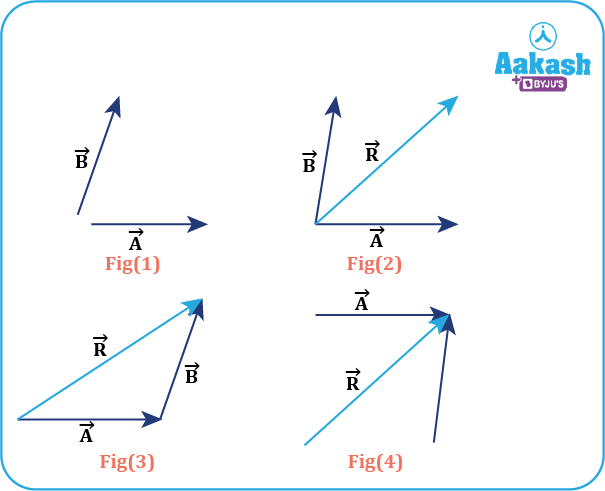
If angle between the vectors, and is  then we can find the magnitude of resultant vector as,

And angle of resultant with the vector as

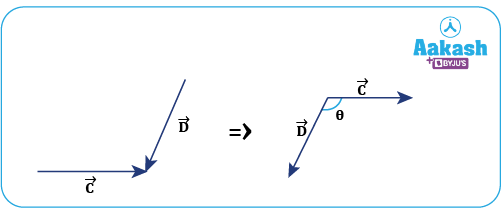
- Angle between two vectors : How to find the angle between vectors also sometimes poses great confusion. To find the angle between the two vectors we first put these vectors tail to tail by shifting any of the vectors. Then the angle between these vectors will be the angle between the direction of these vectors. For example suppose we are dealing with and . Then we put these vectors tail to tail. Now
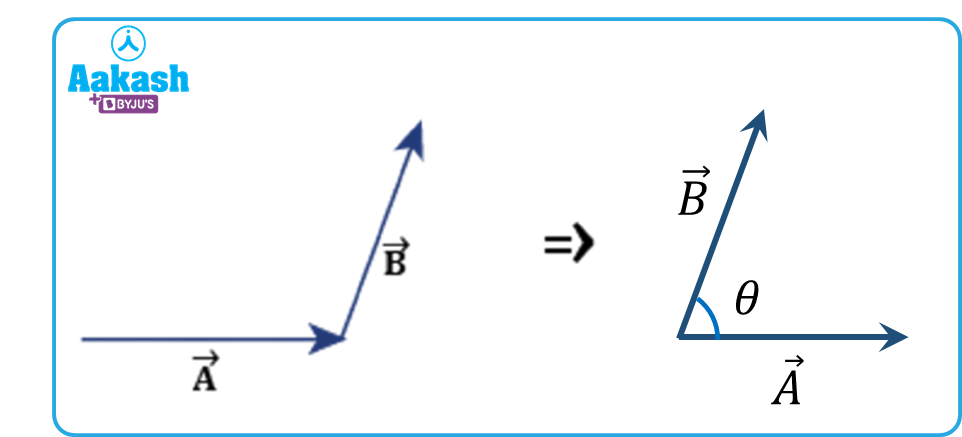
Similarly  and
and  then put these vector tail to tail by shifting then
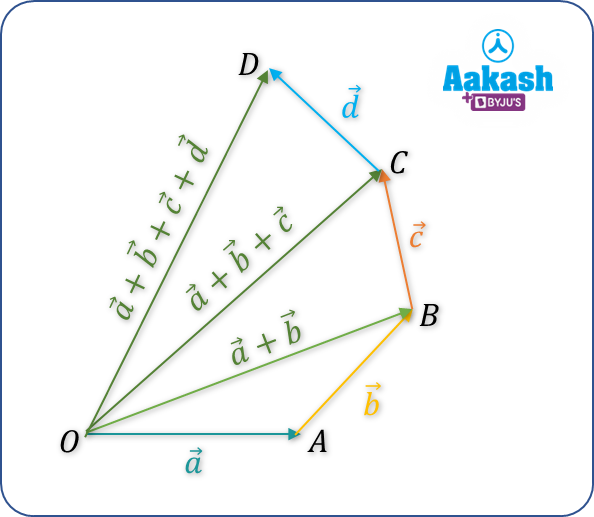
- Laws of vector addition : As we know There are three laws of vector addition such as Triangle law of vectors addition, Parallelogram law of vectors addition and Polygon law of vectors addition. These three laws are the same and can be used one in place of another.
As shown in the figure as per the polygon law If we arrange a number of vector such that Head of one vector is coinciding with the tail of the next vector then the resultant of the all vector will be equal to vector whose tail is on the tail of first vector and head is on the head of the last vector.
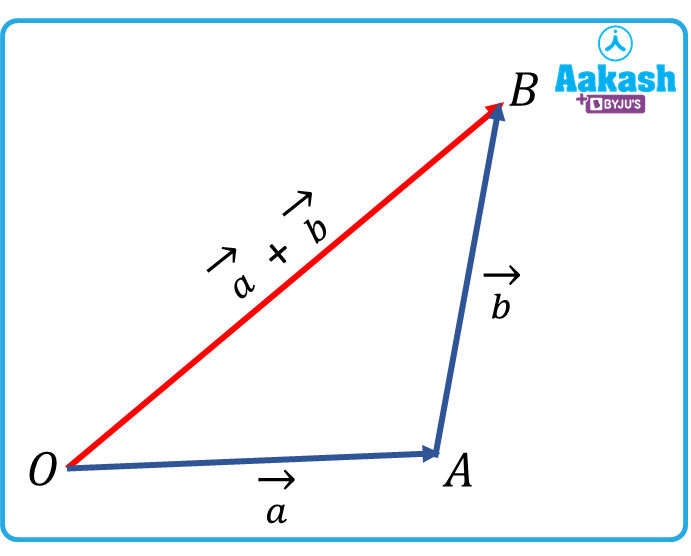
Now if the number of vector is reduce to Two then this will become triangle law of vector addition and resultant  is given by the one side of the triangle OAB as shown in the figure.
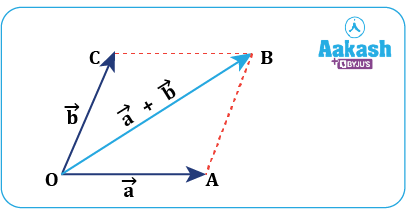
If we shift the vector  such that the the tail of vector coincide with the tail of vector
  Then it will become Parallelogram law of vector addition and the resultant is given by the diagonal of the parallelogram OABC as shown in figure below.
- Vector Vector = Scalar ? : If we add/subtract a vector from a vector then it will be a vector always. If we have two equal vectors then it will be a null vector. So it is a wrong statement that addition or subtraction between vectors gives scalar.
- Vector Scalar = vector ? : We can not add/subtract a scalar from a vector or vice versa. Also we cannot get a scalar from such kinds of operations. So this is wrong.
- Scalar vector = vector ? : We can not perform dot products between a scalar and a vector. So the multiplication of a vector with a scalar will be just scaling of a vector. For example we have a vector
 If you multiply this vector with a scalar say 5 then the multiplication will be a vector having magnitude 5 time than the given vector.
- Vector vector = Scalar ? : The cross product of two vectors is always a vector, so this is wrong. Suppose we have a force vector
 Which is applied at a radial position r then their cross product is a vector and equal to torque vector
  .
.
- Vector . vector = vector ? : Dot product always means the projection of one vector onto another vector. So it can't be a vector. It is a scalar quantity. The sign of this dot product scalar quantity signifies the relative direction between the vectors under consideration. If they are aligned with an acute angle between them then the dot product comes out positive, else negative.
- Projection of a vector on the other vector can not be negative : Students generally assume projection of a vector cannot be negative but it is wrong. If two vectors are in the direction such that angle between them is more the 90o then the projection of one vector on the other will be negative.
Practice problems
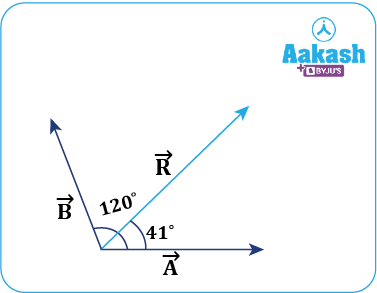
Q1. Draw a resultant vector of the given vectors. Given magnitudes of the vectors, A and B are 3 and 2 respectively and the angle between them is 120o.
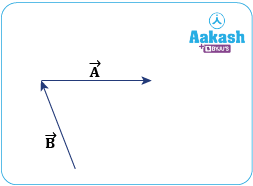
A. Shift the vector B such that tail of vector and coincide. The magnitude of resultant vector


 =2.6457
And angle of resultant with vector is


The resultant vector can be drawn as
Q2. Find the angle between the given vectors.
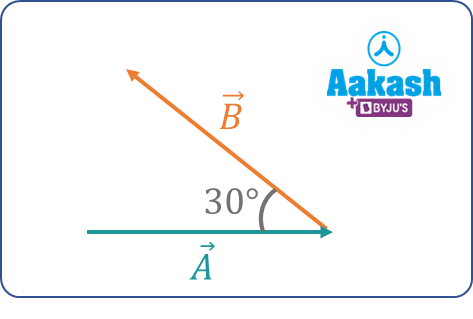
A. To find the angle between the vector Shift the vector B as shown in figure below.
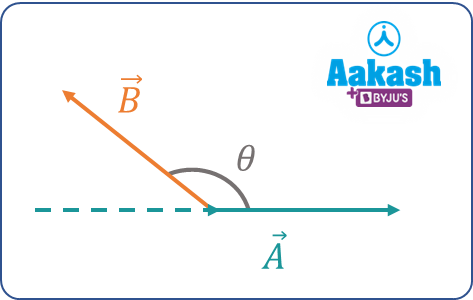
The angle between them by 
To get the angles between the vectors we have to put the vectors such that their tails will coincide at a point and the angles between them is then measured.
Q3. Subtract vector  from the vector
  and find whether the resultant is vector or scalar.
A. Subtract of vector A from the vector B
 |
|


So subtraction of two vectors is always a vector.
Q4. Find the dot product of 2 with the vector .
A. We can't find the dot product of a scalar with a vector. The multiplication of 2 with the given vector will be a scaled vector of the original one. Let the vector is then,


FAQs
Q1. What is the direction of the null vector ?
A. Null vector has zero magnitude and direction is undefined.
Q2. What is triangle law for vector addition ?
A. If we denote two vectors as two adjacent sides of a triangle in order, then the third side will give you the resultant of these two vectors.
Q3. What is the expression of the dot product of two vectors?
A. If and are two vector and is the angle between them, then dot product of these two vector is  , Which is a scalar. Dot product gives the projection of one vector onto another.
Q4. What is the magnitude and direction of the cross product of two vectors ?
A. Magnitude of cross product of two vector is given by  .
.
The direction of the cross product can be found by right hand rule. When we make a fist with our right hand and the thumb pointing outwards, the direction of the curling of the four fingers represents the rotation from the vector to , the thumb points towards the ( )
)

 Call Now
 Let's Chat
 Share
Share