-
Call Now
1800-102-2727


Magnetic Field And Magnetic Force

Magnetic fields are created or produced when an electric current moves within the area of the magnet. Magnetic force is a consequence of electromagnetic force and is caused due to the motion of charges. A moving charge surrounds itself with a magnetic field.
Let’s learn more about the magnetic field and the magnetic force
Magnetic Field
A magnetic field is a region around a magnetic material or a moving electric charge where magnetic effects are seen. The magnetic field is a vector quantity; therefore, it has both magnitude and direction. It is denoted by the symbol B, and the SI unit is Tesla (T).
Oersted’s Experiment
- In 1820, Hans Christian Oersted discovered that a current-carrying conductor produces a magnetic field.
- He observed that when a current passes through a wire, a nearby compass needle deflects. This showed the presence of a magnetic field.
- This proved the link between electricity and magnetism (basis of electromagnetism).
Properties of Magnetic Field Lines
- Magnetic field lines emerge from the north pole and move to the south pole.
- Magnetic field lines form closed loops.
- Magnetic field lines never intersect.
- The density of the magnetic field lines represents the strength of the field.
Magnetic Field Due to a Current-Carrying Conductor
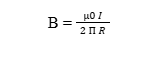
Straight Wire -
A long current-carrying conductor forms a magnetic field in concentric circles. Formula-
Circular Loop -
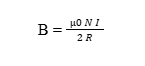
A circular current-carrying loop with radius R creates a magnetic field at the centre. Formula-
Solenoid -
a long coil of wire with many turns, the magnetic field inside is uniform and parallel

where -
B = Magnetic Field (Tesla ‘T’)
μ0 = Permeability of free space (4π×10−7 T·m/A)
I = Current (Amperes ‘A’)
R = Radius of loop
N / n = Number of turns
Magnetic Force
A magnetic force is the force experienced by a moving charge or a current-carrying conductor in a magnetic field. It can also be experienced when another magnetic material or a charged particle is placed in the magnetic field region.
Direction of Magnetic Force: Right-Hand Thumb Rule
If the thumb of the right hand points in the direction of velocity (v), then the curled fingers show the direction of the magnetic field (B). The palm indicates the direction of force on a positive charge. For a negative charge, the direction is taken opposite to the palm.
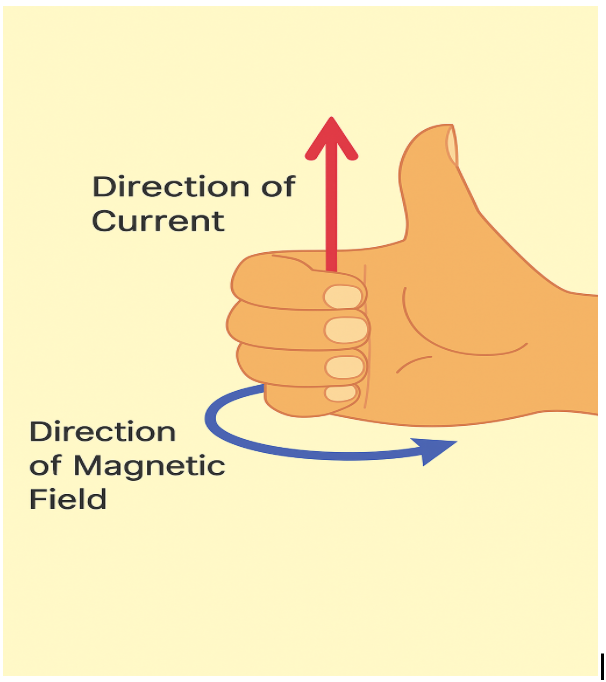
Right-hand thumb rule
Magnetic Force on a Moving Charge
When a moving charge is placed in a magnetic field, a magnetic force is implied.
Formula -
F̄ = q v̄ × B̄
Magnitude Formula:
F = qvB sinθ
where:
F - magnetic force
q - charge
v - velocity of the charge
B - magnetic field strength
θ - angle between v̄ and B̄
- The Right-Hand Thumb Rule gives the direction of the force.
- Force always acts perpendicular to the velocity and magnetic field
- If θ = 0 or θ = 180°, then force is zero.
- If θ = 90°, then the force is maximum (F = qvB)
Magnetic Force on Current-Carrying Wire
When a current-carrying wire is placed in the magnetic field
Formula -

Magnitude:
F = ILB sinθ
where,
L̄ = vector length of the conductor
B̄ = magnetic field
I = current
Fleming’s Left-Hand Rule
To determine the direction of the force on a current-carrying conductor in a magnetic field, stretch the thumb, forefinger, and middle finger of the left hand mutually perpendicular.
- Forefinger → direction of magnetic field (BBB)
- Middle finger → direction of current (III)
- Thumb → direction of force (FFF) on the conductor
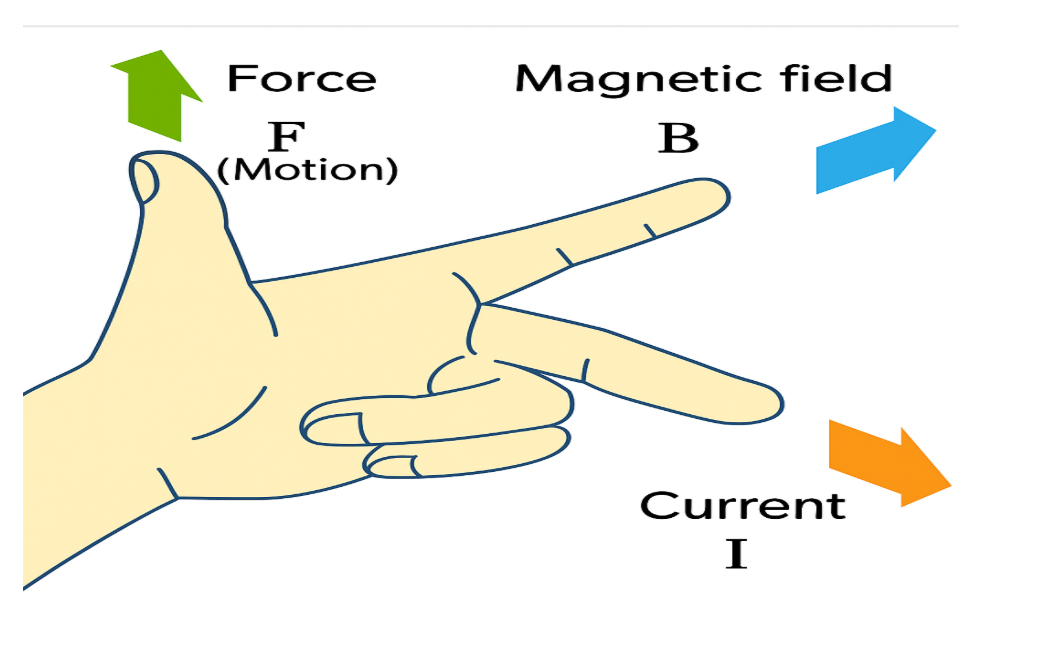
Fleming’s left hand rule
Difference Between Magnetic Field and Magnetic Force
| Magnetic Field | Magnetic Force |
|---|---|
| Region around a magnet or moving charge where magnetic effects can be observed. | The actual force experienced by a moving charge or a current-carrying conductor in a magnetic field. |
| Denoted by B, SI unit = Tesla (T). | Denoted by F, SI unit = Newton (N). |
| Cause of magnetic effects. | Effect produced due to the field. |
| Vector field quantity. | Vector force quantity. |
Applications
- Electric Motors - Magnetic fields are used to convert electrical energy into mechanical energy in electric motors. Rotation in the motors is caused by the force experienced by the coil through which current is passed and placed in a magnetic field.
- Generators - In a generator, mechanical energy is converted into electrical energy. A coil is rotated in a magnetic field, which induces current due to the change in magnetic flux.
- Loudspeakers and Microphones - In loudspeakers, when an electric current flows through a coil and is placed in a magnetic field, vibrations are caused. These vibrations produce sound. In microphones, sound waves cause a diaphragm to move a coil in a magnetic field, inducing an electrical signal.
- Magnetic Resonance Imaging (MRI) - MRI scanners use strong magnetic fields to create detailed images of tissues and organs.
- Electric Bells - In electric bells, a magnetic field is created by a current-carrying coil, which attracts a metal arm to strike the bell.
- Hard Disk Drives and Magnetic Storage - In magnetic storage devices like hard disks, data is written and read by altering and detecting the direction of magnetic fields in small regions.
Summing Up
A magnetic field is the region around a magnet or moving charge where magnetic effects are observed. It is a vector quantity. Magnetic force is the force experienced by a moving charge or current in a magnetic field. Right-Hand thumb rule is followed to know the direction. Some applications of magnetic fields and force are electric motors, generators, MRI machines, loudspeakers, and data storage devices.
Frequently Asked Questions
Q1. Can a magnetic field and magnetic force be present at the same time?
Yes, both the magnetic field and the magnetic force can be present simultaneously
Q2. What is the relationship between the magnetic field and magnetic force?
The magnetic force is directly proportional to the magnetic field
Q3. What is the difference between a magnetic field and magnetic force?
A magnetic field is the medium or potential for force, while the magnetic force is the actual effect experienced by objects in the field.
.


 Call Now
 Let's Chat
 Share
Share