-
Call Now
1800-102-2727


Difference Between Longitudinal And Transverse Waves

A wave is a disturbance that transfers energy from one point to another without the transport of matter. Or it may be stated as waves that carry energy, and the disturbance pattern carries information that travels from one point to another. Two of the forms of waves are Longitudinal Waves and Transverse Waves.
Longitudinal Waves
In longitudinal waves, the particles of a medium oscillate in the direction of wave propagation. Particles in the medium oscillate parallel to the wave propagation direction. These waves produce compressions (high pressure) and rarefactions (low pressure) in the medium of propagation.
Features
- Requires a medium to move; it cannot move in a vacuum.
- The velocity of a longitudinal wave is a function of the elasticity and density of the medium.
Examples
- Ultrasound Waves
- Sound Waves
- Seismic P- Waves
Transverse Waves
In transverse waves, the oscillation of particles of a medium is perpendicular to the direction of wave propagation. The particles move up and down as the waves move horizontally. These waves form troughs (low points) and crests (high points).
Features
- Transverse waves can travel in solids and on the surface of liquids
- Electromagnetic transverse waves do not need a medium to travel, like light
Examples
- Electromagnetic Waves
- Seismic S-waves
- Waves created by a guitar string
- Ripples created on the surface of water
Difference Between Longitudinal And Transverse Waves
| Longitudinal Waves | Transverse Waves |
|---|---|
| The particles of medium move in the same direction as the wave | The particles of the medium are moving perpendicular to the direction of the wave |
| The wave creates rarefactions and compressions | The wave creates troughs and crests |
| The wave cannot be polarised or aligned | The wave can be polarised or aligned |
| The wave can be produced in any medium | These waves propagate in solids and on the surfaces of liquids |
| Example - Sound Waves | Example - Electromagnetic Waves |
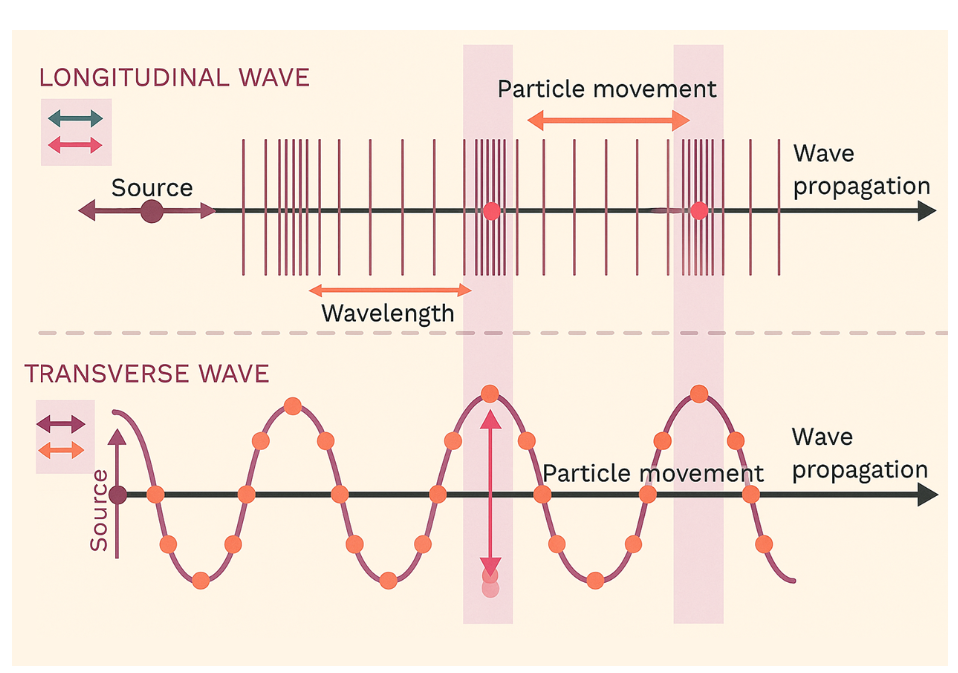
Transverse waves vs longitudinal waves
Applications in Real Life
- Underwater Communication - Submarines utilise longitudinal waves to transmit sonar (Sound Navigation and Ranging)
- Acoustic Engineering - Concert halls, theatres, and recording studios are designed to maximise sound wave characteristics.
- Medical Applications - High-frequency longitudinal waves in ultrasound scanning (Sonography) to visualise organs, babies in the womb, and structures within the body.
- Seismology - The study of the interior of the Earth and epicentres of earthquakes is done by S-waves and P-waves.
- Polarisation - Transverse waves are employed by sunglasses, camera filters, and LCD monitors to eliminate glare and manage light, as only transverse waves can be polarised.
- Communication- Transverse waves, particularly electromagnetic waves, are used in wireless systems. are employed in wireless communication, e.g., Radio waves, microwaves, and television signals.
- Light & Vision - Visible light is an electromagnetic wave that is transverse and enables us to perceive objects and is utilised in optical instruments, cameras, and microscopes.
- Surface waves in oceans (tsunamis) involve both longitudinal and transverse components.
Summing Up
Waves transfer energy but not mass. Transverse waves vibrate perpendicular to the direction of motion, forming troughs and crests, and longitudinal waves vibrate parallel to the direction of motion, forming compressions and rarefactions. They are used in sound, communication, medical imaging, seismology, and optics.
Frequently Asked Questions
Q1.What are the common features between longitudinal and transverse waves?
Both are types of mechanical waves that involve particle vibrations about their mean positions.
Q2. What do longitudinal and transverse waves combine as?
A surface wave is a combination of longitudinal and transverse waves.
Q3.Waves that are always transverse?
Electromagnetic waves are always transverse.
Q4.Waves that move faster, longitudinal or transverse?
Longitudinal waves move faster than transverse waves because they travel by compressing and rarefying the medium, which makes the transfer of energy faster.
Q5.Can longitudinal waves propagate through a vacuum?
No, they cannot propagate through a vacuum. They require a medium to propagate.
Q6. How to identify if a wave is longitudinal or transverse?
The wave can be identified by the direction in which the particle is moving.


 Call Now
 Let's Chat
 Share
Share