-
Call Now
1800-102-2727


Kinematics

Kinematics is the study of mechanics dealing with motion of objects, independent of what causes the motion (such as forces or mass). The term kinematics is derived from the Greek term "kinesis", referring to motion. Kinematics enables us to know how things move, how quickly they move, and in what direction they move over time.
Important Terms
- Distance: It is the sum of the path length covered by a body, irrespective of direction. It is a scalar quantity and is always positive.
- Displacement (s): It is the shortest straight-line distance between two points occupied by a body. It is a vector quantity and can be positive, negative, or zero.
- Speed: The rate at which an object covers distance. It is scalar and is recorded in meters per second (m/s).
- Velocity(v): The rate of change of displacement with respect to time. It is a vector quantity and also measured in m/s.
- Acceleration (a): The rate of change of velocity with respect to time. It is a vector quantity measured in meters per second squared (m/s²).
Types of Motion
-
Uniform Motion
When a body travels equal distances in equal time intervals, the body is in uniform motion. Velocity is constant.
-
Non-uniform Motion
When a body travels unequal distances in equal time intervals, the motion is non-uniform. It consists of changing velocity and acceleration.
Equations of Motion
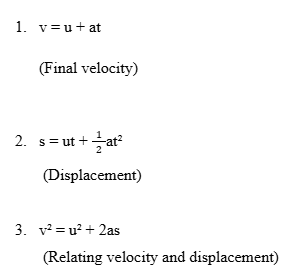
where,
u - initial velocity
v - final velocity
a - acceleration
s - displacement
t - time
Graph Representation
Displacement - Time Graph
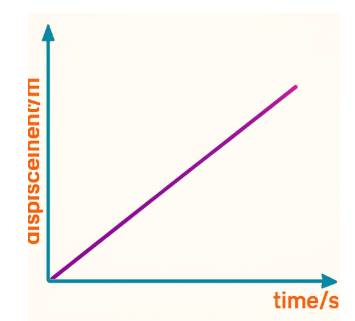
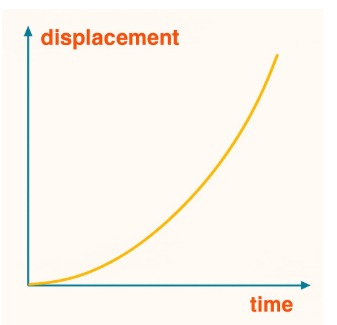
A graph of displacement over time illustrates how the position of an object changes with time. The gradient of the graph is the velocity of the object. A straight sloping line describes uniform motion, and a curved line describes accelerated or decelerated motion.
At Uniform Motion At Non-Uniform Motion
Velocity - Time Graph
A velocity-time graph displays the variation of an object's velocity with time. The gradient of the graph is equal to acceleration. A horizontal straight line indicates constant velocity (zero acceleration), whereas a sloping line suggests uniform deceleration or acceleration. The area under the graph is equal to the displacement of the object.
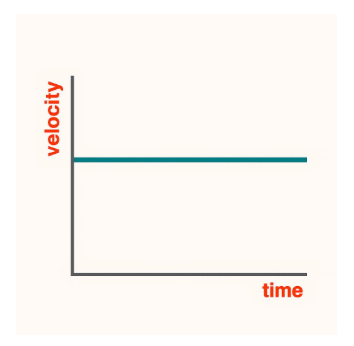
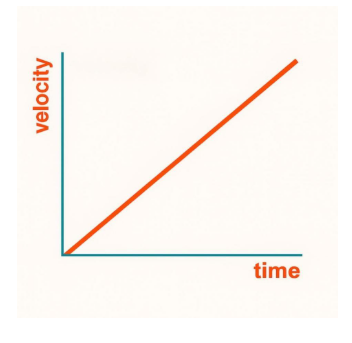
At Zero Acceleration At Uniform Acceleration
Acceleration - Time Graph
An acceleration-time graph indicates how the acceleration of an object varies with time. A horizontal line on the time axis represents zero acceleration, that is, the object is moving at constant speed. If the graph is sloping or curved, then acceleration is not constant with time. The area under the graph represents the change in velocity.
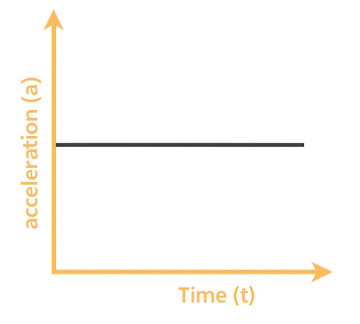
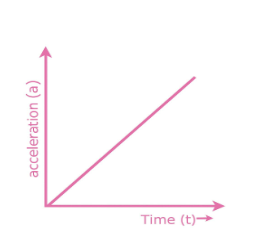
At Zero Acceleration At Uniform Acceleration
Examples
- A vehicle travelling on a road - The vehicle travels a distance in a given time, indicating speed and acceleration.
- An elevator going up or down - It goes from acceleration at the beginning, constant speed in the middle, followed by deceleration to come to a halt.
- A train journeying between two stations - It depicts various phases of motion: from rest, accelerating, moving with uniform speed, and stopping.
Summing Up
Kinematics is a basic branch of mechanics that explains the movement of objects without understanding the causes of such movement, i.e., forces or mass. It deals with quantities such as displacement, velocity, speed, acceleration, and time, which can be measured, enabling one to make a detailed investigation of the way objects move. Kinematics explains various forms of movement, such as uniform and non-uniform movement, free fall, projectile movement, and motion in a straight line (rectilinear motion). With the three equations of motion of constant acceleration, displacement, velocity, and time may be calculated in different situations. Graphical devices like displacement-time, velocity-time, and acceleration-time graphs are employed in visually representing motion and measuring significant physical properties such as slope and area.
Frequently Asked Questions
Q1. What is non-uniform and uniform motion?
In uniform motion, the same distances are covered in equal intervals of time. In non-uniform motion, the distance travelled is a function of time.
Q2.Is it possible for an object to have zero acceleration and yet be moving?
Yes, if a moving object has constant velocity, then its acceleration is zero.
Q3.Is velocity always positive?
No, velocity is a vector quantity and may be positive, negative, or zero, depending on the direction of movement.


 Call Now
 Let's Chat
 Share
Share