-
Call Now
1800-102-2727


Inertia, Galileo experiment, Newton’s Law of inertia, Types of inertia, Practice problems, FAQs

Do a small practical at your home.Take a coin, a paper and a transparent glass. Place the paper on the top of the glass and the coin on the paper as shown in the figure. Now apply a small sudden puss on the paper so that it uncover the glass. You will see that the coin will fall down in the glass. Now the question is why does it happen so? This happened due to a property of the object called inertia. Which signifies the inability of an object in changing its state of rest or motion. The greater the inertia greater will be the inability to change its state. It is measured in terms of mass. The more mass the more will be the inertia. In the above scenario the coin has more mass than the paper. Hence more inertia than the paper. So a small puss will not be sufficient to move the coin. Let's know more about such an interesting example of inertia !
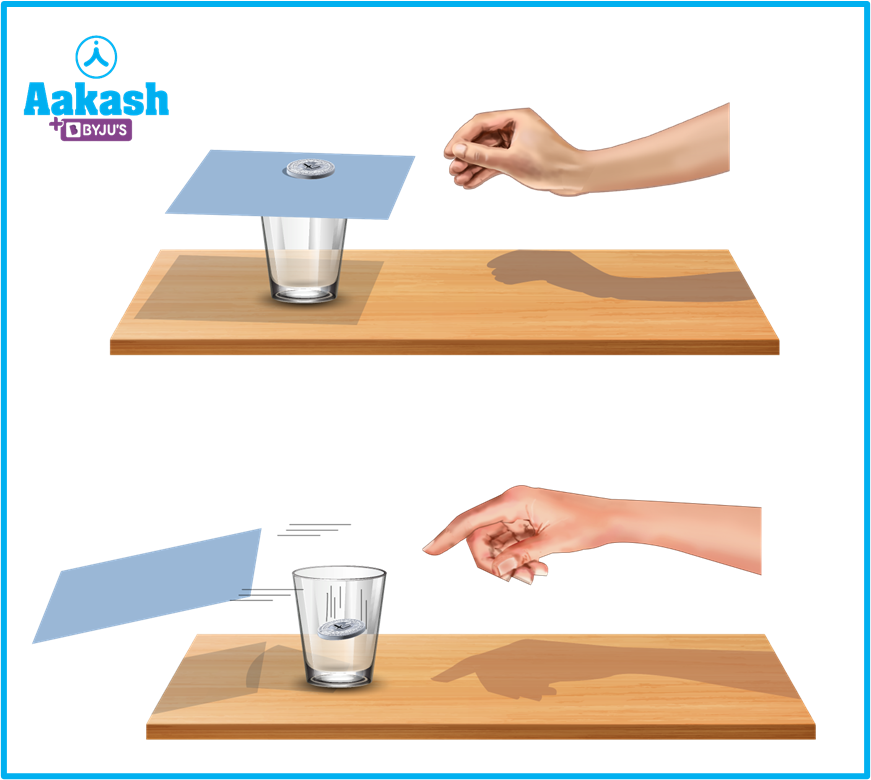
Table of content
- What is inertia?
- Galileo experiment
- Newton Law of inertia
- Types of inertia
- Daily life example of inertia
- Practice problems
- FAQs
What is inertia?
The inertia is the property of a body or system due to which it opposes its change of state of rest or motion. In other words it is an inability of the body to change its state of rest or the motion until an external force is applied to it. The body in state of rest will be in rest and a body in the state of motion will remain in the motion until an external force is not applied to it. The body with larger mass will have more inertia. Therefore, mass is a unit of inertia.
We can understand the inertia by the example of a bus. When we travel in the bus you may observe the following situation :
- When the bus starts its motion a sudden push is applied on your upper portion in backward direction. This push is not actual. It is the inertia which wants to keep you in the same position.Your lower part of the body is attached with the floor of the bus and subjected to the force by the floor. But the upper part has no force by the bus so it will try to keep in the rest. And falls you down in backward direction.

- When the bus is moving with a uniform velocity. Now the driver applies the brake to stop the bus. Your lower body part will stop as it is attached to the bus and subjected to the force by the floor. But the upper part of the body is not applied by the bus, which causes it to fall in the forward direction. Because of this reason the hendells are installed in the bus
- When the bus takes a turn on the road. The upper portion of the body appears to move in the radial outward direction. The inertia causes the upper part of the body to move in the same direction.

Galileo experiment
Galileo, a premier scientist in the seventeenth century, created the concept of inertia. Galileo postulated that friction, a force, is what causes moving objects to eventually come to a stop.
Galileo found that In the experiments using two inclined planes facing one another, a ball would roll down one inclined plane and up the second plane to almost the same height.. The ball would roll up the opposite plane even closer to the initial height if smoother surfaces were utilised. Galileo reasoned that friction was the cause of any variation between the starting and ultimate heights. Galileo proposed that the ball would rise to the same height if friction could be completely eliminated.
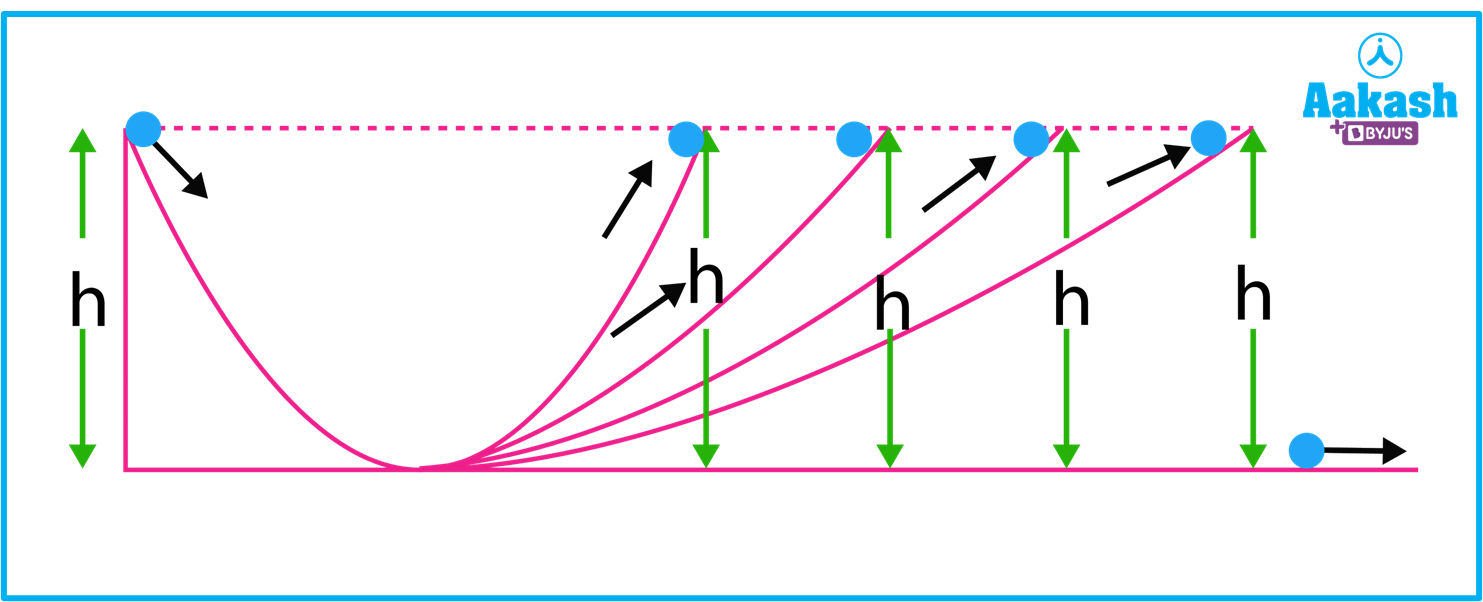
Galileo also noted that the final height was typically equal to the initial height, regardless of the angle at which the planes were oriented. The ball would roll a longer distance to reach that original height if the opposite incline's slope were reduced.
Galileo followed his argument by saying that if the opposite incline were lifted at just greater than 0 degree angle, the ball would roll almost infinitely distance to reach the initial height. Additionally, if the opposing incline were horizontal and not even slightly inclined, an object in motion would continue to move.
Newton Law of inertia
In 1687, English Mathematician and Physicist Sir Issac Newton worked on the idea of Galileo about the motion and gave the law of inertia. It is also known as Newton's first law of motion.
According to the law of inertia “ A object continues to be in its state of rest or uniform motion in the same direction unless it is acted upon by some net unbalanced external force to change the state of rest or motion”.
A body at rest remains at rest if no external force is applied. A body in uniform motion keeps moving uniformly if no external force is applied. A body cannot change its direction of motion in the absence of an external push.
Types of inertia
The inertia can be of three types as shown in the figure,
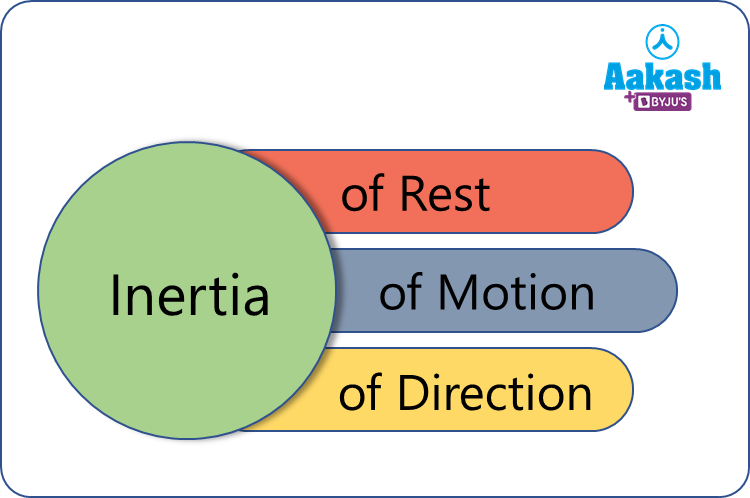
1.Inertia of Rest - The body's resistance to remaining in a condition of rest until the application of an outside force is called inertia of rest.
2. Inertia of Motion - When the body offers resistance to remain in a uniform motion until an outside force acts on it, is termed as inertia of motion.
3. Inertia of direction - When the body offers resistance to keep moving in the same direction unless another force acts on it, is known as inertia of motion.
Daily life example of inertia
The three type of inertia can be understand by the following daily life examples,
1. A carpet releases dust when we beat it. This is due to the fact that when we beat a carpet, the carpet moves, however the dust prefers to remain in its resting form and emerges from the carpet.
2. The rider of the horse falls backwards, when the horse starts suddenly.
3. When we jump from the moving train or bus, we get a jerk on the body because of inertia of motion.
4. A seat belt is installed in the car to prevent the impact of head with the steering in the accident. In an accident the car suddenly comes to rest and the head keeps on moving due to inertia. If the seat belt is installed it will help the upper body come into rest.
5. If we lose the string of the pendulum moving in the horizontal plane. It will keep moving in the direction tangent to the circle at that point.
Practice problems
Q. A car of 400 kg and a truck of 1000 kg are resting on the ground. Which one needs more force to keep them in motion?
A. As the mass is the measurement of inertia of the object. More the mass, more will be the inertia of the object. Here the truck has more mass than the car, so the truck has more inertia than the car. Hence to change the state of the truck to motion will need more force then the car.
Q. Why is a force not necessary to keep an object in motion? Explain .
A. It is due to the object's properties of inertia. Because of this property, once the object is set into motion it will keep on moving without application of external force. Hence a force is not required to keep the object in motion. If there is a need to increase or decrease the velocity of the object, then force is necessary.
Q. When a ball is rolled on the ground it stops after moving some distance. Does it violate the law of inertia?
A. Not at all. According to the law of inertia the ball should move forever if it is not subjected by some external force. But here the ground has friction and it will apply a frictional force on the ball. Due to this external frictional force it will stop.
Q. What is the second law of motion?
A. This law states that a body's rate of momentum change is directly proportional to the external force acting on the body, and this change always occurs in the direction of the applied force.
FAQs
Q. What is the quantitative measurement of inertia?
A. Inertia is measured by the mass of the object. If mass is greater the inertia will be greater and vice versa.
Q. A 10 kg object is travelling horizontally at a 5 m/s speed. How much net force is necessary to maintain the object's motion in this direction and at this speed?
A. 0 N. Due to inertia the object in motion will continue to be in motion. A force is needed when there is a change in the object's velocity.
Q. What is the change in the inertia of the object having mass m when it is sent to the moon?
A. The inertia of the object is related to the mass. The mass of the object on the moon will be the same as on earth, although the weight will change due to change in the gravity. So the inertia will be the same.
Q. Would a force be necessary to move an object if you were in space and a weightless environment?
A. Yes, things have mass even in space. So, they have inertia if they have mass. In other words, a space-based object resists change to its state of motion. A stationary object cannot be moved without the application of a force.

 Call Now
 Let's Chat
 Share
Share