-
Call Now
1800-102-2727


Impulse

Have you ever seen a cricket match? Observe what the fielder does while catching the ball. He or she moves the hands backwards at the time of the catch. Do you know why they are doing it? This action increases the time over which the ball’s momentum is brought to zero. According to the impulse-momentum theorem, impulse is equal to the change in momentum. By moving their hands backward, the fielder increases the time of impact. As a result, the force exerted by the ball on the hands is reduced
Definition
Impulse is described as the effect of force acting over time to change the momentum of an object. It is represented by J and expressed in Newton seconds or kg m/s. It can also be defined as the product of the force applied and the time over which the force is applied. It measures the change in momentum of an object changes when a force is applied.
Equation for Impulse
Impulse (J)= Force (F) × Time (t)
or, it can be calculated as a change in momentum
Impulse = Δp = m × Δv
where:
J - impulse
F - applied force
t - time duration
Δp - change in momentum
m - mass of the object
Δv - change in velocity
Impulse - Momentum Theorem
The theorem states that when a force is applied to an object for a period of time, it results in a change in the object's momentum. The larger the force or the longer the period of time, the larger the change in momentum.
Key Insight: For a fixed change in momentum, if you increase the time interval (Δt), the average force (F) acting on the object decreases. This is why we use cushions or sand pits for long jumpers!
Impulse = p’ - p
where,
p - initial momentum
p’ - final momentum
Area Under The Force Time Curve
The impulse is the area under the curve of a graph of force vs. time. “This represents the total impulse delivered over time. Even if the force is not constant, the impulse can still be found by finding the area under the graph.
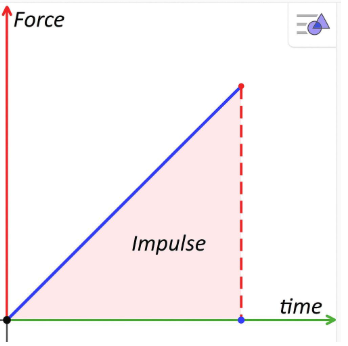
Force vs Time Graph
Real-Life Applications of Impulse
Some real-life applications of impulse are as follows:
Car Airbags:
On impact, airbags inflate and cushion the passengers. The airbags prolong the period of time in which the momentum of the passenger is reduced to zero. Thus, it minimises the force felt by the body.
Jumping on a Trampoline:
When you jump on a trampoline, the contact time is longer than when you jump on a hard surface. Due to this, the force on your body is significantly reduced, though the impulse is the same. This is why trampolines are safer to jump on.
Hammering a Nail:
When a hammer strikes a nail, it transfers a huge force over an incredibly short time. The huge impulse gives a great deal of momentum to the nail and pushes it into the surface.
Impulse from a Force-Time Graph
In your exams, you might see a graph where Force is on the y-axis and Time is on the x-axis.
• The Rule: The area under the Force-Time graph represents the total impulse or the change in momentum.
• If the graph is a simple shape like a triangle or rectangle, just calculate the area to find the impulse.
Solved Example for Practice
Question: A football of mass 0.8 kg is moving toward a player at 5 m/s. The player kicks it back in the opposite direction at 10 m/s. If the foot was in contact for 0.02 seconds, find the average force.
Solution:
1. Change in velocity (Δv): 10−(−5)=15 m/s (we use negative for the opposite direction).
2. Impulse (I): m×Δv=0.8×15=12 N-s.
3. Average Force (F): I/Δt=12/0.02=600N.
Summary
Impulse is one of the central concepts in physics that teaches us how forces influence motion. It bridges the gap between force and momentum and tells us why time is significant when there's forceful interaction. Whether for sports, cars, or protective devices, knowing impulse enables us to design safer and more effective mechanisms. It demonstrates that with increasing contact time reduces the force experienced, thus making interactions less destructive and more manageable.
Frequently Asked Questions
Q1. What is the SI unit of impulse?
The SI unit of impulse is Newton-second (N·s). It is also equivalent to kg·m/s, the unit of momentum.
Q2. Is impulse a vector or scalar quantity?
Impulse is a vector quantity. It has both magnitude and direction, just like momentum.
Q3. What happens if the force is applied for a longer time?
If the time increases and the impulse remains the same, the force decreases. This is derived from the formula Impulse = Force × Time.
Q4. What is the relationship between impulse and momentum?
According to the Impulse-Momentum Theorem, the impulse applied to an object is exactly equal to the change in its momentum. When you apply a force over a specific time, it results in the object speeding up, slowing down, or changing direction.
Q5: Why does a rubber ball experience more impulse than a clay ball?
A rubber ball bounces back, meaning its momentum changes from forward to zero and then to backward. A clay ball simply stops. Because the rubber ball undergoes a much larger total change in momentum, it experiences a greater impulse.


 Call Now
 Let's Chat
 Share
Share