-
Call Now
1800-102-2727


Gravitational Potential - Gravitational potential due to point mass, uniform ring, uniform spherical shell and uniform solid sphere, Practice problems, FAQs

Consider a satellite to be placed in an orbit of the Earth. This satellite will be used for weather forecasting for the next 10 years. Now we know that every body creates a gravitational field around it in which the gravitational force can be sensed. Now we will look into our example. The Earth and the satellite both have their own gravitational fields but the mass of the Earth is much larger than the mass of the satellite. Therefore the gravitational field of the Earth will be more significant. If the satellite is launched from the Earth, the Earth will try to pull the satellite towards it. Therefore we need to do some amount of work against the gravitational field. This external work done on the satellite is defined by using a term known as the gravitational potential. This gravitational potential changes with the distance from the Earth. Therefore, the gravitational potential is defined at a point in the gravitational field. Also, the potential is created due to the effect of the gravitational field therefore we will say that the gravitational potential due to the Earth at a point in the gravitational field on a unit mass. Now, what exactly is this gravitational potential? How does it change with the distance? All these concepts will be discussed in this session.
Table of contents
- Potential at a point
- Gravitational potential
- Gravitational potential due to system of point mass
- Gravitational potential due to uniform ring on its axial point
- Gravitational potential due to uniform thin spherical shell
- Gravitational potential due to uniform solid sphere
- Practice problems
- FAQs
Potential at a point
The amount of work necessary to move a unit mass from one position to another while there is no change in its kinetic energy is known as the potential difference between two points in a source field. The source field is the cause due to which the potential difference is created or it is the cause that creates potential at a point in the source field. This source field can be a gravitational field or an electric field.

Consider two points A and B in a source field . A test mass m is initially kept at point A and then is moved to the point B. Then the potential difference between point A and B in the source field will be,
Potential at a point is not an absolute value. It means that we can not obtain the potential at a point directly. Instead of this, we calculate the potential difference between any two points and then we assume zero potential at one point among them and we calculate the potential at the other point. The point at which we are assuming the zero potential is known as the reference point. In general, the reference point is considered as a point at infinity.
Now if we will apply the above concept in our example by keeping the point A at infinity then,
VA=0 as
Then the potential at point B is expressed as,
Gravitational potential
In a gravitational field, the work done by an external force on a unit mass in order to bring it from infinity to a point in the gravitational field in such a way that the kinetic energy of the mass is zero or the mass moves with a constant velocity. Then the potential at that point is the gravitational potential.
Consider a mass m (known as test mass) that is kept in a gravitational field of a mass M as shown in the figure. The test mass m is initially kept at a point A then a gravitational force is acting on it which will be in the direction of the field.
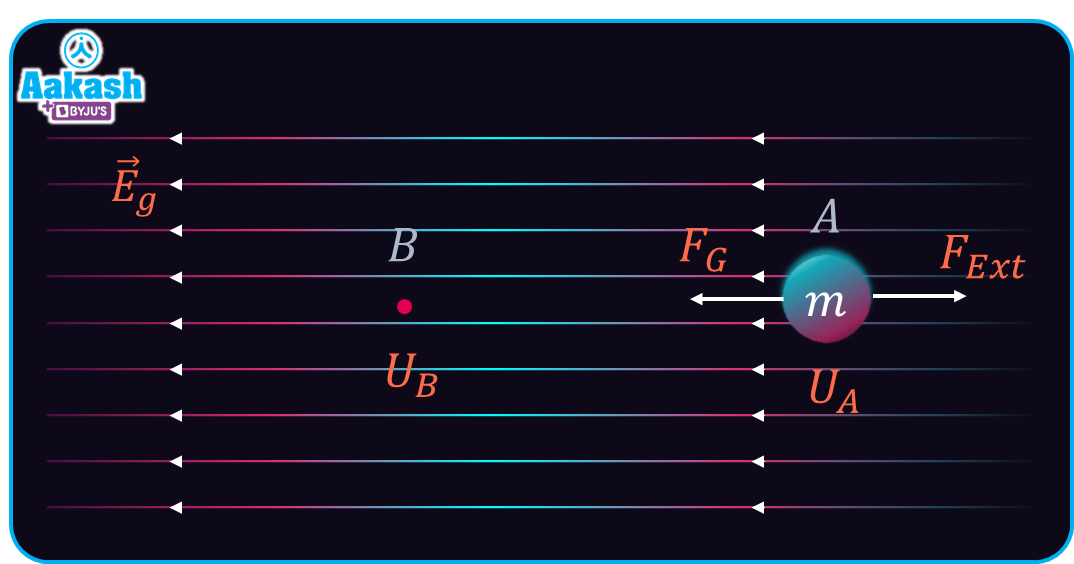
This gravitational force will attract the test mass towards mass M and we know that the gravitational force is variable in nature. Now in order to find the potential at a point, we need to apply a variable external force which will be equal and opposite to the gravitational force (WG) so that the test mass will move with a constant velocity.
Then the gravitational potential between points A and B in the gravitational field will be,
Since gravitational force is a conservative force, therefore,
Gravitational potential due to system of point mass
A point mass M is kept at a fixed point P as shown in the figure. Let a test mass m is at a point A at a distance r1 from the point P and it is moved to point B which is at a distance of r2 from the point P. Then the change in gravitational potential between points A and B,
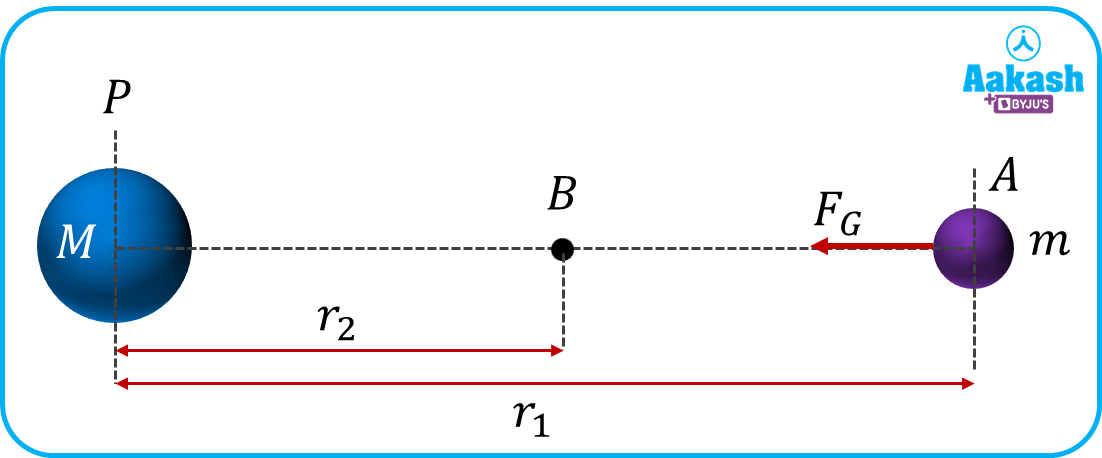
Now, to find the potential at point B,
and
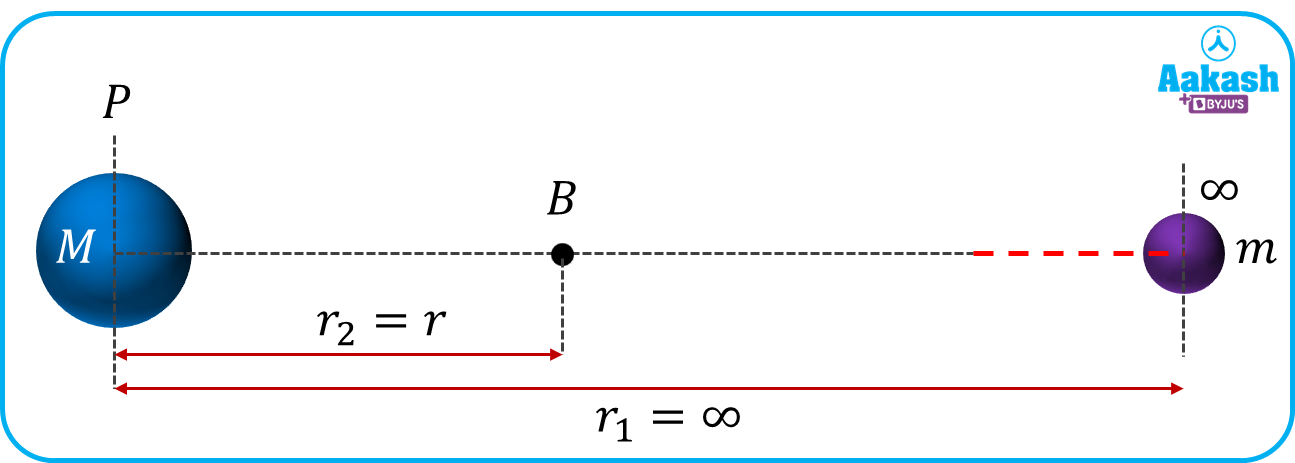
And considering the potential at point A is zero.
Hence,
And,
Then from equation (i),
The above expression is showing the potential energy at a point when the mass is brought from infinity to that point in the gravitational field.
Relation between gravitational potential and gravitational field:
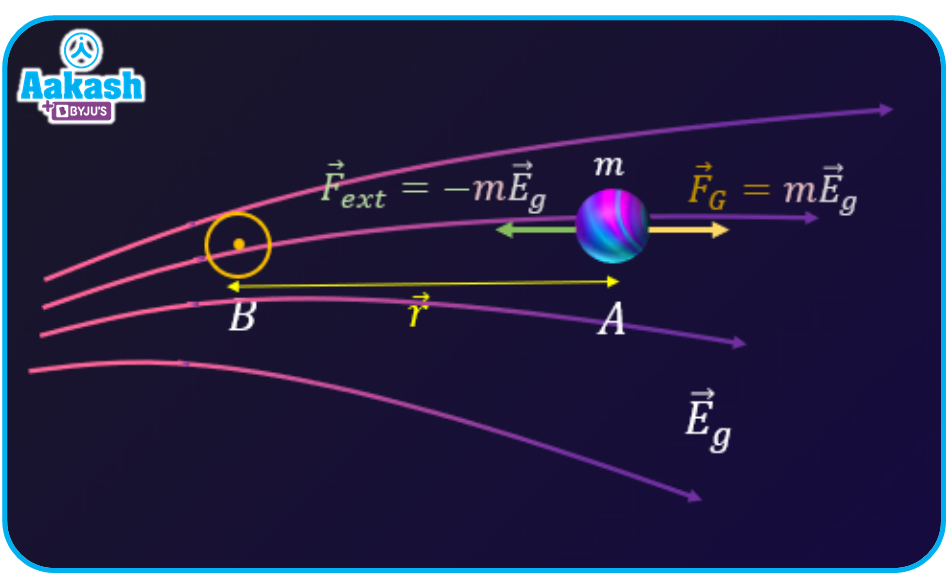
A gravitational field is shown in the above figure. The gravitational force that is acting on the test mass m is given by,
Now if the test mass is moved from a point A to B (opposite to the field direction), an external force is to be applied to the test mass. Then,
The work required to move the test mass from point A to B will be
Since the direction of external force is acting in the direction of r then,
The potential difference between the point A and B in this condition,
Potential difference for a small displacement dr of the mass can be written as,
The above expression is gravitation field in one direction.
Gravitational potential due to uniform ring on its axial point
A uniform ring shown in the figure has mass M and radius R as shown in the figure. Consider a small element of mass dm and let a point P is at the axis of the ring at a distance of x where the gravitational field is to determine.
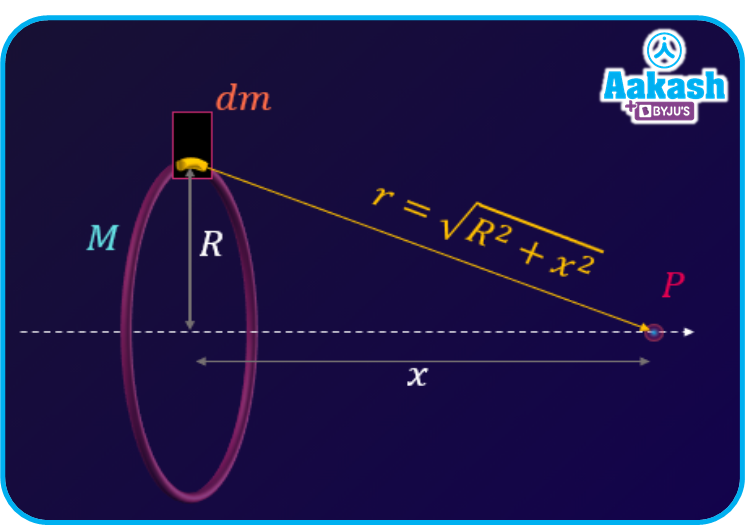
Let r is the distance between elementary mass dm and point P. This distance will be the same for all the elementary masses of the ring and it is given by,
Since the ring is uniform, therefore,
Then the change in gravitational potential is given by,
Therefore the net potential at point P due to the ring,
Now the gravitational field along the axis of the ring can be written as,
From equation (i),
After solving this, we will get the expression as,
Gravitational potential due to uniform thin spherical shell
A uniform spherical shell can be considered as a composition of an infinite number of elementary rings having different radii. Consider a uniform spherical shell of radius R and mass M and let a point P at a distance of r on the axis, passing through its centre. Now consider an elemental ring having mass dm and angular thickness as d, as shown.
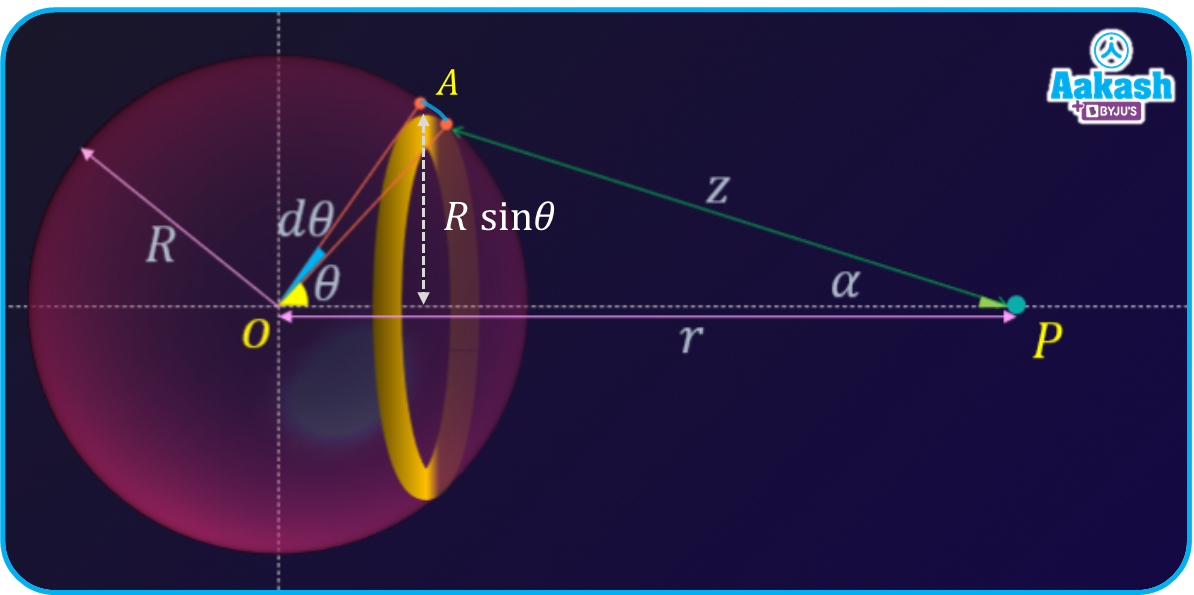
As seen from the above figure, the radius of the elementary ring will be . Let the ring is making a half angle with the horizontal axis. Then the gravitational potential at point P due to the element mass dm will be,
Now drawing a 2-D diagram of the spherical shell as shown below,
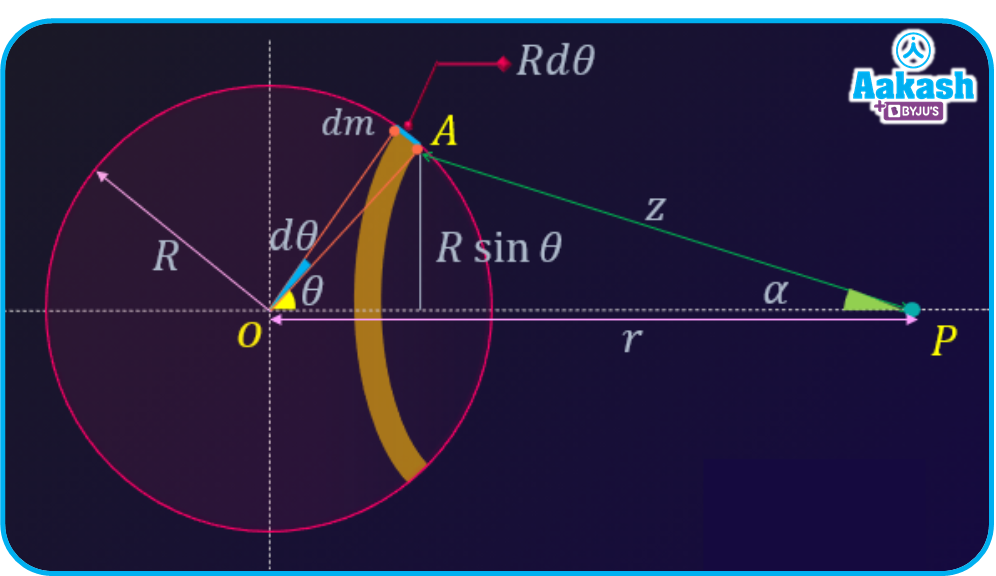
In the above figure, the area of the element ring and the mass per unit area or surface density is given as,
Then the mass of the ring element will be
In the triangle AOP, by applying cosine law,
Differentiating the above equation, we get
Hence from equation (i),
Since the change in the gravitational potential between the elementary mass of the ring and the point P is derived as,
Taking the value of dm from equation (i),
Therefore the potential at the point P due to the spherical shell is,
Case 1: If the point P is outside the shell (r>R)
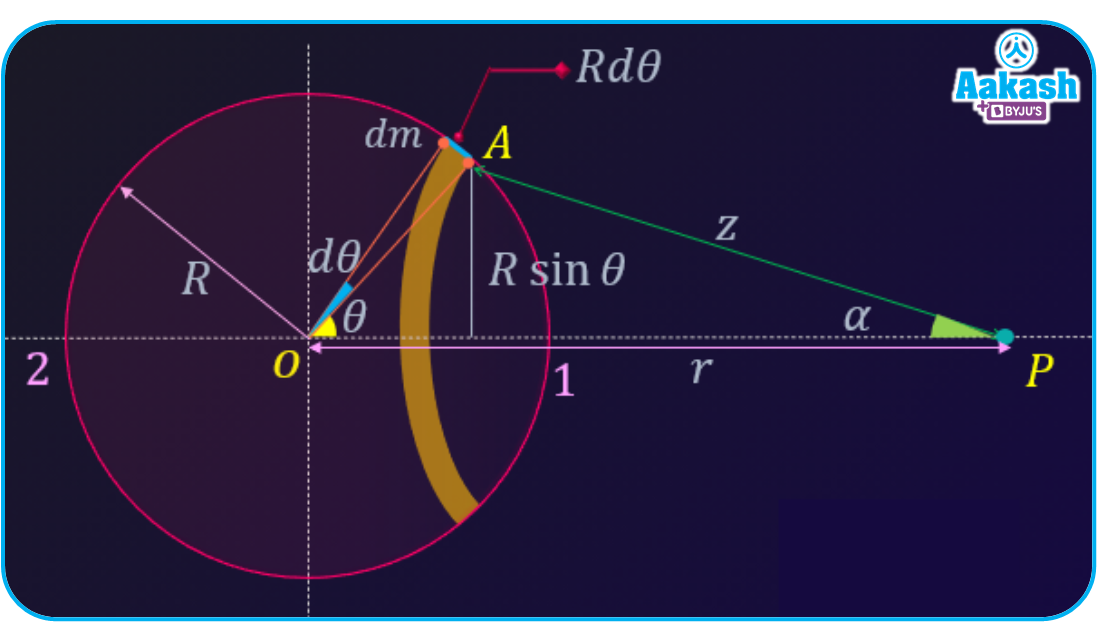
If the point P is present outside the shell then while integrating the equation (ii), then limits for z will be (r-R) at point 1 and (r+R) at point 2. Then from equation (ii),
Case 2: If the point P is inside the shell (r<R)
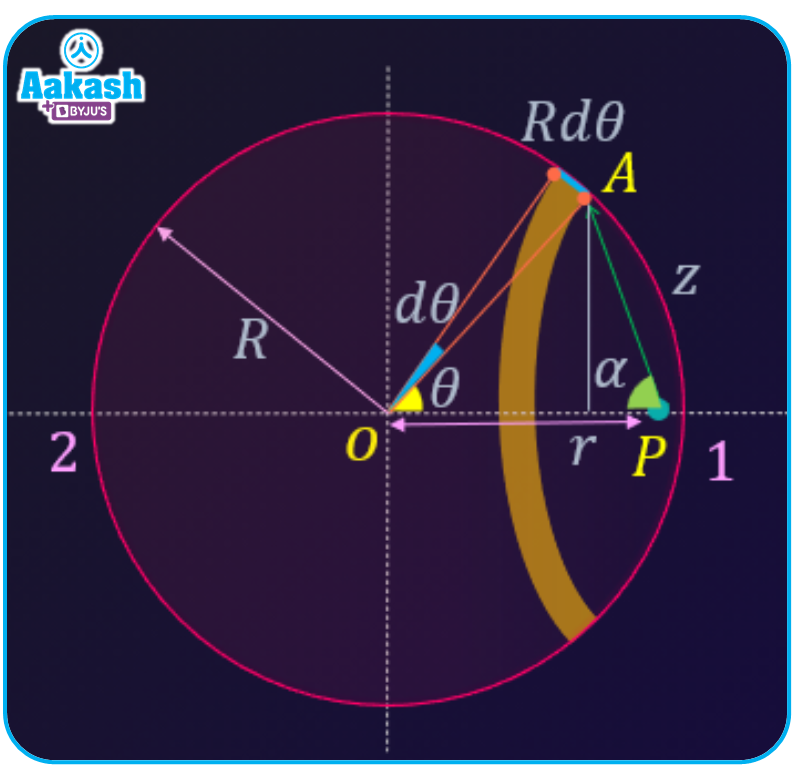
If the point P is present inside the shell then while integrating the equation (ii), then limits for z will be (R-r) at point 1 and (R+r) at point 2. Then from again equation (ii),
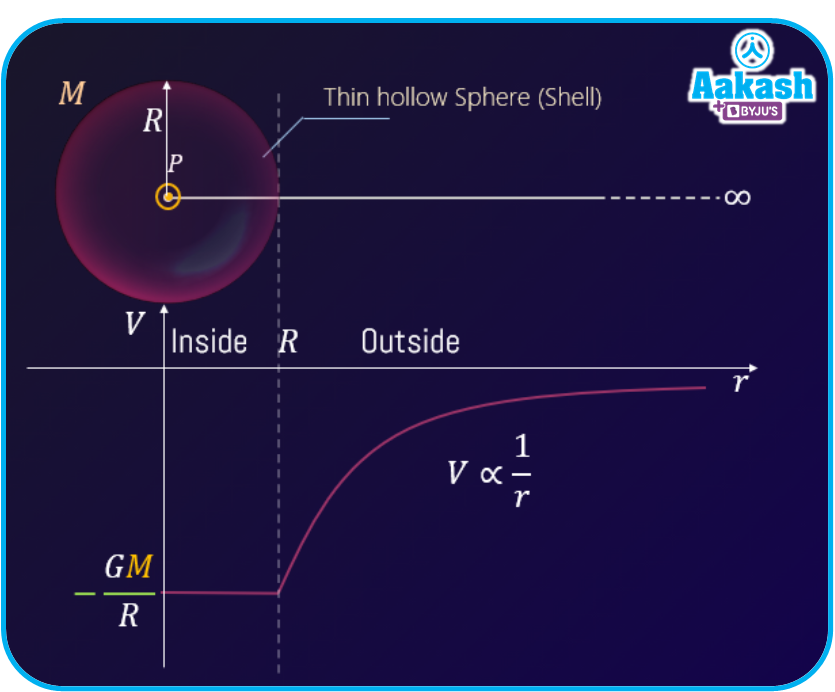
The above expression is showing that the gravitational potential at any point at the surface and inside a uniform spherical shell is constant.
The variation of gravitational potential due to a uniform spherical shell is shown below,
Gravitational potential due to uniform solid sphere
A uniform solid sphere can be considered to be a composition of an infinite number of uniform spherical shells. Consider a uniform solid sphere of mass M and radius R and let the sphere is made up of i numbers of shells, each of mass dm. Then the total mass of the solid sphere will be written as,
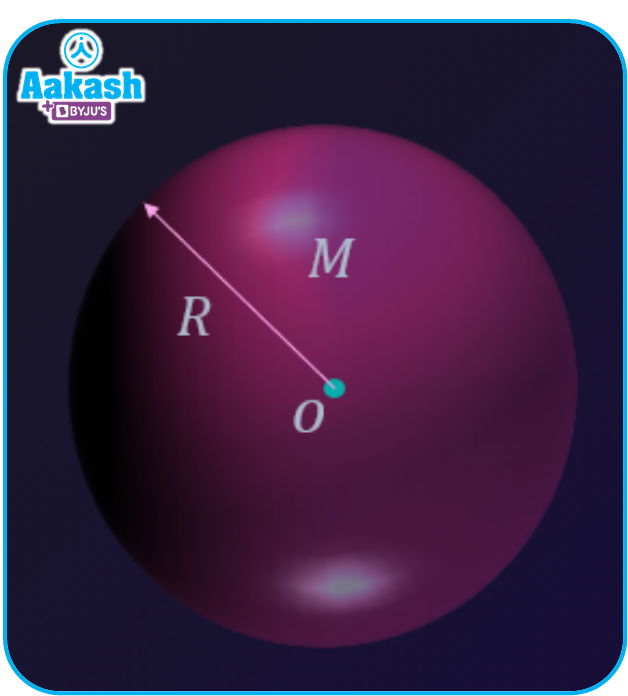
And the gravitational potential for ith elemental shell will be
Let a point P on the line passing through the centre of the solid sphere at which we have to find the gravitational potential.
Case 1: If the point P is outside the solid sphere (r>R)
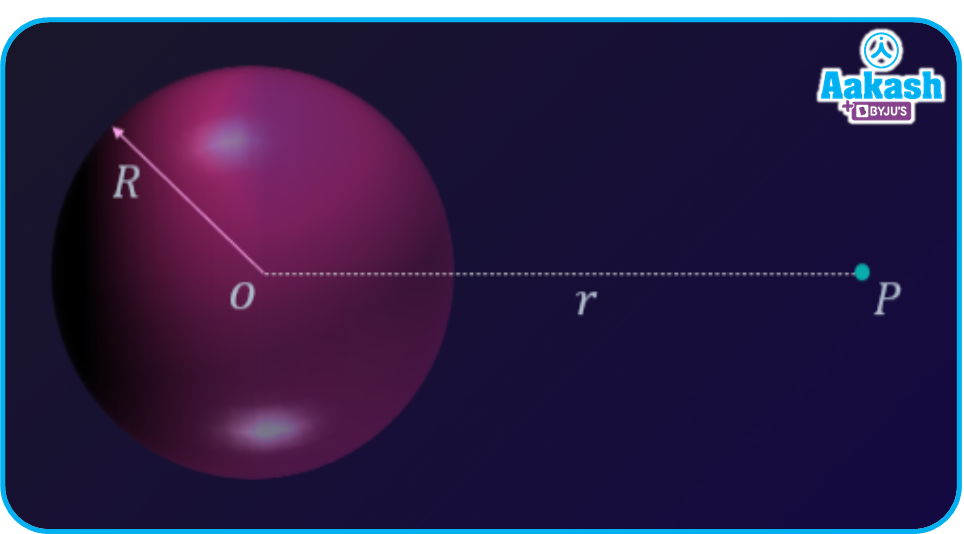
If the solid sphere is made up of i number of shells then the gravitational potential due to solid sphere is given by,
From equation (i),
Hence, the gravitational potential at any point outside the solid sphere is,
If the point P is present at the surface of the solid sphere then, (r=R)
Case 2: If the point P is inside the solid sphere (r<R)
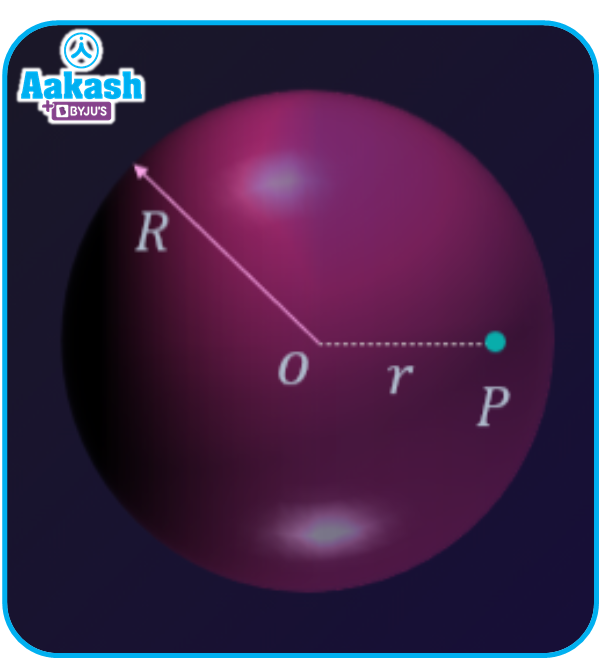
Since the gravitational field due to a solid sphere at any point inside the solid sphere is given by,
The change in the gravitational potential between any two points is given by,
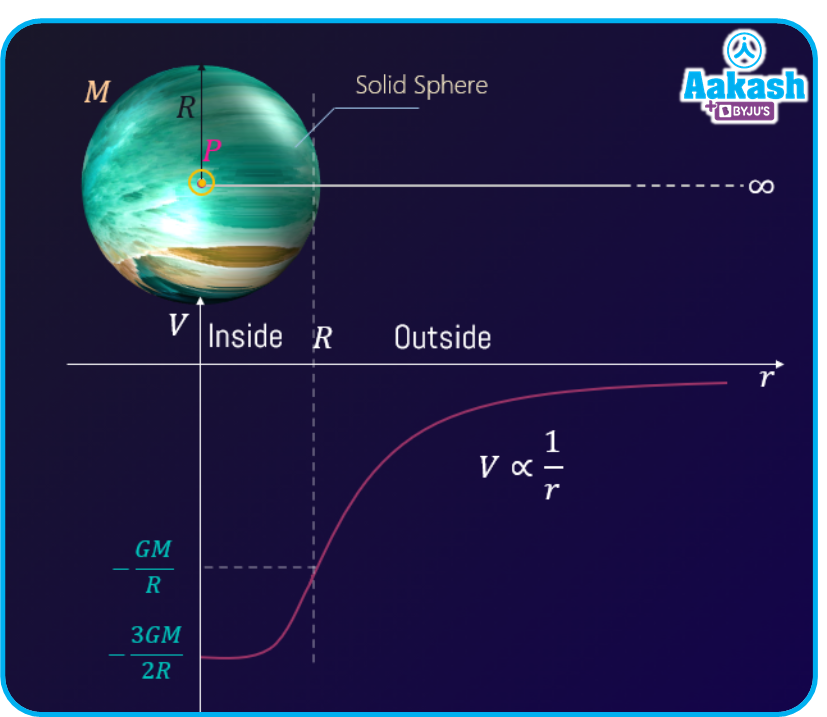
Now we know the value of gravitational potential at the surface of the sphere from equation (ii),
The potential at the centre of the sphere, r=0
Then the variation of potential due to a uniform solid sphere is shown in the plot below,
Practice problems
Q1. A circular ring is placed in YZ-plane and the centre of the ring is at the origin. The mass of the ring is M and the radius is R. An object of mass m is kept initially at a distance of x=2R and then it is released. Then with what speed the object will pass through the centre of the ring?
Answer. Given, the distance of the object from the centre of the ring, x=2R
Mass of the ring =M
Radius of the ring =R
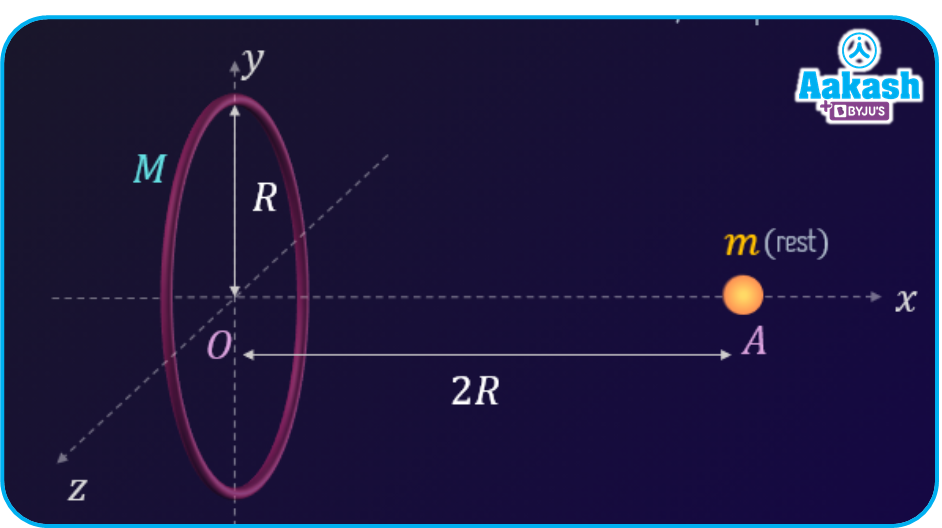
Let the object is kept at a point A at the given distance.
Now the gravitational potential at point A due to the ring is given by,
Now at at point A, (x=2R)
And at the origin O, (x=0)
Now applying the principle of conservation of energy between points A and O,
Initially the object is at rest at point A, then KA=0
Let the velocity of the object at point O is v.
Q2. An object is situated at the midpoint or centre of a uniform spherical shell. The mass of the shell is equal to the mass of the object and it is M. If radius of the shell is a then the gravitational potential at distance of from the centre will be,
(a) (b)
(c) (d)
A. Given, the mass of the object = mass of the shell =M
Radius of the spherical shell =a
Now according to the given problem, we need to find the potential at a point inside the spherical shell (). Also this point will be outside for the object which is at the centre of the shell.
Then applying the formula for the gravitational potential at a point B inside the shell
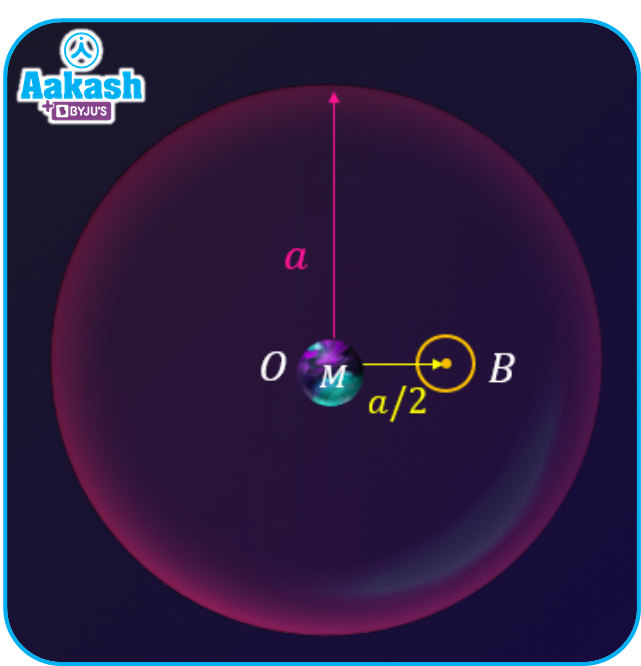
As seen from the above figure,
Gravitational potential at B=
Gravitational potential at B due to object + Gravitational potential at B due to shell
Q3. A ring and a solid sphere are kept apart at a distance of as shown in the figure. Find the work done by the gravitational forces when an object of mass m is displaced from point A to B. The mass of the ring and the sphere are M1 and M2.
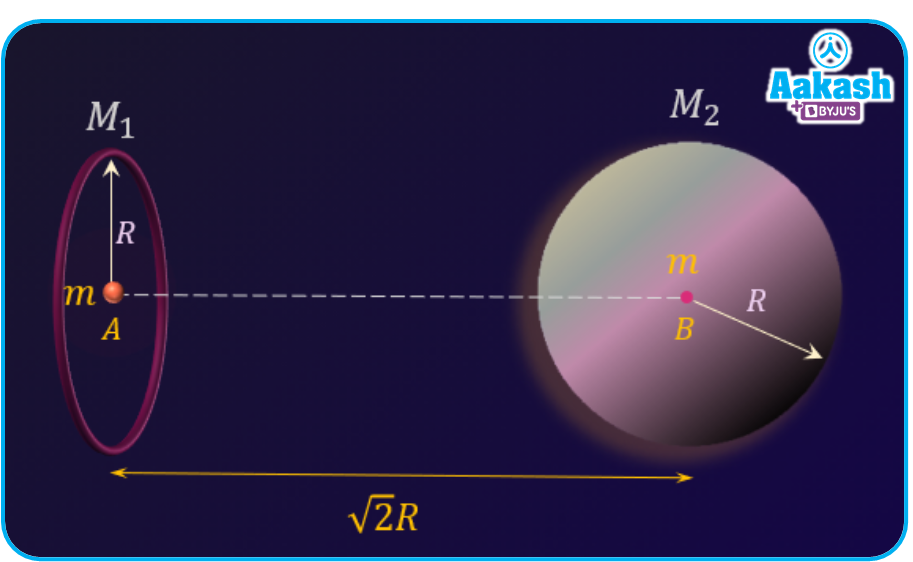
Answer. Since the gravitational potential due to a ring at a distance of x is
And the gravitational potential due to solid sphere at a distance r is
(a) When the point is outside the sphere,
(b) When the point is inside the sphere,
At point A:
The gravitational potential at point A will be the sum of gravitational potential due to ring and due to the sphere at A.
At point B:
The gravitational potential at point B will be the sum of gravitational potential due to ring and due to the sphere at B.
The change in gravitational potential between points A and B can be written as,
Where is the change in gravitational potential energy of the mass m.
Also the change in gravitational potential energy is the negative work done by the gravitational field. If the gravitational potential energy is denoted by Wg then,
Substituting the values of VA and VB from equation (i) and (ii) in the above equation,
Q4. Find the gravitational potential at a point present at a distance of 150 cm from a solid sphere of mass 2 kg and radius 20 cm.
A. Given, the mass of the solid sphere, M=2 kg
Radius of the sphere, R=20 cm
If the distance of the point is denoted by r then,
r=150 cm
As we can see that, r>R
Then the gravitation potential due to solid sphere at a distance r outside the sphere is given by,
G= Gravitational constant
FAQs
Q1. What is the gravitational field?
Answer. Gravitational field is the region in which the effect of gravitational force can be observed. We know that every object in the universe is attracting each other hence every object has its gravitational field. The field can be represented by lines directed toward the object due to which the gravitational field is created.
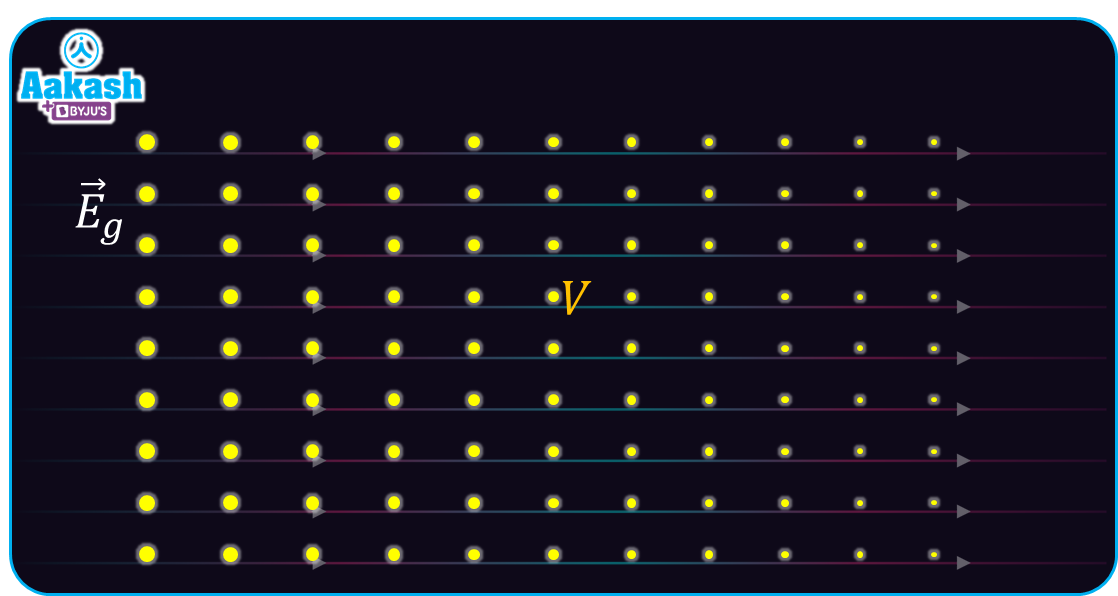
Q. 2If the gravitational field direction is shown from left to right then how the gravitational potential would change in that direction?
Answer. If the gravitational field is directed from left to right, it means that the gravitational mass that is producing the gravitational field is on the right side. Therefore if we move towards the mass, the distance will decrease hence the gravitational potential will decrease in that direction.
Q3. Which continuous mass system causes a constant gravitational potential inside and at the surface, uniform spherical shell, uniform ring or uniform solid sphere?
Answer. Among uniform spherical shells, uniform rings or uniform solid spheres, the uniform spherical shells have a constant gravitational potential inside and at the surface of it. The gravitational potential due to a spherical shell at the surface and inside the shell is inversely proportional to the radius of the shell.
Q4. Define gravitational field intensity.
Answer. The gravitational field intensity is the mathematical entity to measure the strength of the gravitational field. It is directly proportional to the gravitational force within the field. Since the gravitational force is a variable and it increases when the distance between the objects decreases. Therefore as the distance between the objects decreases, the gravitational field intensity increases.

 Call Now
 Let's Chat
 Share
Share