-
Call Now
1800-102-2727


Galvanometer – A Device to Detect Electric Current

Imagine you're in a physics lab, experimenting with measuring the current flowing through a circuit. To accurately measure the current, you need a device that can detect and quantify it. The device that allows you to do that is called a galvanometer.
Table of Contents:
- What is a Galvanometer?
- What is a Moving Coil Galvanometer?
- Construction and Diagram of Moving Coil Galvanometer
- Sensitivity of Moving Coil Galvanometer
- Conversion of Galvanometer to Ammeter
- Conversion of Galvanometer to Voltmeter
What is a Galvanometer?
A galvanometer is a device that is used to detect a small electric current or measure its magnitude. The current and its intensity are usually indicated by a magnetic needle’s movement or that of a coil in a magnetic field, which is an important part of a galvanometer.
What is a Moving Coil Galvanometer?
A moving coil galvanometer is a type of galvanometer that consists of a rectangular coil of wire placed in a uniform radial magnetic field. The coil is free to rotate about a fixed axis and is connected to a circuit that carries the current to be measured. A spring or a strip is attached to the coil to provide a restoring torque and an electrical contact. A pointer or a mirror is attached to the coil to indicate the deflection or rotation of the coil.
The moving coil galvanometer works on the principle that the deflection or rotation angle is proportional to the current in the coil. This can be expressed by the formula:

where ‘I’ is the current in the coil, ‘k’ is the spring or strip constant, ‘θ’ is the deflection or rotation angle, ‘n’ is the number of turns in the coil, ‘B’ is the magnetic field strength, and ‘A’ is the area of the coil.
The moving coil galvanometer can be used to measure small currents, as it has a high sensitivity and a low resistance. It can also be converted into an ammeter or voltmeter using suitable shunts or multipliers.
Construction and Diagram of Moving Coil Galvanometer
The diagram of the moving coil galvanometer is shown below:
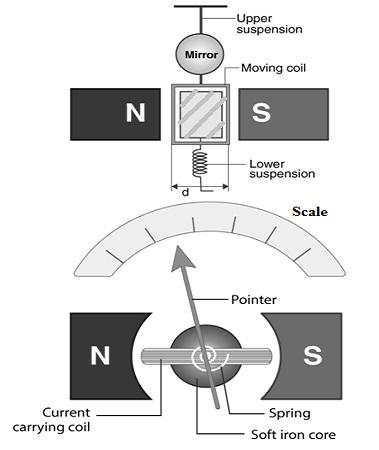
The construction of this galvanometer is as follows:
- The moving coil galvanometer consists of a rectangular wire coil with many turns and is usually made of thinly insulated or fine copper wire. The coil is wound on a metallic frame and is free to rotate about a fixed axis.
- The coil is suspended in a uniform radial magnetic field that is produced by a permanent magnet or an electromagnet. A cylindrical soft iron core is symmetrically positioned inside the coil to improve the strength of the magnetic field and to make the field radial.
- The lower part of the coil is attached to a phosphor-bronze spring that has a small number of turns. The other end of the spring is connected to a binding screw. The spring serves two purposes: it provides a restoring torque that balances the magnetic torque and hence produces a steady angular deflection, and it provides an electrical contact for the current to enter or leave the coil.
- The upper part of the coil is attached to a phosphor-bronze strip that is connected to a movable torsion head. The strip also serves two purposes: it provides another electrical contact for the current to enter or leave the coil, and it allows the adjustment of the initial position of the coil by rotating the torsion head.
- A plane mirror and a lamp, and a scale arrangement are attached to the suspension wire. The mirror reflects a beam of light onto a distant scale, which helps in measuring the deflection of the coil with high accuracy and without parallax error.
- A pointer may also be attached to the coil, which indicates the deflection on a nearby scale.
Working Principle of the Moving Coil Galvanometer
The working principle of a moving coil galvanometer can be explained as follows:
- When a current flows through the coil, it experiences a magnetic force due to the magnetic field. The force acts perpendicular to both the direction of the current and the direction of the magnetic field.
- The force causes a torque on the coil, which makes it rotate about its axis. The torque is given by:

where ‘τ’ is the torque, n is the number of turns in the coil, ‘I’ is the current in the coil, ‘A’ is the area of the coil, ‘B’ is the magnetic field strength, and ‘θ’ is the angle between the plane of the coil and the direction of the magnetic field.
- Since the magnetic field is radial, θ changes as the coil rotates. However, if we assume that θ is small, we can approximate sin θ by θ itself. Thus, we get-

- The spring or strip attached to the coil produces a counter torque that opposes the rotation of the coil. The counter torque is given by:

where  ' is the counter torque and ‘k’ is the spring or strip constant.
- When the coil reaches an equilibrium position, where it stops rotating, its net torque becomes zero. Thus, we have:

Or,

- Solving the above equation, we will get:

This shows that:

- The pointer or mirror attached to the coil indicates the value of θ on a scale. Thus, by knowing the values of k, n, B, and A, we can measure the value of I.
Sensitivity of Moving Coil Galvanometer
The sensitivity of a moving coil galvanometer is defined as the deflection angle's ratio to the coil's current. It measures how much the coil deflects for a given current. Mathematically, it can be expressed as follows:

where S is the sensitivity, θ is the deflection angle, and I is the current in the coil.
Using the formula for ‘I’ derived earlier, we can write:

This shows that S is proportional to n, B, and A and inversely proportional to k.
Therefore, to increase the sensitivity of the moving coil galvanometer, we can:
- Increase the number of turns in the coil
- Increase the strength of the magnetic field
- Increase the area of the coil
- Decrease the spring or strip constant
Conversion of the Galvanometer to Ammeter
An ammeter is an instrument that measures electric current in a circuit. To convert a galvanometer into an ammeter, we need to connect a low resistance called a shunt in parallel with it. The shunt allows most of the current to bypass the galvanometer and only a small fraction of the current to pass through it. This prevents the galvanometer from being overloaded or damaged by high currents.
The diagram of a galvanometer converted into an ammeter is shown below:
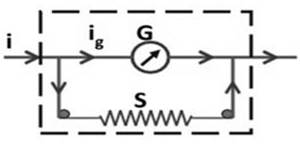
To calculate the value of the shunt resistance, we can use the following formula:

where S is the shunt resistance, G is the galvanometer resistance, ig is the galvanometer current, i is the current in the ammeter, and it is the shunt current.
Conversion of Galvanometer to Voltmeter
A voltmeter is an instrument that measures the electric potential difference or voltage across two points in a circuit. To convert a galvanometer into a voltmeter, we need to connect a high resistance called a multiplier in series with it. The multiplier increases the resistance of the galvanometer and reduces the current flowing through it. This allows the galvanometer to measure high voltages without being affected by them.
The diagram of a galvanometer converted into a voltmeter is shown below:
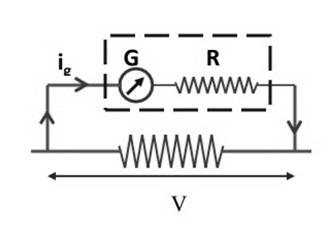
To calculate the value of the multiplier resistance, we can use the following formula:

where M is the multiplier resistance, V is the full-scale deflection voltage of the voltmeter, G is the galvanometer resistance, and ig is the full-scale deflection current of the galvanometer.
Solved Problem
Q1. A moving coil galvanometer of resistance 100Ω is used as an ammeter using a resistance of 0.1Ω. The maximum deflection current in the galvanometer is 100μA. Find the current in the circuit so that the ammeter shows maximum deflection. (IIT JEE 2005)
Solution:
It is given that G = 100Ω, S = 0.1Ω, ig = 100μA
We know that,

Arranging the equation further:

Putting the values in the equation:
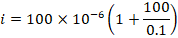
Solving, we get:

Practice Problem
Q1. A galvanometer coil of 30Ω resistance shows full range deflection for a current of 5mA. What will be the voltage displayed on the voltmeter if the multimeter resistance is given as 36.667Ω?
Frequently Asked Questions
Q1. What is a galvanometer used for?
Answer: A galvanometer is a device that is used to detect a small electric current or measure its magnitude.
Q2. What are the different types of galvanometers?
Answer: One type of galvanometer is the moving coil galvanometer. Other than that, there is the tangent galvanometer, astatic galvanometer, mirror galvanometer, ballistic galvanometer, etc.
Q3. What is the difference between a galvanometer and a galvanoscope?
Answer: A galvanometer is an instrument that can measure the magnitude of a small electric current by indicating the deflection of a magnetic needle or a coil in a magnetic field. A galvanoscope is an instrument that can only detect the presence or absence of a small electric current by showing whether the magnetic needle or coil moves or not. A galvanoscope is a simpler and less sensitive version of a galvanometer.

NEET Related Links
JEE MAIN Related Links
JEE Advanced Related Links
JEE Advanced Eligibility Criteria
JEE Advanced Chemistry Syllabus
JEE Advanced Registration Dates
CUET Related Links
Important Topics
Anemometer : Measurement of Wind Speed
Angular Acceleration Atomic Theory Audible and Inaudible Sound Average Speed and Average Velocity Average Velocity Avogadros Number Avogadros Hypothesis Azimuthal Quantum Number Balanced Force Bar Magnet Biconvex Lens Boyles Law Buoyancy Calorimeter Carnot Engine Celestial Bodies Centripetal And Centrifugal Force Concave and Convex Lenses Concave Convex Mirrors Contact and Non Contact Force Controlled Thermonuclear Fusion Convection Currents Convex Lens Convex Mirror Destructive Interference Difference Between Conduction Convection and Radiation Difference Between Electric Field and Magnetic Field Difference Between Heat And Temperature Difference Between Series And Parallel Circuits Differences Between Acceleration And Velocity Distance and Displacement Distance Time Graph Electrical Force : Electric Forces and Their Types Electromagnetic Waves : Definition, Equation and Properties of Electromagnetic Waves Electromagnetism Electron Spin Fluid Flow : Bernoullis Equation Derivation and Fluid Mechanics Fluid Friction : Types and Factors of Fluid Friction Frames of Reference : Inertial and Non- Inertial Frame of Reference Frequency and Wavelength Frictional Force Importance of Hydrosphere Instantaneous Speed and Velocity Introduction to Motion Kinetic and Potential Energy Difference Law Of Conservation of Energy Layers of the Earth Light Energy Light Sources List of physics scientists and Their inventionsLoudness of Sound
Magnetic Dipole Moment Magnetic Field Non - Contact Force Non - Renewable Energy Ohms Law Optics P Wave Physics Symbols Plane Mirrors Poissons Ratio Projectile Motion Properties of Water : Anomalous Expansion of Water Radius of Gyration Reflection of Light Reflection of Waves Relative Density Resonance Reverberation Rolling Friction Rotation and Revolution Screw Gauge Semiconductors and Insulators Sliding Friction Speed Time Graphs Static Friction Stefan Boltzmann Law Stress Tension Tension Force Thermometer: Clinical Laboratory Thermometer Types of Rocks Types of Waves Uniform Motion and Non Uniform Motion Unit of Voltage Uses of Convex Lens Uses Of Convex Mirror Uses of Electromagnet Uses of Optical Fibre Wave Wavelength of Light What is Scattering of Light Working of Electric Bell Conventional and Non-conventional Sources of Energy Buoyant Force Bulk Modulus of Elasticity Bernoulli’s Principle Angular Momentum Difference Between Speed And Velocity ForceUnit of Heat
Difference between Distance and Displacement Simple Microscope Derivation Of Equation Of Motion Thermometer: Clinical & Laboratory Thermometer Difference between Concave and Convex LensDerivation Of Lens Maker Formula
Unit Of Pressure Velocity Uses of Plane Mirror
Wave Theory of Light
Unit of Density Unit of Light Unit of Force Unit of Magnetic Field Unit of wavelength Unit of Viscosity Uses of Electroplating Young's Modulus
What is the Scattering of Light
Lenz Law Space Wave Propagation Schrodinger Wave Equation Relation between Fahrenheit and Celsius Refractive Index Potentiometer Working Pascal Law Oscillatory Motion Optical Instruments Newton's Laws of Motion - First Law Modulation and Demodulation Magnetic Flux Lens Formula and Magnification Kaleidoscope Faradays Law Epsilon Naught Value Energy Bands Electrostatics Electroscope AC Generator Unit of Current Lithosphere Bending Equation Derivation Difference Between Pound and Kilogram Semiconductor Devices OTEC - Ocean Thermal Energy Conversion Hall Effect Rectilinear Propagation of Light Difference Between Ammeter and Voltmeter Coefficient of Linear Expansion Ampere’s Law Cyclone and Thunderstorm Save The Environment From Pollution Particle Nature of Light Types of DC Motor Uses Of Transistor Derivation of Phase Rule Unit of Humidity

 Call Now
 Let's Chat
 Share
Share