-
Call Now
1800-102-2727


Free Energy and Work Function

Energy is neither created nor destroyed. This law of thermodynamics keeps us wondering about all the energy present around us. The concepts of free energy and work function hold a special place in Physics. They offer a profound understanding of energy transfer and utilisation, helping us unravel the mysteries of our universe. Learn about the concept in detail below.
Table of Contents
What is Free Energy?
The energy existing in a system that can be used to complete productive tasks is known as free energy. It is represented using the symbol "G" and calculated as the sum of the system's internal energy (U), entropy (S), and temperature (T).

Free energy is a vital concept in thermodynamics since it informs us about the spontaneity and feasibility of chemical reactions and processes. It helps determine whether an action may occur naturally or an energy input is needed.
Work Function: Explained
The minimal amount of energy needed to remove an electron from a substance's surface is represented by the work function, represented by the symbol " (phi). The energy barrier electrons must cross to break out from the substance's surface is shown.
The type of the material, its surface characteristics, and the frequency of the incident light are some of the factors that affect the work function in tests for the photoelectric effect. Typically, it is measured in electron volts (eV).
The type of the material, its surface characteristics, and, in the case of the photoelectric effect, the frequency of incident light all affect a material's work function. Keep the following in mind as you explore the idea of work function:
Material Properties: Different materials perform various job activities because of electrical structure and bonding variations. In general, metals have low work functions, which makes them efficient in emitting electrons. Conversely, semiconductors and insulators generally have greater work functions, requiring more power to emit electrons.
Surface Effects: The surface work function of a material may differ from its bulk value due to surface contamination, foreign chemical adsorption, or surface roughness. These surface effects can impact the ease with which electrons are released from the substance.
Photoelectric Effect: Understanding the photoelectric effect, which happens when electrons are ejected from a substance's surface when exposed to light, depends critically on the work function. The photoelectric effect cannot happen unless the energy of the incident photons is greater than the work function. Light with a shorter wavelength and a higher frequency has more energy, thus more likely to cause electron emission.
Threshold Frequency: The threshold frequency is the lowest wavelength of light needed for the photoelectric effect to release electrons from a material's surface. A greater work function necessitates a higher threshold frequency for electron emission. The threshold frequency is related to the work function.
Electron Emission Mechanisms: Understanding the work function is necessary to comprehend various electron emission mechanisms, including thermionic and field emissions. Thermal energy is sufficient for electrons to overcome the work function in thermionic emission. Still, a strong electric field must be introduced in field emission to reduce the effective work function for electron emission.
Applications and Examples
Photoelectric Devices: The work function is crucial in producing photoelectric devices such as photodiodes, photovoltaic cells, and image sensors. These devices use the photoelectric effect, which transforms light energy into electrical energy. The work function specifies the least energy needed for electron emission, enabling the effective conversion of light into electric current.
Semiconductor Technology: The operation of semiconductor devices is significantly impacted by differences in work function between materials. By carefully choosing materials with precise work functions, engineers may create energy barriers and regulate the flow of electrons in transistors, diodes, and integrated circuits. This is the basis for contemporary electronics and enables the precise control of electric currents.
Solved Examples
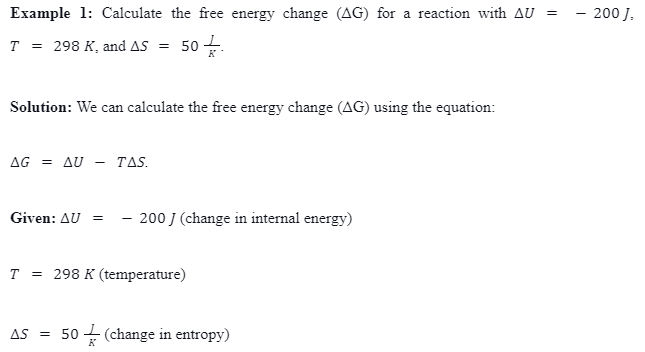
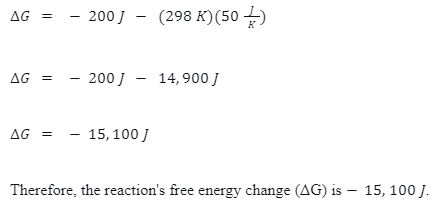
Explanation: In this example, we used the equation ΔG = ΔU - TΔS to calculate the free energy change.
We substituted the given values of ΔU, T, and ΔS into the equation and performed the necessary calculations to obtain the result.
The negative value of ΔG indicates that the reaction is spontaneous, as the free energy decreases during the reaction.
Example 2: A metal surface has a work function of 4 eV. Determine the minimum frequency of light required to liberate electrons from the surface.
Solution: We can use the equation E = hf,
Where E is the energy (work function) and h is Planck's constant,
To determine the minimum frequency of light required.
Given: Work function = 4 eV
Converting electron volts (eV) to joules (J):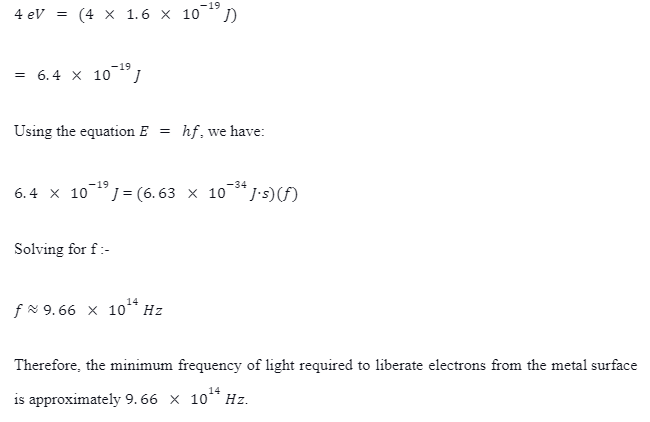
Explanation: In this example, we used the equation E = hf to calculate the minimum frequency of light required.
We first converted the work function from electron volts to joules.
Then, we substituted the values into the equation and solved for the frequency (f).
The obtained frequency represents the minimum frequency of light needed to overcome the work function and liberate electrons from the metal surface.
Example 3: A system absorbs 500 J of heat and performs 300 J of work in a thermodynamic process. Calculate the change in free energy (ΔG) for this process.
Solution: The change in free energy (ΔG) can be calculated using the equation:
ΔG = ΔU - TΔS.
In this case, we must find the change in internal energy (ΔU) and entropy (ΔS).
Given: Heat absorbed (Q) = 500 J
Work done (W) = 300 J
ΔU = Q - W
ΔU = 500 J - 300 J
ΔU = 200 J
Since the process involves no change in entropy (ΔS = 0), we can omit the term TΔS.
Therefore, the change in free energy (ΔG) for this process equals the change in internal energy (ΔU), which is 200 J.
Explanation: In this example, we used the equation: ΔG = ΔU - TΔS to calculate the change in free energy.
We first determined the change in internal energy (ΔU) by subtracting the work done (W) from the heat absorbed (Q).
Since there is no change in entropy (ΔS = 0), the term TΔS was omitted from the equation.
The resulting change in internal energy (ΔU) represents the change in free energy (ΔG) for this process, which is 200 J.
Did You Know?
Did you know how a function behaves can be used to classify it? Unlike some, known as one-to-one functions, which can only produce one output from each input, many-to-one functions can generate several outputs from a single set of inputs.
Did you know that composite functions allow you to combine multiple functions into a single function? By adding the result of one function to the output of another, composite functions offer a powerful tool for examining intricate interactions between variables.
Did you know that functions may be expressed graphically? Graphs show how the behaviour of functions changes concerning the input and how the output changes visually. Information on symmetry, intercepts, and the general shape of functions are included in the graphical representations.
Practice Problems
Q1. What is the value of f(x) = 3x + 2 when x = 4?
a) 10
b) 14
c) 16
d) 20
Answer: b) 14
Explanation: To find the value of f(x), we substitute x = 4 into the given function:
f(4) = 3(4) + 2 = 12 + 2 = 14
Q2. Find its roots in the quadratic equation f(x) = x² - 5x + 6.
a) x = 2, x = 3
b) x = -2, x = -3
c) x = 2, x = -3
d) x = -2, x = 3
Answer: a) x = 2, x = 3
Explanation: To solve the quadratic equation, we factorise it:
f(x) = (x - 2)(x - 3) = 0
Setting each factor equal to zero:
x - 2 = 0 --> x = 2
x - 3 = 0 --> x = 3
Q3. Evaluate f(x) = 5x when x = 2.
a) 10
b) 15
c) 20
d) 25
Answer: d) 25
Explanation: To evaluate the exponential function,
Substitute x = 2 into the given function:
f(2) = 52 = 25
Frequently Asked Questions:
Q1. Who gave the concept for functions?
Answer: The concept of functions was introduced in classical Greece by the mathematician Euclid, who also invented the concepts of magnitudes and ratios.
Q2. Can functions support multiple inputs and outputs?
Answer: Multivariable or vector-valued functions are extensively employed in physics, engineering, and computer science because they accept a large number of inputs and produce a big number of outputs.
Q3. Should all values for functions have to be numerical?
Answer: Other mathematical objects besides numerical values can also be operated on by functions. For instance, functions can work on strings, arrays, and other data structures in programming and translate sets to sets in set theory.

 Call Now
 Let's Chat
 Share
Share