-
Call Now
1800-102-2727


Frames of Reference - Definition, Examples, Types, Practice problems, FAQs

Megha goes to drop her mother Neha at the train station. Her mother sits in the train and Megha sits on a bench in the platform and observes her mother. The train starts to move slowly. Now if one were to ask Megha if Neha is at rest or motion, her obvious answer would be- yes, she is moving. On the other hand, a passenger sitting inside the train would say that Neha is at rest. To solve this discrepancy, one must understand the concept of frame of reference. When observed from Megha’s frame of reference, Neha is in motion. However, when observed from the passenger’s frame of reference, Neha is at rest. It is appropriate to say that everything in this universe moves relative with respect to something or the other. For instance, Neha is at rest when we compare the relative motion of the passenger and Neha. On the other hand, when we compare the motion of Neha and Megha, Neha is said to be in motion. It all depends on the frame of reference. So what exactly is the frame of reference, and how to define it?
Table of contents
- Definition of Frame of Reference
- Inertial frame of reference
- Non inertial frame of reference
- Practice problems
- FAQs
Definition of Frame of Reference
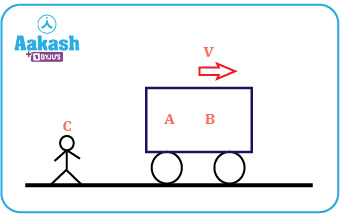
In physics, a frame of reference is a coordinate system and a set of reference points which are needed to specify certain parameters like velocity, distance and acceleration. Consider the following example where a trolley is moving with a constant velocity v to the right. With respect to an observer C , the trolley is in motion. On the other hand, with respect to point A on the trolley, point B is at rest.
Inertial frame of reference
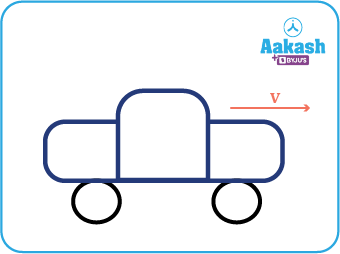
An inertial frame is one in which Newton’s laws are valid. Consider the following example where a truck is moving with a constant velocity v without accelerating. Now if there is a passenger in this truck, they would also move with the same speed. By Newton’s first law, the truck would continue to move with the same velocity unless it is acted upon by an external force.
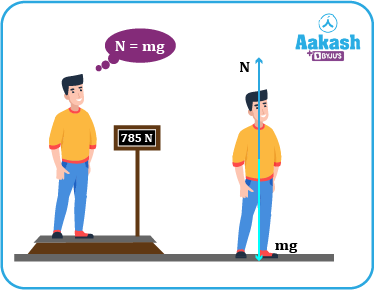
Consider another example where a weighing machine is kept on the ground and a man of mass let’s say 78.5 kg standing on it. When the machine is not accelerating (in the vertical direction), the normal reaction N is balanced by his weight mg. Hence the machine shows a reading of 785 N. (g=10 ms-2)
N=mg=785 N--(i)
The effective acceleration the man is feeling,
Non inertial frame of reference
A non-inertial frame is one in which Newton’s laws are not obeyed– they rotate or accelerate. Consider the example of a passenger seated in a bus which is uniformly accelerating in the rightward direction. A pseudo force equal to ma acts on the passenger (m- mass of the passenger, a-acceleration). If one were to say the earth is an inertial frame of reference, the moon would be a non-inertial frame since it is accelerating with respect to earth (centripetal acceleration).
Consider a man of mass m standing inside an elevator that is accelerating upward with an acceleration a. The normal reaction N exerted by the elevator also acts upwards. The net force can be written as,
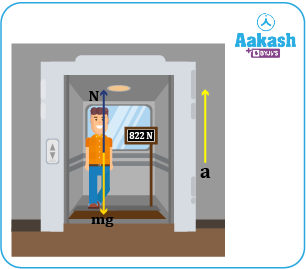
N-mg=ma
N=ma+mg=m(g+a)--(i)
The effective acceleration the man is feeling,
Now if the same elevator is moving downward with an acceleration a, the net force acting on the man can be written as,
mg-N=ma
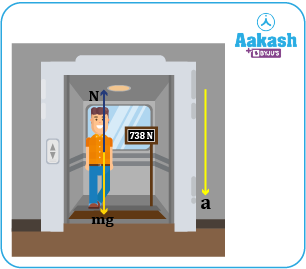
N=mg-ma=m(g-a)--(ii)
The effective acceleration the man is feeling,
Video explanation
https://www.youtube.com/watch?v=B62rxASXxb0&t=3s
Practice problems
Q. A man weighs 80 kg. He stands on a weighing machine in a lift that is moving upwards with an acceleration of 5 ms-2. What would be the reading on the machine? (g=10 ms-2)
(a) zero (b) 400 N (c) 800 N (d) 1200 N
A. d
Given, m=80 kg.
When the lift is accelerating upwards,
Q. A woman of mass 50 kg stands on a weighing machine in an elevator that is going downwards with an acceleration of 2 ms-2. The reading on the weighing machine would be?
(a)zero (b)400 N (c) 800 N (d)1200 N
A. b
Given, m=50 kg.
When the lift is accelerating downwards,
Q. The figure shows a pendulum suspended from the roof of a truck that has a constant acceleration a relative to the ground. Find the deflection of the pendulum from the vertical as observed from the ground frame and from the frame attached with the truck.
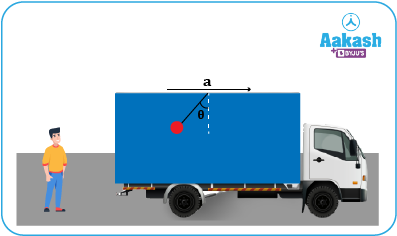
(a) (b) (c) (d)
A. a
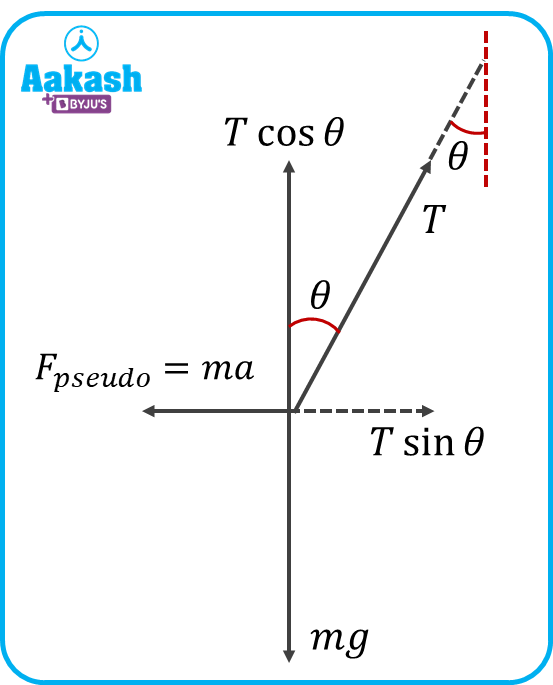
Resolving the tension in the string T into horizontal and vertical components, we get
Tsin=ma--(iii)
Tcos=mg---(iv)
ma is the pseudo force acting towards the left.
Dividing equation (iii) by (iv), we get
Q. A block of mass n is placed in contact with a truck. The coefficient of static friction between the truck and the mass is . The acceleration of the truck for which the block does not fall would be
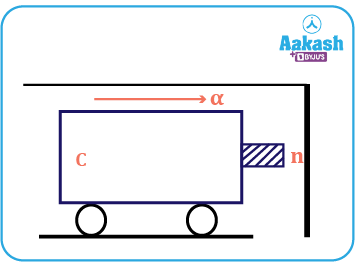
(a) (b) >(c) (d)
A. c
Let fs indicate the static frictional force. Then, max friction, The normal force N is equal to the pseudo force n .
The block will not slide and leave the cart if this frictional force is balanced by its weight ng.
FAQs
Q. What is another word for frame of reference?
A. Another term for frame of reference would be framework or co-ordinate system.
Q. What is the importance of frame of reference?
A. A frame of reference helps to understand the motion better from every observer’s perspective. It helps to uniquely fix the coordinate system for measurement and also to standardize the measurements done in the frame under consideration.
Q. What are the three frames of reference?
A. Relative frame of reference, intrinsic frame of reference, absolute frame of reference are the three types of frames of reference.
In a relative frame of reference the location of a body is expressed with respect to the position of another body and its motion.
In an intrinsic frame of reference where the location of the object is defined as a relation to another body’s orientation.
In an absolute frame of reference the location of a body is defined as in relation to any arbitrary fixed object.
Q. How does a frame of reference help an observer detect motion?|
A. An observer standing still, in his own frame of reference would find a tree to be at rest. But a passenger sitting in the bus in motion will find the objects outside the bus moving in the opposite direction, though they are at rest from the viewpoint of the former one.

 Call Now
 Let's Chat
 Share
Share