-
Call Now
1800-102-2727


Fundamental forces in nature, comparison of forces, unification of forces, practice problems, FAQs

We all have an intuitive notion of force. Although we often conceive of force as push, carry or throw objects, deform or break them, the correct notion of force was given by Isaac Newton in his famous laws of motion. There are four universal or fundamental forces in nature and without these fundamental forces, all the matter in the universe would fall apart and float away.
Table of contents:
- Four fundamental forces in nature
- Comparison of forces
- Unification of forces
- Practice problems
- FAQs
Four fundamental forces in nature
- Gravitational force
- Electromagnetic force
- Strong nuclear force
- Weak nuclear force
Gravitational force
It is a force that exists by virtue of the masses between two bodies. This force of attraction between two point masses is , where m1 and m2 are the masses of the given point masses and r is the distance between them. G is a universal constant having the value .The gravitational force is surprisingly weak, it is only because gravity is always attractive that we notice it at all.

Gravity is responsible for the sun, planets, stars, galaxies and moon revolving in their respective orbits. Since it is a long range force, gravity can act over infinite distances.
- Gravity was conceived by Isaac Newton as a pull between two objects that was directly related to their masses and inversely related to the square of the distance separating them.
- Albert Einstein realised that gravity and laws of motion by Newton doesn't apply to objects travelling at huge speeds, like that of speed of light or in high gravity.
- Gravity was explained by Albert Einstein using the Theory of General Relativity. It imagines that gravity is generated when matter distorts space, like a heavy object would stretch a rubber sheet. Objects with smaller mass then 'roll' downwards, towards the large mass objects.
- When we apply gravity at the atomic level, it has a very negligible effect (due to small masses of subatomic particles) but gravity becomes more powerful when we consider massive objects like earth, stars, galaxies etc.
Properties of gravitational force:
- Gravitational force is always attractive i.e. it consistently tries to pull masses together.
- The force is proportional to the product of two masses and inversely proportional to the square of distance between them.
- It is a conservative force.
- It exists between objects at large distances such as at interplanetary distance and for interatomic distances as well.
- The force does not depend upon the participating medium between the two masses.
- The force is responsible for the motion of the planets in elliptical orbits.
- The force is the weakest of the four fundamental forces.
Electromagnetic force
The force due to the magnetic field and electric field is known as electromagnetic force.
The force consists of an electric force that generates between the stationary charged particles and magnetic force due to the moving charged particles.
All of the contact forces that we study in mechanics are electromagnetic in nature.
Electromagnetic force is the force between charged particles. What makes a comb get charged when someone brushes his hair? Why are the subatomic particles held together? Because… Electromagnetic forces!
The study of electromagnetic force existing between electrically charged particles is known as electromagnetism.

- Comb getting charged.
2. Pieces of paper getting stuck to the charged comb.
Charles Coulomb explained the force between the electrically charged objects as directly proportional to the magnitude of the charges on the objects and inversely proportional to the square of the distances between them. Like gravity, electromagnetism is also long range. If two particles having charges q1 and q2 placed at a separation r are at rest with respect to the observer, the force between them has a magnitude
Hans Christian Oersted, Michael Faraday, James Clerk Maxwell, Dutchman Hendrik Lorentz etc are few notable physicists who made significant contributions to the field.
Properties of electromagnetic force:
- Electromagnetic force can be attractive or repulsive.
- Chemical processes occurring due to the interaction of electrons are governed by electromagnetic force.
- The force is conservative in nature.
- Similar to the gravitational force, electromagnetic force is central in nature.
- The range of the force is infinite.
- The electromagnetic force similar to the gravitational force obeys inverse square law.
- The force has many applications from small microchips to life saving devices like radiotherapy.
- Everyday use devices like speakers, television, radios etc use the principle of electromagnetism.
- The electromagnetic force is best described using the Lorentz force.
- Light itself is an electromagnetic wave.
- Strong nuclear force
- The positively charged protons and neutral neutrons constitute the nucleus of an atom. We also know that gravity does not have much role on the subatomic level, so there must be some other force that exists within the nucleus that has more strength than gravity and electromagnetism.
- The force holding the nucleus together is called the strong nuclear force.
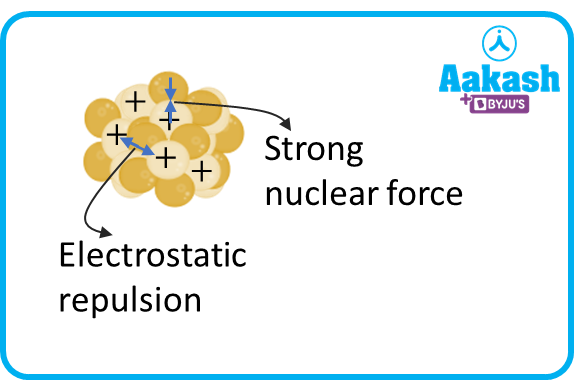
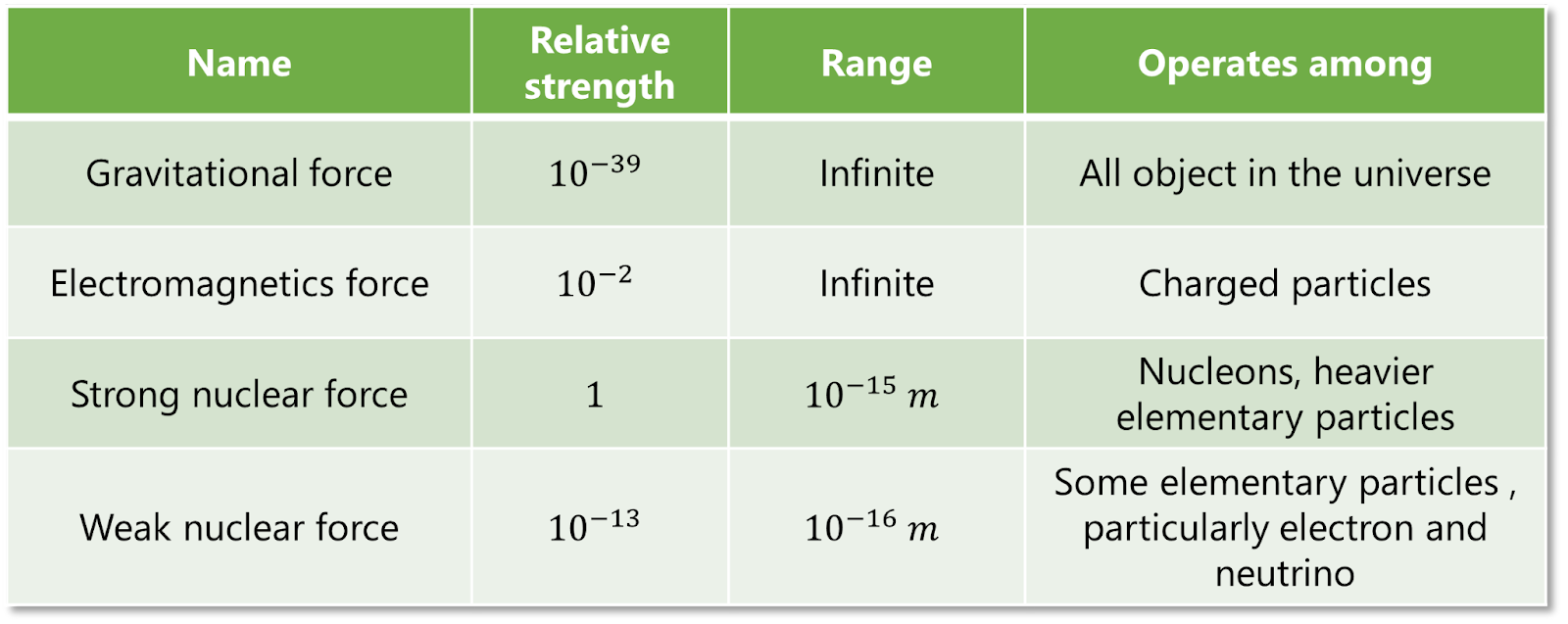
- The strong nuclear force is about 100 times the electromagnetic force in strength and is the strongest of all fundamental forces.
- Its range is, however, extremely small, of about nuclear dimensions (10-15 m). The stability of nuclei is possible due to this force.
- In 1935, this force was modelled by Hideki Yukawa who proposed that proton interactions with each other and also with neutrons, exchanged a particle known as a meson which was later called a pion, that transmits the strong force.
- Weak nuclear force

- The weak nuclear force appears only in certain nuclear processes such as the β-decay (the nucleus emits an electron and an uncharged particle called a neutrino) of a nucleus.
- The weak nuclear force is much weaker than the strong nuclear and electromagnetic forces. It is not as weak as the gravitational force.
- Its range is extremely small of the order of 10-16 m.
- The force is responsible for the formation of deuterons due to the fusion of neutrons and protons.
- The force is non conservative.
- The force is non central.
- The force is neither attractive nor repulsive.
- The mediating particles involved in weak nuclear forces are bosons.
Comparison of forces
Unification of forces
Whether the four fundamental forces are manifestations of just a single great force of the universe continues to remain the unsettled question about the four fundamental forces. If they are, then each one of them should be able to integrate with others and there exists some evidence that it might be possible.
- In 1979, physicists Sheldon Glashow, Abdul Salam and Steve Weinberg suggested that the weak nuclear force and electromagnetic force might combine at higher energies in what would be called the electroweak force.
- In 1984, Carlo Rubia and Simon Vander Meer experimentally verified the predictions of the theory of electroweak force.
- Physicists found it difficult to merge the microscopic world with the macroscopic one. At substantially astronomical scales, gravity dominates, which is best described by Einstein's Theory of general relativity. But at molecular, atomic or subatomic scales, quantum mechanics best describes the natural world. So far, no one has been able to come up with a better way to merge those two worlds.
What do you think would happen if someone could show us that four fundamental forces truly came from one unified force? Is that gonna change our daily life? Presumably not but it will help us to advance our deductions of the nature of forces, origins and fate of the universe.
Practice problems
Q. Two masses 1 kg and 2 kg are separated by a distance of 10 cm. Calculate the gravitational force of attraction between them.
(a)
(b)
(c)
(d)
A. b
Given two masses, m1=1 kg, m2=2 kg, Fg(Gravitational force)=?
Distance, r=0.1 m
Q. Two charged particles are separated by a distance of 20 cm. If the magnitude of the charges is 6 C and 2 C, calculate the coulombic force between them.
A.
Given, value of charges
distance of separation, r=20 cm=0.2 m
Applying Coulomb's force, 
Q. Explain electromagnetic forces.
A. The forces which exist between charged particles are termed electromagnetic forces. Charges at rest and not being accelerated, produce electric lines of force which start from the positive charge and terminate at the negative charge. On the other hand, moving charges produce magnetic fields. They form closed loops which travel from the North to South pole outside the magnet and from the south to north pole inside the magnet.
Q. Which of the following forces is charge independent?
(a)Nuclear force
(b)Tension
(c)Spring force
(d)Electrostatic force
A. a
Nuclear force is the force that is charge independent. The force between the proton and neutron is the same as the force between two protons or two neutrons.
FAQs
Q. Which force is responsible for the existence of the protons in the nucleus of an atom?
Ans. Protons exist in the nucleus of an atom due to a strong attractive nuclear force that binds them with each other.
Q. With reference to four fundamental forces in nature, which one of the following statements is not correct?
- Gravity is the strongest of the four
- Particles with an electric charge only experience electromagnetism.
- The weak nuclear force causes radioactivity
- Strong nuclear force is responsible for holding neutrons and protons inside the nucleus of an atom.
Ans. Option A that says Gravity is the strongest force is not correct; rather it is the weakest of four.
Q. Is there any particular force that is more important than the others or are all equally important?
Ans. All the four fundamental forces are equally important because even with the absence of the weakest force the universe wouldn’t be the same as it is right now. They remain equally important despite having different relative strengths.
Q. Which of the four forces is responsible for radioactive decay?
- the electromagnetic force
- the gravitational force
- the strong nuclear force
- the weak nuclear force
Ans. D
The weak nuclear force is responsible for radioactive decay.
Q. Which is the strongest force of the four fundamental forces?
Ans. The strong nuclear force is the strongest of the four fundamental forces of nature. Fundamental particles are bound together by the strong nuclear force.

 Call Now
 Let's Chat
 Share
Share