-
Call Now
1800-102-2727


Forward Bias in Electronic Circuits Explained

Imagine a scenario where you have a battery and a light bulb. You want the light bulb to glow, but it remains dim or doesn't light up. What could be the reason behind this? The answer lies in the concept of forward biasing. Forward biasing is a crucial phenomenon in electronic circuits that allows current to flow in a desired direction, enabling the proper functioning of electronic devices. In this article, we will delve into the details of forward biasing, its significance, and its applications in NEET, JEE, and the students' studies in classes 11 and 12.
Table of Contents
- What is Forward Bias?
- The Significance of Forward Bias
- Forward Bias in Different Types of Electronic Devices
- Real-Life Examples of Forward Bias
What is Forward Bias?
Forward biasing applies a voltage in a specific direction across a diode or a P-N junction in an electronic circuit. In this configuration, the battery's positive terminal is connected to the p-side (anode) of the diode, and the negative terminal is connected to the n-side (cathode). This arrangement allows most charge carriers (electrons on the n-side and holes on the p-side) to move toward the junction, facilitating the flow of electric current.
When a forward bias voltage is applied, it overcomes the potential barrier at the P-N junction, reducing the width of the depletion region and allowing the current to pass through the diode. The voltage required to be a diode is typically around 0.7 volts for silicon diodes and 0.3 volts for germanium diodes.
The Significance of Forward Bias
Forward biasing is crucial for the proper functioning of various electronic devices. It plays a significant role in enabling the flow of current in specific directions and facilitates the desired operation of these devices. Some key significance of forward biasing are:
Diode Operation: Forward biasing allows diodes to conduct current in a controlled manner. It ensures that the diode functions as an electronic switch, allowing current flow when needed and blocking it in the reverse direction.
Transistor Action: Transistors, fundamental building blocks of electronic circuits, rely on forward biasing to control current flow between different terminals. The current amplification and switching action can be achieved by applying a forward bias to the base-emitter junction of a transistor.
LED Illumination: Light Emitting Diodes (LEDs) operate through forward biasing. When a forward bias voltage is applied, it allows the current to flow through the LED, exciting the electrons and producing light in the process.
Forward Bias in Different Types of Electronic Devices
Forward biasing finds application in various electronic devices. Let's explore some of them:
Diodes: Diodes are semiconductor devices that exhibit the property of allowing current flow in one direction and blocking it in the reverse direction. Forward biasing a diode allows current to flow through it, making it conductive.
Transistors: Transistors, such as Bipolar Junction Transistors (BJTs) and Field-Effect Transistors (FETs), rely on forward biasing to control their operation. These devices can amplify signals or act as switches by appropriately applying a forward bias.
LEDs: Light Emitting Diodes (LEDs) are widely used for illumination. Forward biasing an LED enables the desired current flow, producing light emission.
Real-Life Examples of Forward Bias
Forward biasing is not just a theoretical concept but can be observed daily. Here are a few real-life examples:
Flashlights or torchlights: They use forward biasing to produce light. When the switch is turned on, the battery applies a forward bias to the LED inside the flashlight, allowing current to flow and emitting light.
Solar Cells: Solar cells are the devices that convert sunlight into electricity. They utilize forward biasing to let the generated electric current flow in a desired direction, producing usable electrical energy.
Radios and Televisions: The diodes used in radios and televisions depend on forward biasing to demodulate the radio frequency (RF) signal, which separates the audio or video signals from the carrier wave.
Solved Examples
Example 1: A silicon diode is forward-biased with a voltage of 0.7 V. If the diode has a forward current of 15 mA, what power is dissipated by the diode?
Answer: The power dissipated by the diode can be calculated using the formula:
P = IV, where P is the power, I is the current, and V is the voltage.
Given: A forward bias voltage (V) = 0.7 V
Forward current (I) = 15 mA = 0.015 A
P = IV
P = 0.015 A  0.7 V
0.7 V
P = 0.0105 W or 10.5 mW
Explanation: The power dissipated by the diode is found by multiplying the forward current (I) with the forward bias voltage (V).
In this case, the power dissipated is 10.5 mW.
Example 2: In a transistor circuit, the base-emitter junction is forward biased with a voltage of 0.6 V. If the base current is 50 µA and the transistor's current gain (β) is 80, what is the collector current?
Answer: The collector current (Ic) can be calculated using the formula:
Ic = β Ib, Where β is the current gain, and Ib is the base current.
Given: A forward bias voltage (V) = 0.6 V
Base current (Ib) = 50 µ A = 0.00005 A
Current gain (β) = 80
Ic = β Ib
Ic = 80 0.00005 A
Ic = 0.004 A or 4 mA
Explanation: The collector current (Ic) is obtained by multiplying the base current (Ib) with the current gain (β).
In this case, the collector current is 4 mA.
Example 3: An LED requires a forward bias voltage of 2.5 V and operates at a current of 25 mA. If the power supply provides a voltage of 6 V, what resistor should be connected in series with the LED to limit the current?
Answer: A series resistor should be used to limit the current through the LED.
The resistor value can be calculated using Ohm's Law: 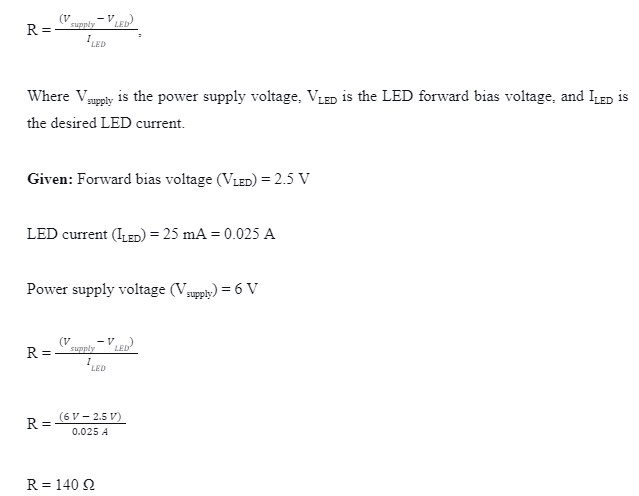
Explanation: The resistor value (R) is calculated by subtracting the LED forward bias voltage (VLED) from the power supply voltage (Vsupply) and dividing it by the desired LED current (ILED). In this case, a resistor of 140 Ω should be connected in series with the LED to limit the current.
Practice Problems
Q1: In a forward-biased silicon diode, if a current of 10 mA flows through the diode, how does the diode dissipate the power? (Assume the diode is ideal and has no resistance when forward-biased).
a) 1 mW
b) 10 mW
c) 100 mW
d) 1 W
Answer: b) 10 mW
Explanation: The power dissipated by a component can be calculated using the formula:
P = IV, where P is the power, I is the current, and V is the voltage.
Since the diode is ideal, it has no resistance and hence no voltage drop.
Therefore, the power dissipated is given by 
Q2: In a transistor circuit, the base-emitter junction is forward-biased with a voltage of 0.6 volts. If the base current is 20 µA, calculate the collector current, assuming a current gain (β) of 100.
a) 2 mA
b) 20 mA
c) 200 mA
d) 2 A
Answer: c) 200 mA
Explanation: The collector current (Ic) can be calculated using the formula:
Ic = β Ib, where β is the current gain, and Ib is the base current.
Substituting the given values,

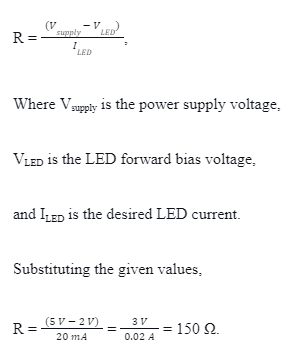
Q3: An LED requires a forward bias voltage of 2 volts and operates at a current of 20 mA. If the power supply provides a voltage of 5 volts, what resistor should be connected in series with the LED to limit the current?
a) 150 Ω
b) 200 Ω
c) 250 Ω
d) 300 Ω
Answer: a) 150 Ω
Explanation: A series resistor should be used to limit the current through the LED.
The resistor value can be calculated using Ohm's Law:
Frequently Asked Questions
Q1. Can a diode be forward-biased and reverse-biased simultaneously?
Answer: No, a diode cannot be forward-biased or reverse-biased simultaneously. The forward biasing and reverse biasing conditions are mutually exclusive.
Q2. What happens if a diode is reverse-biased?
Answer: When a diode is reverse-biased, it blocks the current flow and acts as an insulator. Only a small leakage current, known as reverse saturation current, flows in the reverse direction.
Q3. Why is forward bias voltage typically around 0.7 volts for silicon diodes?
Answer: The energy bandgap of silicon diodes determines the forward bias voltage of 0.7 volts for silicon, which governs the voltage required to overcome the potential barrier at the P-N junction.

 Call Now
 Let's Chat
 Share
Share