-
Call Now
1800-102-2727


Ferromagnetic Materials

There are numerous forms of magnetism, among which ferromagnetism is considered the strongest. Materials classified as ferromagnetic resemble spontaneous net magnetisation at the atomic level, irrespective of the lack of an external magnetic field. When exposed to an external magnetic field, they get intensely magnetised in the direction of the field and get strongly attracted to a magnet.
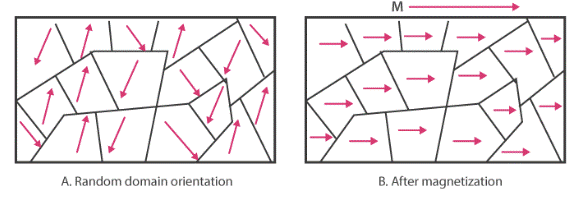
Image: Magnetisation of Ferromagnetic Materials
Table of Contents:
- What is Ferromagnetism?
- Causes of Ferromagnetism
- What are Ferromagnetic Materials?
- Properties of Ferromagnetic Materials
- Applications of Ferromagnetic Materials
- Hysteresis and Curie Temperature
What is Ferromagnetism?
Iron was the first metal known to have attractive properties to magnetic fields, giving rise to Ferromagnetism, derived from ferrous, i.e. Iron. Certain materials like Iron, alloys, cobalt and so on show Ferromagnetism, a unique magnetic behaviour. The materials either acquire attractive powers or permanent magnetism due to this phenomenon. It can also be explained as a method in which electrically uncharged materials strongly attract each other. In addition to a material’s chemical composition, its crystalline and microstructure are among the factors taken when describing its Ferromagnetism.
Causes of Ferromagnetism
Atomic dipoles are aligned in small regions known as domains in a ferromagnetic material in the unmagnetised state. Despite no outside magnetising field, the domains exhibit a net magnetic moment. Although, the magnetic moments of adjacent domains are aligned in opposite directions. As a result, they cancel out, leaving the material with zero net magnetic moments. When an external magnetic field is applied, these domains are oriented in the field’s direction. Thus, a direction parallel to the magnetising field is produced in which the material is strongly magnetised.
What are Ferromagnetic Materials?
The magnetism in ferromagnetic materials is mainly generated by the orientation patterns of their constituent atoms, which tend to act as elementary electromagnets. Because of the magnetic field, ferromagnetic materials typically exhibit or manifest intense magnetism in the field’s direction.
Most ferromagnetic materials comprise metals like nickel, cobalt, ferrous, metallic alloys, and rare earth magnets. Furthermore, ferrous is oxidised to produce an oxide that converts into ferromagnetic material called magnetite. It was recognised as a magnetic material with a curie temperature of 580 degrees. Magnetites are popularly known as the most powerful magnetism material among all other natural minerals on Earth.
Properties of Ferromagnetic Materials
There are various properties of ferromagnetic materials. They include the following:
- It tends to lose ferromagnetic properties because of high temperature when it liquefies.
- Domains of permanent dipole exist in the atoms of ferromagnetic materials.
- Atomic dipoles in the ferromagnetic materials are aligned parallel to the magnetic field’s direction. The magnetic dipole moment is intense and towards the direction of the magnetising field.
- The intensity of magnetisation, denoted by M, is significantly high and positive and alters linearly with the magnetising field denoted by H.
- Saturation relies on the nature of the substance.
- The inside material field is significantly stronger than the magnetic field, and the relative permeability also changes linearly with the magnetic fields and is very large. They possess a tendency to pull a large number of lines of force by the material.
- The field exerts a strong pull on ferromagnetic materials resulting in a non-uniform field. They are inclined to stick on the poles where the field is intense.
- As the field is intense at the poles, the ferromagnetic powder will accumulate at the sides and show depression in the centre if it is placed in a watch glass set on the pole pieces that are sufficiently apart.
Applications of Ferromagnetic Materials
There is a wide range of applications for ferromagnetic materials. They are primarily used in the following:
- Electric motors
- Loudspeakers
- Telephones
- Credit cards
- Generators
- Transformers
Hysteresis and Curie Temperature
Hysteresis:
When the external magnetic field is eliminated, a ferromagnetic material does not fully demagnetise. A magnetic field in the opposite direction should decrease the material’s magnetisation to zero. When the external magnetic field is removed, the property of retaining magnetisation by ferromagnetic material is called hysteresis.
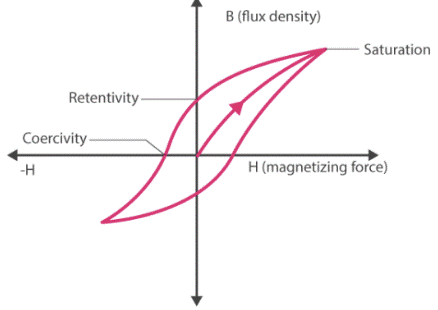
Image: Hysteresis
When the magnetisation of the material is plotted against the external supplied magnetic intensity, denoted as H is calculated as magnetic flux density B will trace out a loop called a hysteresis loop. When magnetising force is reduced to zero, the magnetic flux density remains and is referred to as retentivity. At the same time, coercivity is the intensity of the reverse magnetising field that should act to fully demagnetise the substance or material.
Curie Temperature
Ferromagnetic materials rely on temperature; at high temperatures, ferromagnetic material attains paramagnetic properties. The transition happens at a certain curie temperature, denoted by TC.
Practice Problems
Q1. Choose the non-ferromagnetic material
a. Cobalt
b. Iron
c. Nickel
d. Calcium
Ans. d. Calcium
Calcium is not a ferromagnetic material.
Q2. Ferromagnetic materials can be utilised to form
a. Telephone
b. Transformers
c. Loudspeakers
d. Wood
Ans. d. Wood
Wood is not a ferromagnetic substance. On the other hand, telephones, transformers and loudspeakers are produced by utilising ferromagnetic materials.
Q3. The temperature at which ferromagnetic material becomes paramagnetic is called
a. Transition phase
b. Curie temperature
c. Standard temperature
d. None of the above
Ans: b. Curie temperature
The Curie temperature is when ferromagnetic materials attain paramagnetic characteristics.
Frequently Asked Questions
Q1. State the difference between paramagnetic and ferromagnetic substances.
Answer: Paramagnetic substances are those which are weakly attracted to the magnets. At the same time, ferromagnetic substances attract intensely with magnets.
Q2. What are diamagnetic materials? State one example.
Answer: Materials that are freely magnetised while placing it in a magnetic field are called diamagnetic materials. However, the magnetisation tends to be opposite the magnetic field. For example, NaCl.
Q3. Give 3 examples of ferromagnetic materials.
Answer: The three examples of ferromagnetic materials are as follows:
- Iron (Fe)
- Cobalt (Co)
- Nickel (Ni)
Because of their ability to retain magnetic fields, these materials play an important role in a wide range of technological applications and are essential to the operation of many common devices.

 Call Now
 Let's Chat
 Share
Share