-
Call Now
1800-102-2727


Escape and Orbital Velocity

Have you seen a satellite revolving around the Earth and wondered how it is flying in space? Escape and orbital velocity aid in learning how objects escape and revolve around the planet and how several forces are involved.
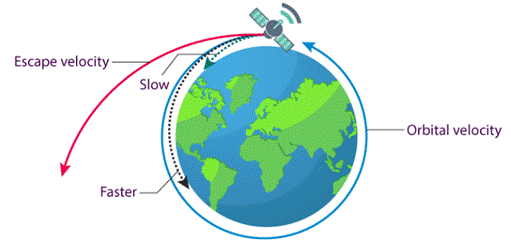
Image: Escape and Orbital Velocity
Table of Contents
- What is Escape Velocity?
- The Formula of Escape Velocity
- Derivation of Escape Velocity
- Unit and Dimensional Formula of Escape Velocity
- What is Orbital Velocity
- The Formula of Orbital Velocity
- Derivation of Orbital Velocity
- Unit and Dimensional Formula of Orbital Velocity
What is Escape Velocity?
The minimal speed at which a mass should be ejected off the Earth's surface to escape the planet's gravitational pull is called escape velocity. It is sometimes also called escape speed.
Definition: The slowest possible velocity at which an object can free itself from the gravitational pull of a massive object is called escape velocity.
For example, consider the earth as an enormous body. The escape velocity is the minimum speed required for an object to acquire to overcome the earth's gravitational pull and continue the motion to infinity without falling back. It completely relies on the object’s proximity to the massive body and its mass. The escape velocity will be enhanced as the mass rises and the distance increases.
The Formula of Escape Velocity
The mathematical formula for escape velocity for any given distance of any massive spherical symmetrical body like stars and planets is expressed as

Where
ve = the escape velocity
G =universal gravitational constant
M = Mass of the massive body from which the object is to be escaped.
R =distance to the object from the centre of the massive body
The formula mentioned above is independent of the object’s mass that is getting away from the massive body.
Derivation of Escape Velocity
In normal escape, velocity is achieved when an object travels at a velocity where the gravitational potential energy and the object's kinetic energy combinedly equate to zero. Therefore, the object must have higher kinetic energy than gravitational energy to escape to infinite space. The easiest way to derive the formula is by utilising the conservation of energy principle.
Suppose an object is trying to move away from a uniformly round planet. The gravitational force is the prime force acting on the object. As we know, only two forms of energy are involved, i.e., kinetic energy, denoted by K and gravitational energy, denoted by Ug.
Using the principle of conservation of energy, we can write

Where  , and
, and

The distance is infinite. Thus Ug is said to be zero. Kf will also be zero due to the final velocity of zero. Therefore, we get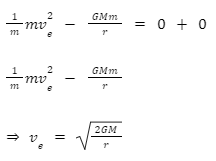
The formula below delivers the minimum velocity required to escape a massive body’s gravitational pull.

Where 
It is known that the Earth’s surface escape velocity is approximately 11.186 kilometres per second. Accordingly, an object has to move with an initial velocity of around 11.186 kilometres per second to escape the Earth's gravitational pull and fly to infinite space.
Unit and Dimensional Formula of Escape Velocity
The escape velocity can be measured in metres per second, i.e., ms-1. It is also known as the SI unit of escape velocity. The dimensional formulas are as follows.
The dimensional formula of Mass of the Earth = [M1L0T0]
The dimensional formula of universal gravitational constant = [M-1L3T-2]
The dimensional formula of distance to the centre of the Earth = [M0L1T0]
Thus, by substituting the above-mentioned dimensional formulas, we get
The dimensional formula of escape velocity = [M0L1T-1]
What is Orbital Velocity?
The velocity at which one body revolves around the other is called orbital velocity. The orbit is the uniform circular path at which the body revolves around the planet. The orbital velocity completely relies on the distance between the object and the planet's centre. For example, an artificial satellite follows the orbital velocity principle.
The Formula of Orbital Velocity
If the mass and the radius are known, orbital velocity can be identified using the formula expressed below.
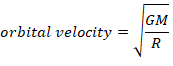
Where
G = gravitational constant
R = radius of the orbit
M = body's Mass at the centre
Derivation of Orbital Velocity
We must have information about gravitational and centripetal forces to calculate the orbital velocity. The gravitational force aids in keeping the object in its orbit, while the centripetal force is needed for the object to move in a circular motion. Suppose a satellite with mass m revolving in its orbit around the Earth with radius r and height h from the Earth's surface. Assume M and R be the Mass and the radius of the Earth, and then the formula will be expressed as
R = R + h
A centripetal force  is needed to aid in revolving the satellite via gravitational force
  . This force is applied between the satellite and the Earth. Now, by equalising both the forces, i.e., gravitational and centripetal, we obtain

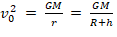 ------- (Equation 1)
Gravitational acceleration (g) is also involved, then we have

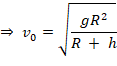
On simplifying the formula, we get

Assume we have h as height and the acceleration due to gravity (g). Therefore we obtain
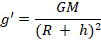
 —--------- (Equation 2)
Now, on merging both equations, we get

The formula for the orbital velocity is derived.
Unit and Dimensional Formula of Orbital Velocity
The orbital velocity can be measured in metres per second, i.e., ms-1. The dimensional formula for the orbital velocity can be expressed as  .
.
Practice Problems
Q1. The correct dimensional formula for the escape velocity is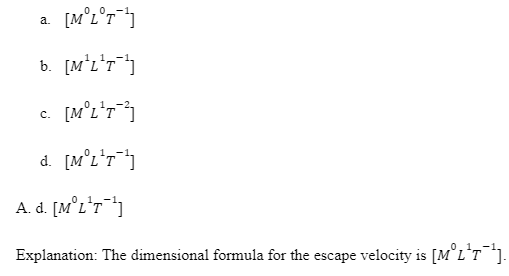
Q2. The orbital velocity can be measured in
a. Metres per second
b. Kilometres per square second
c. Metres per cubic second
d. None of the above
Answer: a. Metres per second
Explanation: The orbital velocity’s unit is metres per second.
Q3. The dimensional formula for the orbital velocity is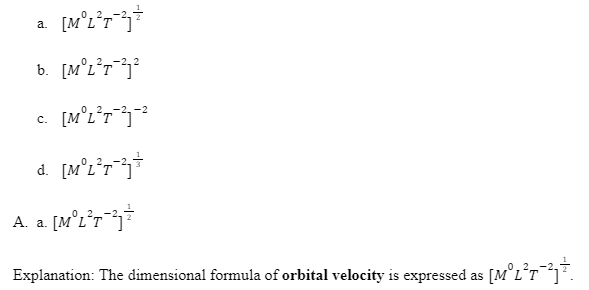
Q4. Forces required in orbital velocity are
a. Centripetal force
b. Gravitational force
c. Frictional force
d. Both a and b
Answer: d. Both a and b
Explanation: Orbital force involves centripetal and gravitational force.
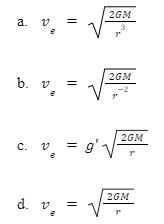
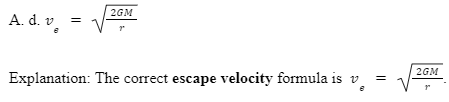
Q5. Choose the correct formula for escape velocity
Frequently Asked Questions
Q1. State the factors that have an influence on the orbital velocity?
Answer: The factors that influence the orbital velocity are the Mass and radius of the planet and the distance of the satellite from the planet’s surface.
Q2. What is the formula of gravitational and centripetal force?
Answer: The centripetal force can be calculated using the formula  On the other hand, the formula of the gravitational force is
  .
.
Q3. State the gravitational constant value.
Answer: The gravitational constant value is 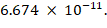

 Call Now
 Let's Chat
 Share
Share