-
Call Now
1800-102-2727


Equipotential surface, Properties of Equipotential Surface, Relation between electric field and potential, Practice Problems, FAQs

Rahul is super excited as it is his first day at the electrical physics lab. He sees the voltmeter for the first time. He comes to know that the voltmeter tells the voltage difference between any two points when connected to its probes. He touched both the probes to one of the ends of a cell. The voltmeter shows zero voltage. Then he touched the two probes on two distinct ends of a regular pencil battery. The voltmeter now shows 1.5 V. The lab teacher tells him that any point on one end of the pencil battery is at same potential. Thus the reading showed zero in the first case. Any surface which has the same potential at all points is called an equipotential surface. Let’s understand more about equipotential surfaces here!
Table of content:
- Equipotential surface
- Properties of Equipotential Surface
- Relation between electric field and potential
- Practice Problems
- FAQs
Equipotential surface
Electric potential at a point is the amount of work done by an external force in moving a positive unit charge from infinity to that point.
Any surface which is the locus of all points with the equal electric potential is known as the equipotential surface. No work is required to move a charge from one point to another on the equipotential surface. A surface with the equal electric potential at all points is termed an equipotential surface.
If the points in an electric field are all at the equal electric potential, then they are known as the equipotential points. When these points are connected by a line or a curve, it is known as an equipotential line. When such points lie on a surface, it is called an equipotential surface. When these points are distributed throughout a space or a volume, it is known as an equipotential volume.
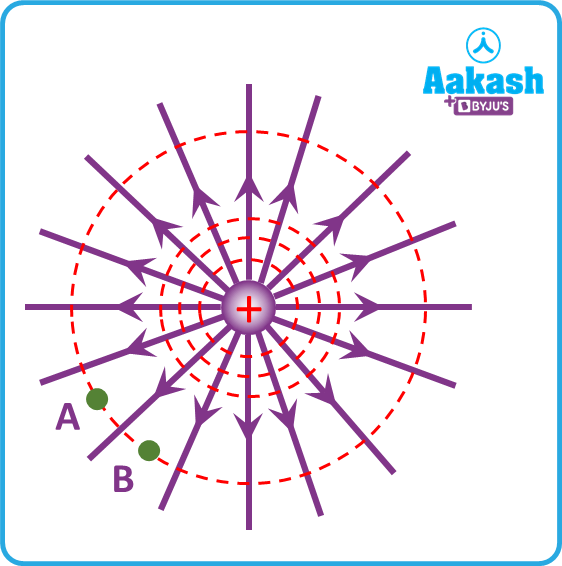
When a charge q0 is moved between two points in an equipotential surface, the work done is zero. When a point charge is moved from point with potential VA to VB in an equipotential surface, the work done in moving the charge is expressed as
Properties of Equipotential Surface
a. Electric field is always at a right angle to an equipotential surface.
b. Any two equipotential surfaces can never intersect.
c. For any point charge, the equipotential surfaces are in the shape of concentric spherical shells.
d. In case of a uniform electric field, the equipotential surfaces are planes normal to the direction of the electric field.
e. The direction of the equipotential surface is from high to low potential.
f. The potential is the same at any point which is inside a charged hollow spherical conductor. It is like equipotential volume. No work is required to move a charge from the centre to the surface in case of a spherical shell.
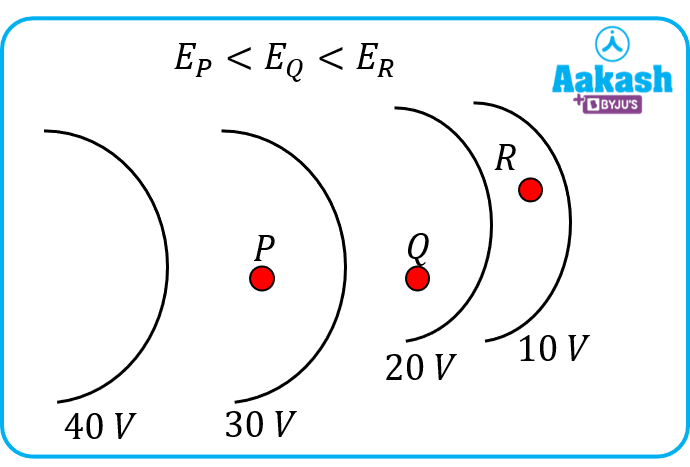
g. The spacing between the equipotential surfaces depicts regions of a weak and strong field.
Relation between electric field and potential
Let’s consider a point charge +q1. Take a point P at a distance r from the charge.
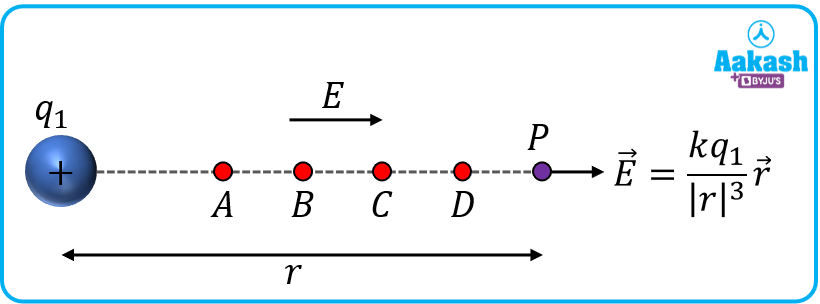
At point P, the value of the electric field is,

The direction of the electric field is away from the point charge. At point P, the value of the electric potential is given by,

Since potential is a scalar quantity, it does not have any direction.
We can observe that the electric potential is inversely proportional to the distance from the charges. Let us take three points A, B and C. Point A is near to charge +q1 and C is far away from the charge along the line joining the charge and point P.
Electric potential at these three points is different because, they are present at different distances from the charge +q1. As the distance increases, the electric potential decreases.
Therefore, VA > VB > VC
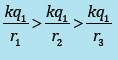
Hence, we can conclude that the electric potential decreases along the direction of the electric field.
When the electric field is uniform
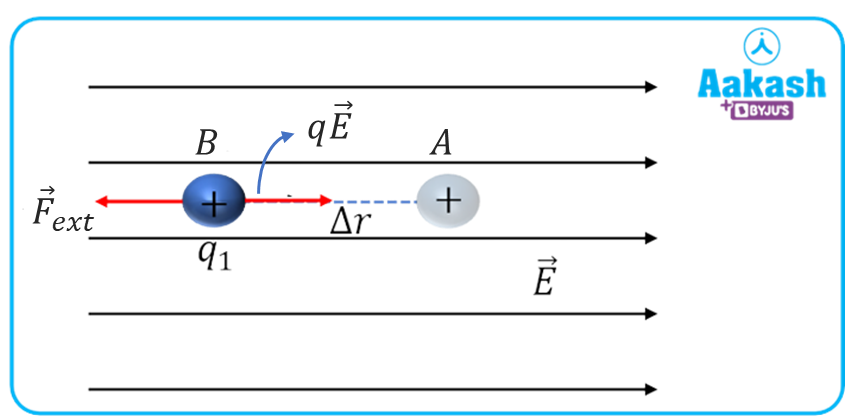
Let’s consider a point charge +q1 be placed in a uniform electric field. So, it experiences an electrostatic force q1E along the direction of the electric field. It is moved from point A to point B in the electric field, slowly without changing its speed. It is done by applying an
external force equal in magnitude, acting in the opposite direction as shown in the figure. While moving charge +q1 from point A to point B, the change in kinetic energy is zero
(ΔKE = 0).
The value of the external force is equal to the electrostatic force but is opposite in direction.
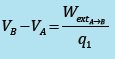
The potential difference between points A and B is given by,
The work done by the external force is given by,
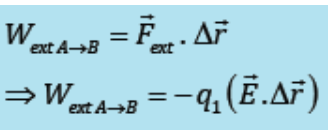
Thus,
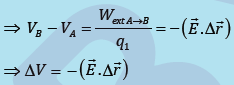
The negative sign shows that the electric potential is decreasing along the direction of the electric field. Alternately, the electric field is directed from high potential to low potential.
When the electric field is non-uniform
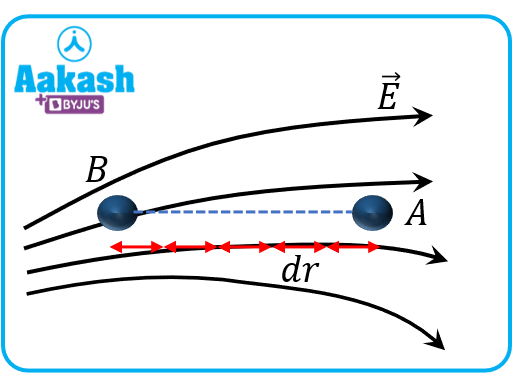
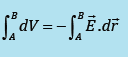
In case of a non-uniform electric field, we have to divide the whole path from point A to B into small lengths dr. For this small length dr, the electric field is almost uniform.
Therefore, the small potential difference is given by,

The total potential difference is given by,
When the electric field is uniform but charges are moving in a random path
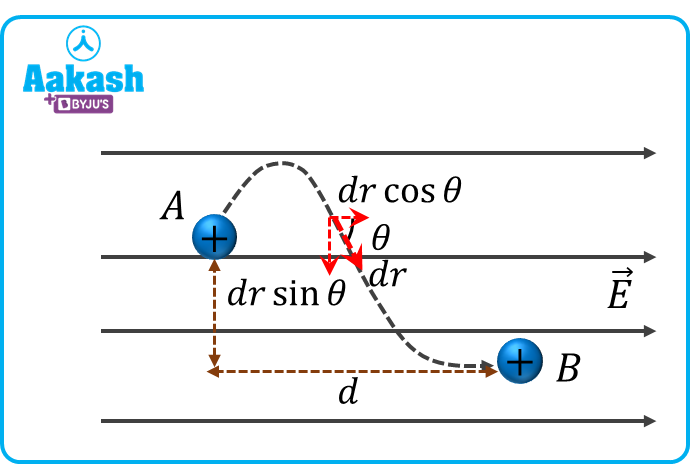
Let’s consider a charge q1 is placed in a uniform electric field. The charge is moved from A to B along an arbitrary path as shown in the figure. The separation between point A and point B be d. The total path between A and B is broken into small lengths dr . Resolving dr such that the components are parallel and perpendicular to the electric field, i.e., dr cos θ along the electric field and dr sin θ perpendicular to the electric field.
Thus, the electric potential is given by,
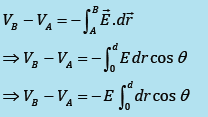
If drcos is along E, then the electric potential is given by,

If drcos is opposite to E, then the electric potential is given by,

Practice Problems
Q. An infinite number of charges of magnitude q, 2q, 4q, 8q…. are placed at a distance of 1 m, 4 m, 16 m, 64 m…. . What will be the potential at the origin?
A. Potential at the origin due to the charge qi at a distance xi from the origin is
So,
Q. A charged particle of 1 μC moves 1 m along an equipotential surface of 10 V. Calculate the work done by the field.
A. The work done by the field is given as, W=-qV=0 [ ∵equipotential surface ]
Q. A charged particle of +1 C moves from an equipotential surface of 50 V to 10 V. An electric field of 200 Vm-1exists in the region. What is the distance the charge travelled?
A.
Here,
Q. An electron enters into an electric field of 1 NC-1 with a speed of 1 ms-1. After how much time will the electron achieve double its initial speed?
A.
The initial speed of electron =1 ms-1
After t s, the final speed of electron
The acceleration of the electron is
FAQs
Q. Is the electric field zero along the equipotential surface?
A. The electric field along the equipotential surface is zero as no change in potential is observed along the equipotential surface. The electric field normal to the surface is not zero. From that equipotential surface to some other equipotential surface, there will be some change in potential which will give rise to the potential gradient. Thus, an electric field will come into the picture.
Q. Can the earth be treated as an equipotential surface?
A. Yes. The earth’s surface, everywhere if measured will show zero voltage. So this can be treated as an equipotential surface. Whenever we need to have a terminal with zero voltage, we can consider the earth. This is also used in railway systems and earthing.
Q. Equipotential surfaces are closer in regions of high electrical fields than in the region of low electric field. Explain.
A. We know,
It means electric field intensity is more in those regions of higher potential gradient.
Equipotential surfaces are closer in those regions of large electric fields compared to regions of lower electric fields. In those regions, like the sharp edges of a conductor, the charge density is more. Therefore, the electric field is stronger. Hence equipotential surfaces are more crowded.
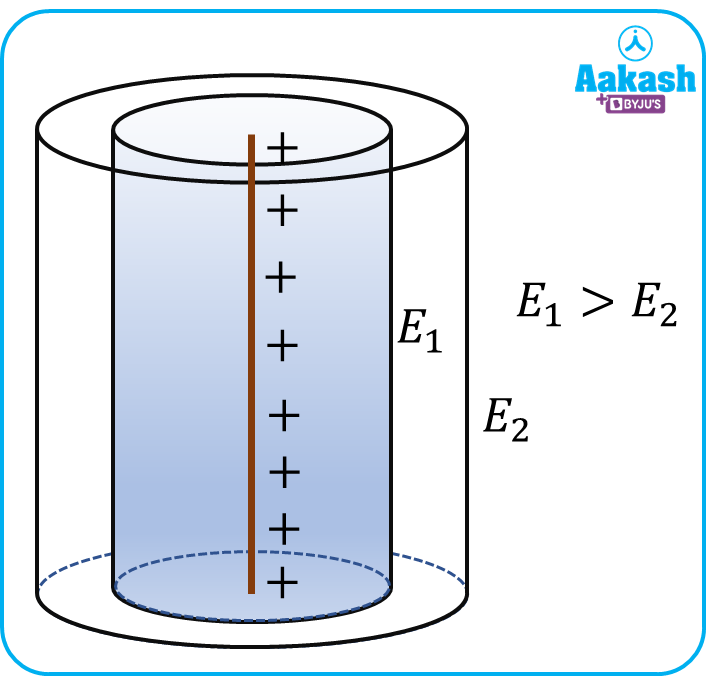
Q. For a uniformly charged long thin wire how will be the shape of equipotential surfaces?
A. For a uniformly charged long thin wire, the equipotential surfaces will be in the form of concentric cylinders.

 Call Now
 Let's Chat
 Share
Share