-
Call Now
1800-102-2727


Electrostatic Potential Energy of a Two-Charge System

The concept of energy in electrostatics provides a powerful way to interpret interactions between electric charges. Just as masses interacting through gravity possess gravitational potential energy, electric charges interacting through electrostatic forces possess electrical potential energy.
This energy depends on the separation between charges and whether they attract or repel each other. When multiple charges are involved, analysing forces alone becomes complicated. A scalar quantity like potential energy simplifies analysis and helps explain how work is stored within the system.
Point Charges and Electrostatic Interaction
A point charge is an idealised charge whose physical dimensions are negligible compared to the distance between interacting charges. This approximation allows electric forces and energies to be calculated using simple mathematical expressions.
When two point charges are placed in space:
- Like charges repel each other.
- Unlike charges attract each other.
- The interaction between them is governed by Coulomb’s law.
These interactions give rise to electrical potential energy.
Definition of Electrical Potential Energy
Electrical potential energy is defined as the energy possessed by a system of charges due to their relative positions.
System-Based Definition
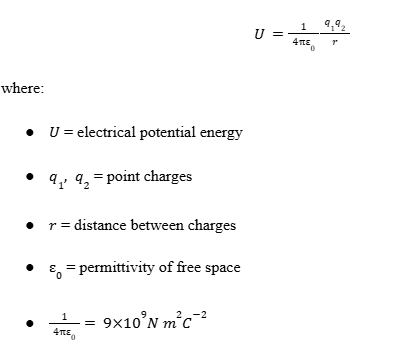
The electrical potential energy of a system of two point charges is equal to the work done in assembling the charges from infinite separation to their given positions against electrostatic forces.
Concept of Reference Point
Each calculation of potential energy takes place according to a base position. The standard method for electrostatics is to use infinite separation between charges as the reference point at which potential energy is zero.
While electrostatic forces fade at infinite boundaries, this method secures consistency and makes calculations simple.
Work Done in Bringing Charges Together
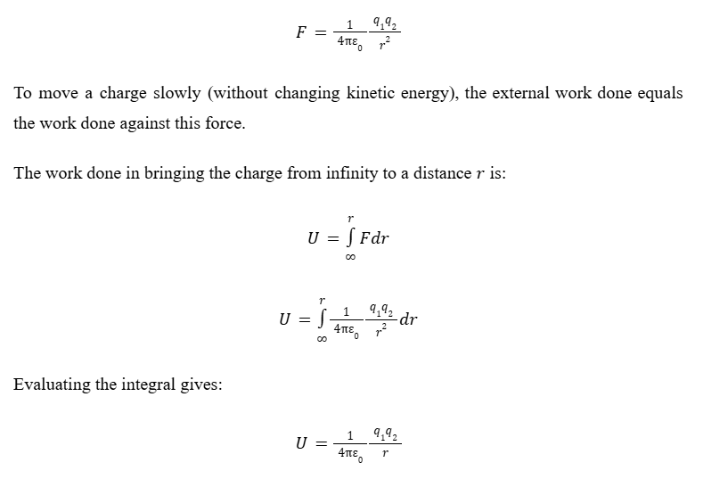
Suppose two point charges 𝑞1 and 𝑞2 are initially separated by an infinite distance. One charge is kept fixed, and the other is slowly brought to a distance 𝑟.
The work done against the electrostatic force during this process is stored as electrical potential energy of the system.
Derivation of Electrical Potential Energy
The electrostatic force between two point charges is given by Coulomb’s law:
Formula for Electrical Potential Energy
Nature of Electrical Potential Energy
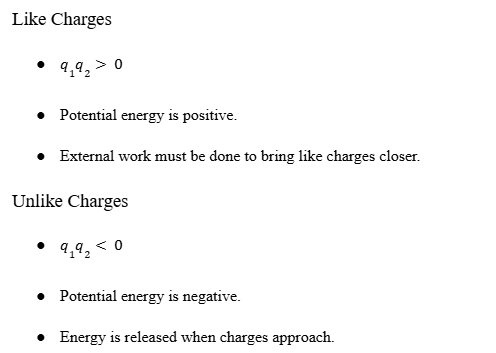
The sign of electrical potential energy depends on the nature of charges:
Physical Interpretation
- Positive potential energy indicates a repulsive interaction.
- Negative potential energy indicates an attractive interaction.
- The magnitude of energy reflects the strength of interaction.
A system naturally moves toward a configuration of lower potential energy, which corresponds to greater stability.
Variation of Potential Energy with Distance
- As distance increases, the magnitude of potential energy decreases.
- At infinite separation, potential energy becomes zero.
- At smaller distances, interaction becomes stronger.
This variation explains why charges tend to move towards configurations of lower energy.
Electrical Potential Energy and Force
Electrical force is related to potential energy through:
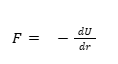
This relation shows that force acts in the direction of decreasing potential energy. The negative sign indicates that the force acts in the direction of decreasing potential energy.
Energy Conservation in Electrostatics
In the absence of external work:
- A decrease in potential energy leads to an increase in kinetic energy.
- This confirms that electrostatic forces are conservative forces.
- An increase in potential energy requires external energy.
Thus, electrical potential energy obeys the law of conservation of energy.
System Approach to Energy
Electrical potential energy belongs to the system of charges, not to any single charge. This is an important conceptual distinction.
- A single isolated charge has no potential energy.
- Energy arises due to interaction.
Effect of Medium
In a medium with permittivity ε\varepsilonε:
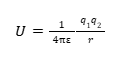
The presence of a medium reduces the strength of interaction and hence the potential energy. Since 𝜀>𝜀0 in most media, potential energy decreases compared to vacuum.
Solved Examples
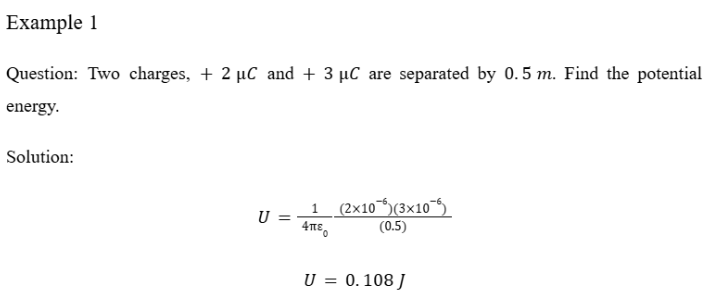
Here are a few solved examples for your better understanding.
Example 2
Question: Why is the potential energy negative for opposite charges?
Answer:
Because energy is released as the charges move closer due to attraction.
Example 3
Question: What happens to potential energy when two like charges are separated further?
Answer:
The potential energy decreases as repulsion weakens.
Example 4
Question: Is electrical potential energy a vector quantity?
Answer:
No. It is a scalar quantity.
Importance of Electrical Potential Energy
- Simplifies analysis of electrostatic systems
- Explains charge motion without using vectors
- Essential in understanding electric fields and potentials
- Forms the basis for studying multi-charge systems
- Fundamental for understanding electric potential and electric field energy
- Essential for capacitor energy analysis
Common Misconceptions
- Potential energy is not the energy of a single charge.
- Zero potential energy does not imply the absence of force.
- Negative energy does not mean energy loss.
Clarifying these points ensures correct conceptual understanding.
Conclusion
Electrostatic interaction is powerfully and clearly described by the electrical potential energy of a system of two point charges. It provides information about attraction, repulsion, and system stability by connecting energy to charge magnitude and separation. This energy-based method emphasizes the conservative nature of electrostatic forces and enhances force analysis. A thorough grasp of electrical potential energy enhances comprehension of how energy controls the behaviour of electric charges in space and serves as a basis for more intricate electrostatic systems.
FAQs
Q1: Why is infinity chosen as the reference point?
Because electrostatic forces vanish at infinite separation.
Q2: Can electrical potential energy be zero at a finite distance?
Only if one of the charges is zero.
Q3: Does potential energy depend on the path taken?
No. Electrostatic forces are conservative.
Q4: Can potential energy be greater than kinetic energy?
Yes. They are independent forms of energy.
Q5: Is potential energy stored in the charges?
It is stored in the configuration of the system.

 Call Now
 Let's Chat
 Share
Share