-
Call Now
1800-102-2727


Electrical Energy, Potential Difference and Power – Formula Derivations and Exam Traps

Electrical energy is the energy associated with electric charges either due to their position (electrostatic potential energy) or due to their motion (current electricity).
In circuits, electrical energy is transferred by an electric field established inside the conductor when a potential difference is applied.
SI unit: Joule (J)
Electrical energy supplied in a circuit:
W=VQ
Where:
- V = potential difference
- Q = charge transferred
Using Q=It,
W=VIt
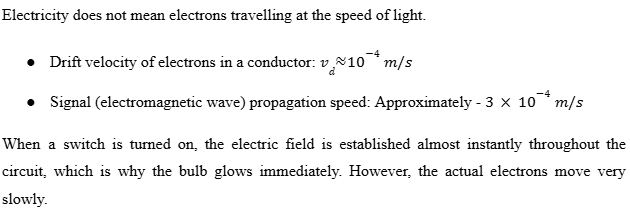
Students assume electrons travel at the speed of light. Rather:

The signal propagation ≈Speed of light
Energy Transfer Mechanism
In metallic conductors, electrical energy is not carried by electrons as kinetic energy over long distances. It is transferred via the electric field established in the conductor.
This prevents conceptual errors in field-based questions.
What are Charged Particles?
Take two plastic straws and suspend one straw with the help of a thread. Bring the other straw close to the suspended one. You will observe that they do not interact at all. Rub one straw with a piece of paper and repeat the same activity. You will observe that the rubbed straw attracts the other. If both the straws are rubbed with a piece of paper and brought near each other, it is observed that they repel each other. If a glass rod is rubbed with a silk cloth, it attracts the straw. This activity helps to understand the concept of Charged Particles.
Observations:
- There are two types of charges, one positive (proton) and the other negative (electron).
- Two materials acquire different charges when rubbed by different materials.
- When two similar materials are rubbed by the same material, they acquire similar charges.
- Like charges repel each other, and unlike charges attract each other. It means that two protons repel and two electrons repel, whereas a proton and an electron attract each other.
Therefore, charged particles are the protons and electrons that make up matter. The movement of these charges is responsible for the origination of electric charges/electricity.
Coulomb’s Law
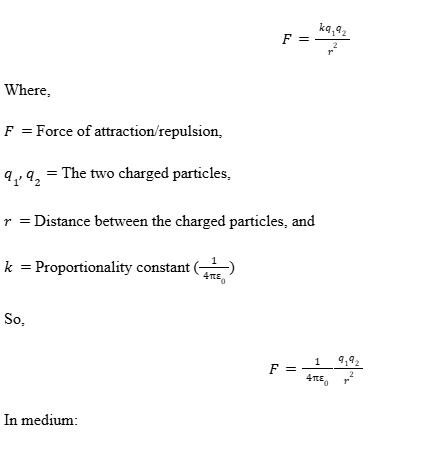
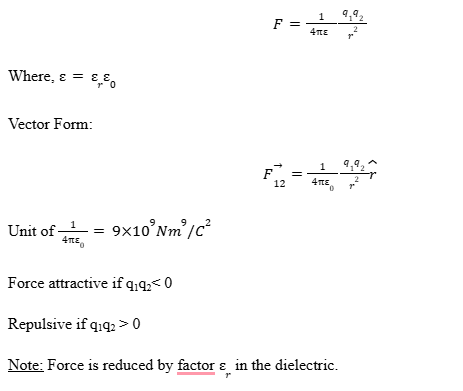
The force of attraction or repulsion of the charged particles is calculated using the coulomb’s law. According to this law, ‘the force of attraction or repulsion between two charged particles is directly proportional to the product of the two charged particles and inversely proportional to the square of the distance between them. ’ The mathematical representation of this law is,
Electric Potential and Potential Difference
Electric potential at a point is the work done per unit charge in bringing a positive test charge from infinity to that point.
The electric potential is given by,
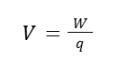
Where,
V= Electric potential,
W= Work done, and
q= unit charge.
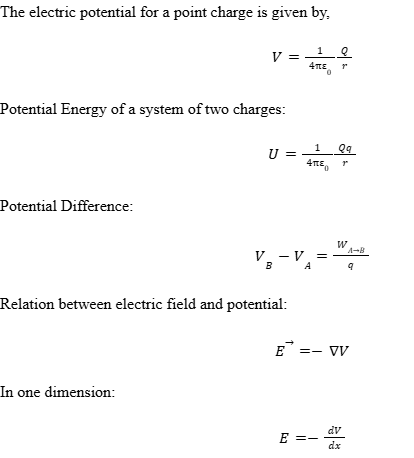
Consider a charge ‘q’ is brought from infinity to the point ‘B’ or ‘A’.

charge ‘q’ is brought from infinity to the point ‘B’ or ‘A’
- Equipotential surface properties
- No work is done along an equipotential
- Potential decreases in the direction of the electric field
- Potential can be negative. Students assume always positive
- Zero potential does not mean zero electric field
Electric Current
Electric current is defined as the quantity of charge flowing through a conductor per unit time. Whenever there is a movement of charges in a conductor, there will always be a flow of electric current as well. The formula of electric current is,
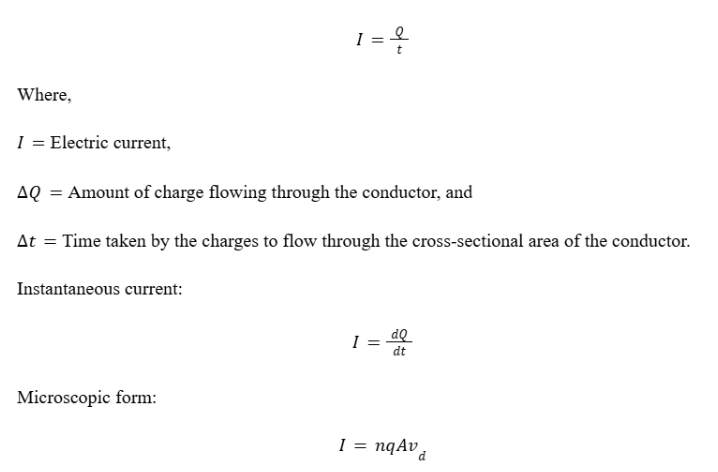
Where
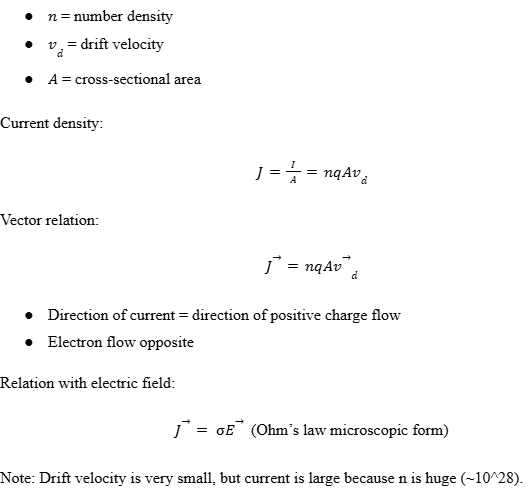
Electric Energy and Cell
Every matter contains equal amounts of electrons and protons that make it electrically neutral. When there is an excess of protons in a material, it gets positively charged. In contrast, when there is an excess of electrons in a body, it gets negatively charged. When a positively/negatively charged body comes in contact with a neutral or uncharged body through a metallic wire, the positive charges flow from a region of higher potential to a region of lower potential, whereas the negative charges flow from a region of lower potential to a region of higher potential. These movements continue till there is the same potential between the bodies. For a continuous charge flow between two bodies, it is essential to maintain a constant potential difference between the ends of a conducting wire. This is achieved by a device called a cell. A cell is a device that converts chemical energy to electrical energy.
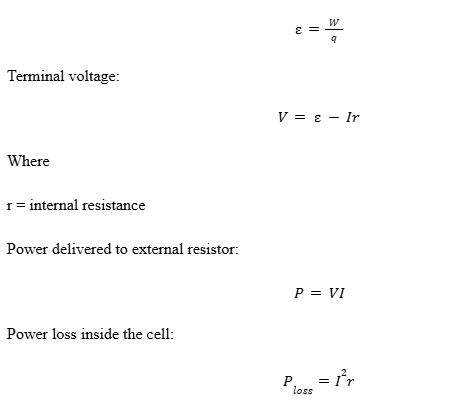
Note: When the current increases, the terminal voltage decreases
The negative plate of a cell repels electrons, which makes them move from the negative plate to the positive plate. The conventional flow of electric current is taken opposite to the flow of electrons in a cell. This means that the flow of electric current is from the positive terminal to the negative terminal.
Electric Power
Electric power is the rate at which electrical energy is consumed or delivered in a circuit.

Where
P = power (Watt)
W = work done (Joule)
t = time (second)
Derivation in Electric Circuit
Electrical work done:
W=VQ
Using Q=It,
W=VIt
Substitute in the power definition:
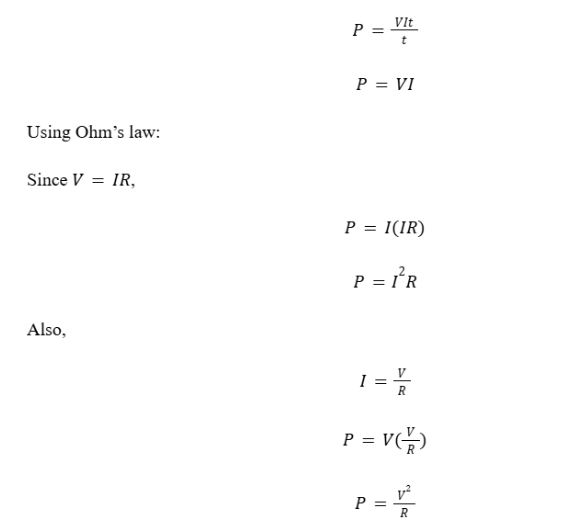
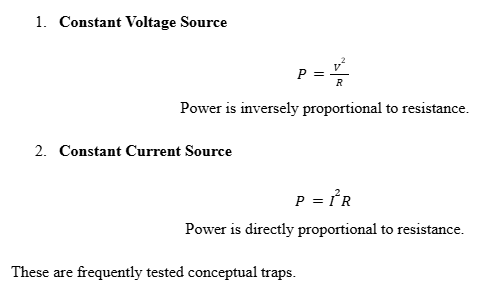
Important Observations (Exam-Oriented)
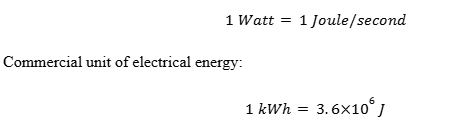
SI Unit
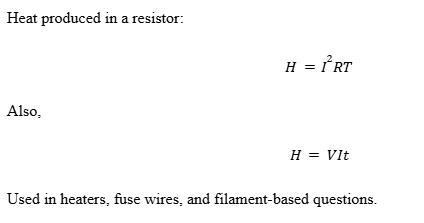
Heating Effect of Current (Joule’s Law)
Power Loss in Transmission
Power loss in the transmission line:
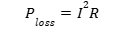
Reducing current reduces transmission loss. Hence, power is transmitted at high voltage.
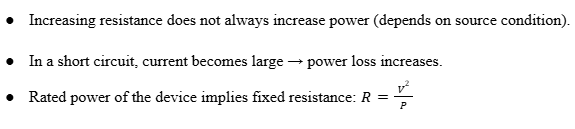
Common Exam Traps
Summary
When a unit charge is moved in a specified electric field, it stores some energy moving against the applied electric field. This stored energy is known as Potential Energy. Starting with one point, the gap in electric potential compared to another forms what is known as the Electric Potential Difference. A Flowing charge across a material during each second gives rise to what we refer to as electric current. Found commonly in circuits, a cell operates by transforming stored chemical energy into usable electrical output.
FAQs
Q1. Why do electrons move from low potential to high potential?
Electrons shift toward higher potential because they carry a negative charge. Movement occurs due to the electric field direction opposing the conventional current. Their flow aligns with increasing energy states naturally. This behaviour reflects fundamental properties of charged particles in fields. Such motion continues until equilibrium is reached across regions.
Q2. How fast does electricity travel?
Q3. What is the SI unit of electric power?
The SI unit of electric power is the Watt. It is also measured in Kilowatt.

 Call Now
 Let's Chat
 Share
Share