-
Call Now
1800-102-2727


Electric Potential Energy

The electric potential energy is defined as the total amount of work done by an external agent to bring the charge or collection of charges from infinity to the present configuration without experiencing any acceleration. It is formed from conservative Coulomb forces. It occurs due to the electric charge and its position compared to the presence of other charges in the vicinity.
Table of Contents
- Electric Potential and Electric Potential Energy
- Electric Potential Difference
- Electric Potential Due to Multiple Charges
- Electrostatic Field
- Practice Problems
- Frequently Asked Questions
Electric Potential and Electric Potential Energy
The electric potential is defined as the amount of work done in moving the object or charge from one point to another specific point against the electric field. The energy gained in the process is defined as the electric potential energy. Mathematically, the electric potential is the electric potential energy per unit charge.
The mathematical formula of electric potential energy is
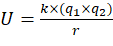 , where U is the electric potential energy, k is the electrostatic constant, q1 and q2 are charge magnitudes, and r is the distance between the charges. The dimensional formula of electric potential energy is
  .
.
The formula for electric potential is:
 , where V is the electric potential at a point, U is the electric potential energy and q is the charge at the point. The dimensional formula of electric potential is
 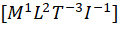 .
.
Electric Potential Difference
It is defined as the difference in electric potential between two points in an electric field. It indicates the difference in electric potential energy per unit charge between the stated two points. Based on this difference, the electric charges move from higher to lower potential.
The mathematical representation of electric potential difference is
 , where
  V is the electric potential difference, V2, is the final electric potential and V1 is the initial electric potential. The unit of measurement is volts or V.
The positive potential difference states higher potential at the second point, while the negative potential difference states lower potential at the second point.
Alternatively, the electric potential difference is expressed as
 , where E is the electrical potential difference between the two points, W is the work done to move charge between stated points, and Q is the magnitude or quantity of charge. The dimensional formula of electric potential difference is .
Electric Potential Due to a Point Charge
The electric potential due to a point is the energy a point charge possesses at a specific location. It is defined as the electric potential energy per unit charge.
Electric Potential Due to Multiple Charges
The electric potential is determined through the principle of superposition in case of the presence of multiple charges. The overall electric potential is calculated using multiple charges. The mathematical representation for the same is
 , where V is the total electric potential at the point and subsequent V1 to Vn is the individual electric potential due to each charge.
Electrostatic Field
The electric or electrostatic field is the field created by electric charges by the exertion of their forces. The field is vector due to its presence surrounding the charges. It exists at every point and imparts force to the objects or particles placed in its vicinity. The mathematical formula of the electric field is
 , where E is the electric field, F is the experienced force, and q is the magnitude of charge.
Practice Problems
Q1. What is the electric potential energy of a dipole in a uniform electric field?
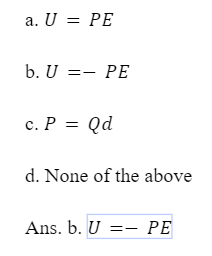
The negative sign of electric potential energy indicates lower energy in alignment with the dipole moment.
Q2. What is the electric potential energy if a point charge of  is present at a distance of 2 metres from a point charge of
  ?
?
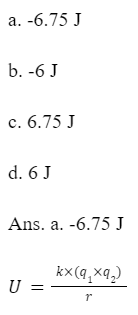

Q3. What is the dimensional formula of an electric field?
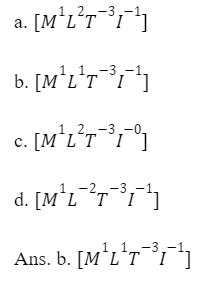
In the dimensional formula, M represents mass, L represents length, T represents time, and I represents current. The electric field involves components' force and charges which determines its dimensional formula.
Q4. What happens to potential differences when free space between the capacitor plates is replaced by the dielectric?
a. The potential difference remains unchanged while other related parameters (capacitance and energy) increase
b. The potential difference remains unchanged while other related parameters decrease
c. The potential difference decreases contrary to the increase in other related parameters
d. There is a decrease in potential difference along with capacitance but an increase in energy
Ans. c. The potential difference decreases contrary to the increase in other related parameters
The formula relating to the stated entities are:
 and
and  , where U is the electric potential energy, C is the capacitance, V is the electric potential, A is the area of capacitor plates, d is the distance between the capacitor plates and
  is the permittivity of free space.
Frequently Asked Questions
Q1. What is the value of k in the electric potential energy formula?
Ans. The value of k is 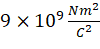 . It is represented as
  .
.
Q2. When is electric potential energy negative?
Ans. The electric potential energy is negative when work is done by external force in bringing like charges or separating opposite charges.
Q3. How is electric potential energy related to the capacitor?
Ans. The electric potential energy is stored in the electric field between capacitor plates.
Q4. What is the significance of electric potential energy in electrical systems?
Ans. The electric potential energy is important for understanding the behaviour of electric circuits and charges. It is also significant for energy transfer in batteries, capacitors, electricity power generation and distribution.

 Call Now
 Let's Chat
 Share
Share