-
Call Now
1800-102-2727


Electric flux

Electric Field and Surface Area
The electric flux through a surface basically depends on the strength of the electric field and the surface area. The stronger the electric field, the greater the electric flux passing through a surface. A larger surface area will allow more electric field lines to pass through it.
When the strength of the electric field is uniform, the surface is orientated at a right angle to the electric field, and the intensity of the electric flux is at its highest. When the surface is orientated parallel to the electric field, the magnitude of the electric flux is zero.
Mathematical Expression for Electric Flux
The electric flux (Phi) through a surface can be calculated using this formula:
Φ = E × A = EA cosθ
where:
- E = electric field strength,
- A =Area of the surface,
θ is the angle between the electric field vector and the normal (or perpendicular) vector of the surface.
This formula shows that electric flux depends on the angle between the electric field and the surface.
When θ = 0°, cos θ = 1, and the flux is maximum.
When θ = 90°, cos θ = 0, and the flux is zero.
SI Unit of Electric Flux

Positive and Negative Electric Flux
If the electric field (EF) turns inward or outward from the surface influences the direction of electric flux. As an instance, the flow direction of the electric flux is said to be positive for a surface with outward EF's and negative for a surface with entering EF's.
Imagine a surface containing a positive charge in order to get a better understanding of this. This surface will be the primary source of the EF lines, showing a positive electric flux. On the other hand, a negative charge will lead the EF lines to penetrate this surface, producing a negative electric flux.
Electric Flux Through Different Surfaces
The electric flux also depends on the surface and its orientation with which the electric field is enclosed or intersects. Flux through a surface placed perpendicular and flat to the electrical field is maximum. In the case of curved surfaces, the electric flux can be determined by considering infinitesimal area elements.
If the closed surface does not enclose any charge, the electric flux passing through the closed surface will be zero. This requires that the number of electric field lines entering the surface be equal to the number of electric field lines leaving the surface.
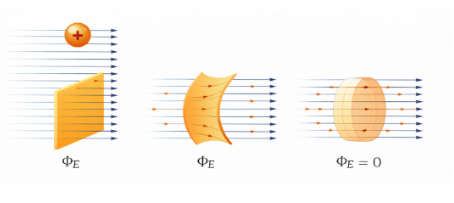
Electric flux through different surfaces
Electric flux through different surfaces
Electric Flux and Gauss’s Law
Electric flux has a close relationship with Gauss’s law. Gauss’s law states that electric flux through a closed surface is proportional to the enclosed charge divided by permittivity.
The formula is
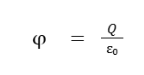
where
- Q is the charge enclosed, and
- ε₀ is the permittivity of free space.
Gauss’s law is quite helpful in the calculation of the electric fields associated with symmetric charges, such as spherical, cylindrical, and planar charges.
Physical Significance of Electric Flux
The electric flux is of major physical importance in electrostatics since it assists in explaining the phenomenon of electric fields simply.
First of all, the electric flux provides information regarding the amount of electric fields passing through a surface area. This is because it illustrates the number of electric field lines going through the surface.
Secondly, the electric flux through a surface also depends on its orientation within the electric field. The electric flux is strongest when the surface is orientated at a perpendicular angle to the electric field and is weakest or absent when the surface lies along or parallel to the electric field.
Lastly, electric flux is directly proportional to electric charge according to Gauss’s law. The amount of electric flux passing through a closed surface is solely dependent on the charge enclosed within it. A positive flux corresponds to a positive charge enclosed, and a negative flux corresponds to a negative charge enclosed.
For closed surfaces:
If no charge is enclosed:
Φ=0
This follows directly from Gauss’s law.
Therefore, the practical significance of the electric flux consists in its ability to establish a connection among the electric field, the surface on which the field is acting, and the charge enclosed.
Applications of Electric Flux
Electric flux has several applications:
- It is used in Gauss’s law for calculating electric fields conveniently.
- It assists in comprehending the function of capacitors.
- It is employed in electrostatic shielding.
- It assists in calculating the electric field around conductors.
- It finds application in designing electrical and electronic systems.
Conclusion
The electric flux is a fundamental quantity of electrostatics; it allows us to know how electric fields pass through surfaces and, therefore, how they interact with charges. It also provides a straightforward method to calculate a characteristic of the whole of an electric field, rather than having to deal in detail with the field at each point. Since it is the electric field multiplied by surface area, and direction, electric flux gives us a means to relate electric field, surface orientation, and enclosed charge; it is the basis of Gauss’s law and therefore of much of the rest of electrostatics. Thus, electric flux is an important concept needed to explain much of electric field behaviour, but one that presents some challenging aspects.
FAQs
Q1. What is electric flux in Physics?
Electric flux is a measure of the number of electric field lines passing through a given surface. It quantifies the flow of the electric field through an area and is a scalar quantity. The higher the electric flux, the more electric field lines pass through the surface.
Q2. What is the SI unit of electric flux?
The SI unit of electric flux is newton metre squared per coulomb(Nm²C). This can be written as a voltmetre(Vm) in some contexts.
Q3. What is the physical meaning of electric flux?
Electric flux represents the total number of electric field lines passing through a surface. It helps visualise the strength and orientation of the field across that surface and is fundamental for understanding Gauss’s law and field mapping.

 Call Now
 Let's Chat
 Share
Share