-
Call Now
1800-102-2727


Electric Current

Electrical devices have become an integral part of our lives. Devices like a laptop, a smartphone, a television, a light bulb, etc., have become so important that going one day without them can be uncomfortable. But have you ever wondered what exactly is used to make them operable? The answer is electricity, which is the flow of electric charges when a potential difference is created between two ends of a wire.
Table of Contents:
- What is Electric Current?
- Mathematical Formula of Electric Current
- Unit of Electric Current
- Ohm’s Law – Relation Between Current, Voltage and Resistance
- Properties of Electric Current
- Solved Problems
- Practice Problems
What is Electric Current?
Electric Current refers to the flow of electric charges from a higher potential level to a lower potential level in a conducting material. It can also be defined as the rate of electron flow through the conducting material.
Electrons are the minute particles that exist within the molecular structure of a substance. They are negatively charged particles that constitute the outer layers of an atom and are held together loosely by the nucleus of the atom. Due to the loose connection between the electrons and the nucleus, some electrons are free to move. These free-to-move electrons are called free electrons, and when they move, an electric current is generated.
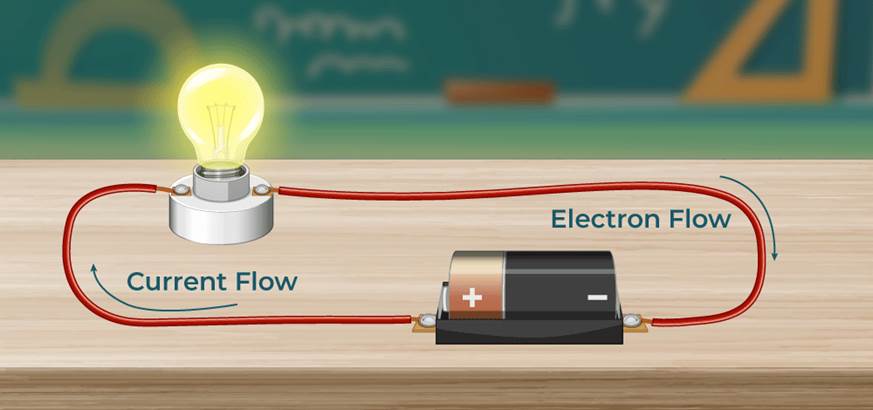
Various materials in the world conduct electricity, while many do not. Materials that conduct electricity are called conductors, and materials that do not conduct electricity are called insulators.
Conductors are materials that allow the free flow of electrons through them because of excess free electrons. Thus, conductors have a high electrical conductivity. Insulators, on the other hand, have a rigid molecular structure and lack free electrons. Thus, insulators have very low electrical conductivity.
Mathematical Formula of Electric Current
As we know, electric current is defined as the rate of flow of electric charge.
It is mathematically represented as follows:

Where 'q' is electric charge, 't' is time and 'I' is an electric current.
Unit of Electric Current
Electric charge and time are both fundamental quantities, and their units in the SI systems are Coulomb and second, respectively.
So, by definition, the electric current has a unit of Coulombs per second.
The unit Coulomb per Second has been given a special name called an ampere. So, in the SI system, the unit of electric current is the ampere.
In the CGS system, the unit of electric current is a biot, sometimes called an abampere.
Ohm’s Law: Relation Between Current, Voltage and Resistance
Ohm’s Law is a very important concept that establishes the relationship between current, voltage, and resistance.
It states that the amount of current flowing from one point to another point in a conductor is directly proportional to the voltage difference across the two points.
Mathematically, we represent Ohm’s Law as follows:
V ∝ I

Where ‘R’ is a proportionality constant called the resistance of the conductor.
This formula of Ohm’s law can also be written as follows:

If V is constant, then Ohm’s Law can alternatively be stated as: “The amount of current flowing through the conductor is inversely proportional to the resistance of the conductor.”
Properties of Electric Current
- Current is due to the flow of electrons in a circuit.
- Electric current can be categorised as AC or DC. DC flows in one direction, while AC flows in both directions.
- The electric current in a circuit can be controlled by resistance.
- 1 A of electric current is said to flow through a circuit when there is a 1 V potential difference across two points in a conductor separated by 1 m of length.
- Electric current flows from a higher to a lower potential in a circuit.
Solved Problems
Q1: In a conductor, 15 coulombs of charge flow for 5 seconds. Find the current flowing through the conductor.
Solution: We use the formula:

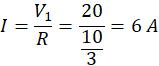
Q2: In the circuit given below, find the current flowing through the circuit.
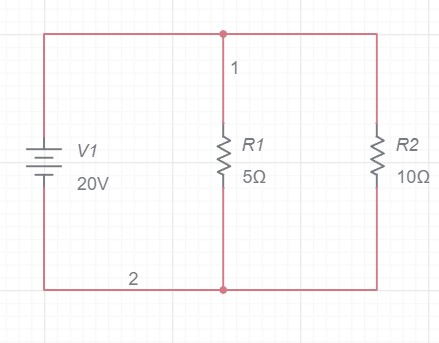
Solution: Both R1 and R2 are parallel to each other.
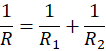
Let the equivalent resistance be R.
Then,
|
|
|
|
|
|

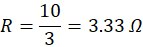
Therefore, the amount of current flowing through the circuit
Q3: What is the heat energy produced when 3 amperes of current flow in a circuit for 5 minutes with an overall resistance of 0.04 ohms in the circuit?
Solution: The amount of heat energy produced is given by the equation:



Practice Problems
A circuit consists of three resistors having a ratio of 1:2:3 connected parallel to each other. A 12 V DC source is connected to the circuit. The current flowing through them is 1.1 A. How much current will flow through the circuit when these resistances are connected in parallel?
- A circuit with a resistance of 4 ohms produces 160 J of heat when current flows through it for 10 seconds. How much current is flowing through the circuit?
- A circuit consumes 9 W when operated with a 3 V DC source. How much current is being pulled in by the circuit?
Frequently Asked Questions
Q1. What is an Electric Charge?
Answer: Electric charge is the fundamental property of subatomic particles that decides how the particles will act in the presence of an electromagnetic field.
Q2. What is Electric current?
Answer: The rate of flow of charge is called Electric Current.
Q3. How do you define ampere?
Answer: ampere is said to be the current flowing through a conductor having 1 ohm of resistance and having 1 V of potential difference across itself.

 Call Now
 Let's Chat
 Share
Share