-
Call Now
1800-102-2727


Electric Charges And Fields: Definition, Types, and Important Laws

Electric charges and fields are fundamentals of electricity and magnetism in physics. It plays a crucial role in understanding the behaviour of particles and electric field lines. These ideas are important in many industries, including electrical engineering, electronics, and telecommunications. You obtain a comprehensive knowledge of the concepts that regulate the behaviour of electric currents, circuits, and electromagnetic phenomena by studying electric charges and fields.
Table of Contents:
- What are Electric Charges and Fields?
- Electric Charges
- Electric Fields
- Practice Problems
- Frequently Asked Questions
What are Electric Charges and Fields?
Electric charges and fields aid in the explanation of many scientific phenomena. Understanding electric fields, for example, is critical to understanding how lightning happens, how electric charges interact in atoms and molecules, and how static electricity is formed. You may learn about the fundamental mechanics of natural occurrences by studying electric charges and fields.
Electric Charges
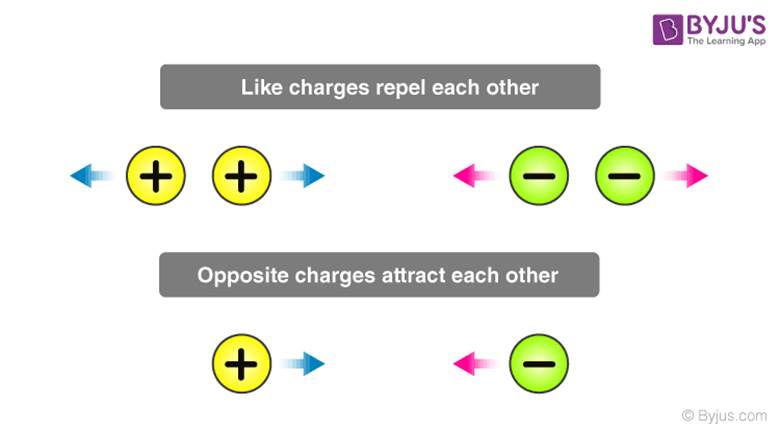
The fundamental features of matter that generate electric fields are electric charges. These charges experience some force when placed in the vicinity of an electromagnetic field. The Coulomb is the unit of charge (C).
Types
There are two types of charges: Positive and Negative.
- Positive Charge: Protons, which are subatomic particles located in the nucleus of an atom, are connected with positive charges. Protons have a positive electric charge.
- Negative Charge: Electrons, which are subatomic particles that circle the nucleus of an atom, are connected with negative charges. Electrons are electrically charged negatively.
Laws
1. Conservation
Electric charge, according to the charge conservation idea, cannot be created or destroyed; it can only be transferred from one thing to another. The overall quantity of charge remains constant in any isolated system.
2. Quantization
The electric charge has been quantised, which means it exists in discrete packets. An electron's charge, roughly -1.6 x 10⁻¹⁹ Coulombs, is the lowest attainable charge unit. Integer multiples of this fundamental unit can exist as charges.
3. Coulomb’s Law
According to Coulomb's Law, the force between two charged objects is equal to the product of their charges and inversely proportional to the square of their distance. It may be stated mathematically as follows:
F = k (q1 q2) / r2
where F is the force between the charges, q1 and q2 are their magnitudes, the distance between the charges is denoted by r, and K here is the electrostatic constant.
Electric Fields
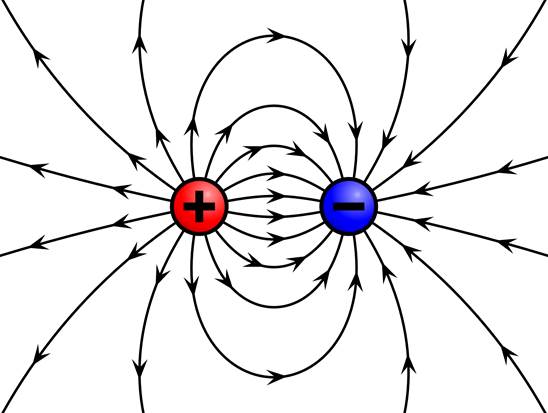
A charged object's electric field is an area surrounding it that exerts a force on other charged things. The electric field is a vector quantity, meaning it contains magnitude and direction.
Source: Toppr
Electric Field Strength
The force experienced by a unit of positive charge deposited at a spot is defined as the electric field strength at that point. It is represented by the letter E and measured in Newtons per Coulomb (N/C).
Electric field due to a point charge
A point charge's electric field has an inverse-square connection. E = k (Q / r2), where k is the electrostatic constant, gives the magnitude of the electric field at a distance r from a point charge Q.
Electric field lines and their properties
Electric field lines are imaginary lines used to depict the electric field. The characteristic properties of electric field lines are as follows:
- Positive charges start electric field lines, while negative charges finish them.
- The electric field's strength is represented by the density of field lines. The strength of the field lines increases with their closeness.
- Field lines are never crossed.
- At equilibrium, field lines are perpendicular to the surface of a conductor.
Electric field due to multiple charges
The electric field at a location is the vector sum of the electric fields produced by each charge when dealing with many charges. The net electric field is calculated using the superposition concept.
Practice Problems
Q1. Two objects have charges of +2C and -2C, respectively. How will these objects interact?
a. They will repel each other.
b. They will attract each other.
c. They will remain stationary.
d. Their interaction cannot be determined based on the given information.
Ans: b. They will attract each other.
The like charges always repel, and the unlike charges always attract each other. Here, both charges have opposite signs therefore, they will attract each other.
Q2. What is the direction of the electric field lines around a positive charge?
a. Radially inward towards the charge.
b. Radially outward from the charge.
c. Circular around the charge.
d. They do not exist around positive charges.
Ans: b. Radially outward from the charge.
The electric field travels outward from the positive and towards the negative charge. As a result, given a positive charge, the electric field lines will radiate away from the charge.
Q3. Which of the following assertions regarding the electric field is correct?
a. Electric fields always point towards negative charges.
b. Electric fields always point towards positive charges.
c. Electric fields always point in the direction of decreasing potential.
d. Electric fields always point in the direction of increasing potential.
Ans: c. Electric fields always point in the direction of decreasing potential.
As electric field lines travel outward from positive charges towards negative charges, we can say that they will always point toward decreasing potential.
Frequently Asked Questions
Q1. Can fractional electric charges exist?
Answer: Electric charges exist in distinct packets and cannot exist in fractions. They have been quantised.
Q2. What happens when two charged things come into contact?
Answer: When two charged items are placed close together, depending on the nature of their charges, they can either attract or repel one other. Similar charges repel, whereas opposing charges attract.
Q3. What effect does distance have on the strength of the electric field?
Answer: When one moves away from a charged item, the intensity of the electric field weakens. The connection is governed by an inverse-square law.

 Call Now
 Let's Chat
 Share
Share