-
Call Now
1800-102-2727


Inelastic Collision: Definition, Examples, Practice Problems, FAQs

Interesting events can occur when two objects collide. They often interact with one another and move in different directions, while other times, they remain together. The latter is known as an inelastic collision. An inelastic collision includes the transfer of kinetic energy, which alters the motion of an object.

Image: Inelastic Collision
Table of Contents:
- Definition of Inelastic Collision
- The Formula of Inelastic Collision
- Derivation of an Inelastic Collision
- Kinetic Energy in Inelastic Collision
- Practice Problems
- Frequently Asked Questions
Definition of Inelastic Collision
An inelastic collision is a type of collision between two objects in which some energy is lost. Momentum is considered conserved in an inelastic collision, but kinetic energy is not. In our daily life, inelastic collisions are predominant.
Conservation of momentum operates distinctly along each axis for an inelastic collision in two dimensions. There is one conservation of the momentum equation per dimension. It is due to the momentum being a vector equation. The conservation of energy only possesses one equation. There are two types of inelastic collision, which include the following:
- Perfectly Inelastic Collisions: They are a specific case of inelastic collisions. In this case, two objects collide and are bound together, moving as a single object. For example, a wet mud ball thrown on a wall gets adhered to the wall after striking.
- Partially Inelastic collision: The majority of collisions that take place in the real world are partially inelastic. The objects engaged in the collision do not stick in a partially inelastic collision. Though, some kinetic energy is still lost. Kinetic energy is lost through sound, friction, or heat in a partial inelastic collision.

Image: Inelastic collision in two dimensions.
The Formula of Inelastic Collision
When two objects collide with each other, the velocity of the moving objects can be calculated by
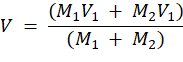
Where V represents the velocity of the objects,
M1 denotes the mass of the first object expressed in kilograms
M2 denotes the mass of the second object taken in kilograms
V1 represents the initial velocity of the first object taken in  ,
,
V2 is the initial velocity of the second object expressed in .
Derivation of an Inelastic Collision
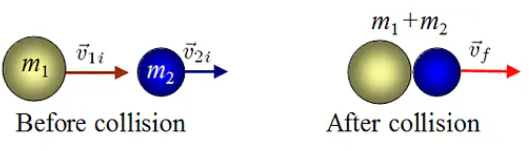
Image: Before and After effect in an inelastic collision
Source: College Duniya
According to the law of conservation of momentum,
Momentum of the Collided Body = Momentum of Object A + Momentum of Object B
--- (Equation 1)
Where Momentum of Object A  ---- (Equation 2)
Momentum of Object B  ----- (Equation 3)
Therefore, Momentum of the collided Body 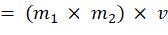 —-------- (Equation 4)
Now on substituting equations, we get


The given equation is for the perfectly inelastic collision to determine the velocity after the collision in one dimension.
Kinetic Energy in Inelastic Collision
Kinetic energy is not conserved in case of inelastic collision. Friction within the object is the cause of the loss of kinetic energy. It might convert into atomic vibrational energy that would cause a heating effect and deformation of the objects.
Practice Problems
Q1. The formula for the perfectly inelastic collision is expressed as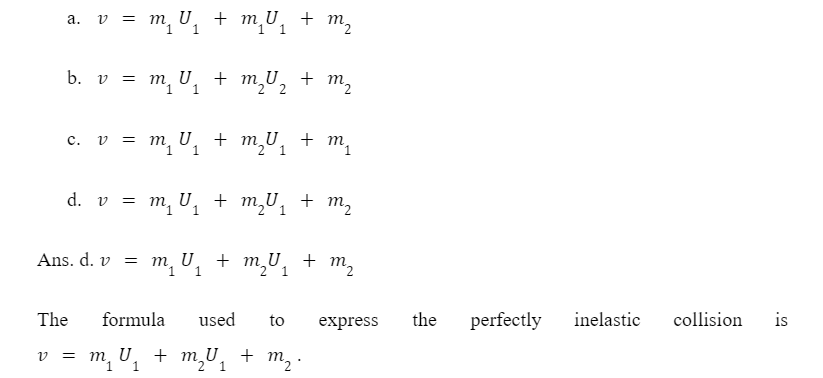
Q2. In all types of collision, momentum remains
a. Variable
b. Conserved
c. Not conserved
d. None of the above
Ans. b. Conserved
Momentum is conserved in both elastic and inelastic collisions.
Q3. The coefficient of restitution is ____ for the perfectly inelastic collision
a. 1
b. 2
c. 3
d. 0
Ans. d. 0
Generally, restitution of collision lies between 0 and 1, but for perfectly inelastic collision, the coefficient of restitution is 0.
Frequently Asked Questions
Q1. What is elastic collision?
Answer: When two objects collide, the separation of both objects takes place. It is called an elastic collision. Kinetic energy tends to be conserved. Both conservation of energy and conservation of momentum are utilised to calculate the object’s motion in an elastic collision.
Q2. State some real-world examples of inelastic collision.
Answer: Some examples of inelastic collisions include
- A vehicle hits a tree.
- When two vehicles met with an accident.
- When a mud ball strikes the wall, it gets adhered to the wall.
- When a ball is dropped from a certain height, it cannot return to its original height.
Q3. Give the common examples of inelastic collisions?
Answer: Some common examples of inelastic collisions are as follows:
- Two automobiles collide and become entangled in each other
- Throwing a clay ball to the ground
- Billiard ball collisions
- A hammer striking a nail
- Due to adhesion, two things collide and cling together.

 Call Now
 Let's Chat
 Share
Share