-
Call Now
1800-102-2727


Dual Nature Of Matter And Radiation - Definition, Theory and Equation

Dual Nature Of Matter And Radiation - Definition, Theory and Equation
The dual nature of matter and radiation refers to the two natures of every object, which is associated with wave and particle nature. This dual nature of matter and radiation is known as wave-particle duality. De Broglie Wavelength explains that the wavelength of an object is related to its mass and momentum. It explains the dual nature of matter; that is, it can act both like particles and waves.
Table of Contents:
- What is the Dual Nature Of Matter And Radiation?
- Photoelectric effect
- Limitations of the Photoelectric Effect
- Laws of Photoelectric Effect
- Wave Theory of Light and Photoelectric Effect
- Particle nature of light: The photon
- Wave nature of matter: De Broglie Wavelength
- Derivation of De Broglie Equation
- Practice Problems On Dual Nature Of Matter And Radiation
- Frequently Asked Questions
What is the Dual Nature Of Matter And Radiation?
The dual nature of radiation and matter refers to the dual property of matter in nature. They are particle nature and wave nature. A matter shows the wave nature by exhibiting the phenomenon of interference and diffraction. It shows particle nature by exhibiting the packets of light. Both these phenomena are exhibited by electromagnetic radiation.
Photoelectric Effect
When electromagnetic radiation like light strikes the surface, the photoelectric effect takes place. This photoelectric effect leads to the emission of electrons. The effect depends on many factors, such as potential, intensity and frequency of the radiation.
Limitations of the Photoelectric Effect
- The photoelectric effect does not apply to all kinds of elements.
- This effect works only at specific temperature ranges and not beyond that.
Laws of Photoelectric Effect
- The incident ray frequency is directly proportional to the incident ray intensity.
- The threshold frequency for a metal is a particular frequency level under which photoelectric emission doesn’t occur.
- The particle's kinetic energy depends on the frequency of the incident ray.
Wave Theory of Light and Photoelectric Effect
The wave theory of light explains concepts such as the phenomenon of diffraction, polarisation, interference, etc. According to wave theory, the electrons remain on the surface of the metal. It absorbs the radiant energy of the surface.
Particle Nature of Light: The Photon
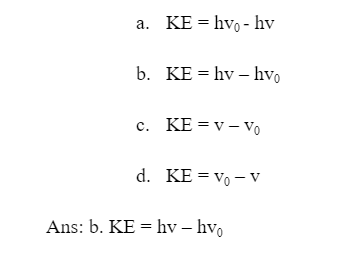
Einstein’s theory of the photoelectric equation states that electrons don’t absorb radiation continuously. Quanta of energy of radiation create the radiation energy. Thus photoelectric equation is given as follows:
KE = hv – hv0
KE refers to the kinetic energy of the photoelectron, where h is Planck's constant.
v= frequency of photons.
v0 = threshold frequency of material.
- Photons are independent of the intensity of radiation.
- The neutral electric or magnetic field does not deflect them.
- The photon-electron collisions conserve the total energy.
Wave Nature of Matter: De Broglie Wavelength
If a particle acts as a wave, then it has a frequency and a wavelength. De Broglie’s theory states that if a free particle with mass ‘m’ is moving with a speed of ‘v’, then the wavelength is related to its momentum, i.e., p=mv.
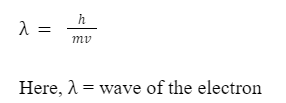
For an electron, the de Broglie wavelength equation:
m = mass of the electron
v = velocity of the electron
mv = the momentum of the electron.
Derivation of De Broglie Equation
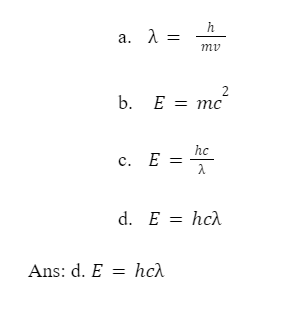
Einstein’s equation: E=mc2……. (i)
Here, E refers to energy, m means mass, and c is the speed of light 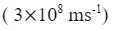
According to Plank’s equation of quantum energy, E is directly proportional to the radiation frequency.
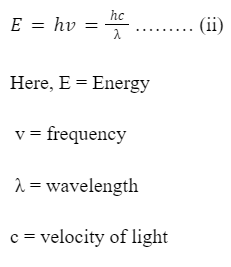
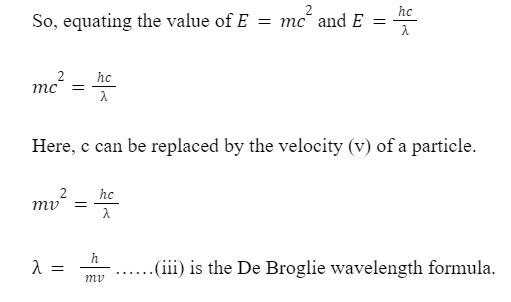
Energy from a moving particle is directly proportional to the wave frequency and inversely proportional to the wavelength. Electromagnetic radiation is emitted due to the acceleration of charged particles in an atom. Atoms radiate photons when they are accelerated.
Practice Problems On Dual Nature Of Matter And Radiation
Q1. The incident ray frequency is directly proportional to __________.
a. incident ray momentum
b. incident ray intensity
c. Both a and b correct
d. None of the above
Ans: b. incident ray intensity
The incident ray frequency is directly proportional to the incident ray intensity.
Q2. Which of the following is not correct?
Q3. Which of the following is correct about the photoelectric equation?
Frequently Asked Questions
Q1. What is the De Broglie formula?
Answer: The De Broglie wavelength equation:  which stands for the wave of the electron, ‘m’ stands for the mass of the electron and ‘v’ stands for the velocity of the electron.
Q2. What is the application of the De Broglie theory?
Answer: De Broglie equation applies to all the particles that have wave-particle duality.
Q3. What is the speed of light?


 Call Now
 Let's Chat
 Share
Share