-
Call Now
1800-102-2727


Distance and Displacement: Definition, Differences, and Formulas

Distance and displacement are two quantities that measure how much an object has moved or travelled, but in two different ways. Since they seem similar, it is common to confuse them with one another. However, one of them measures only the total path travelled, and the other measures the total change from an object’s initial position to its final position. Let us understand the difference, definitions, and more.
Distance
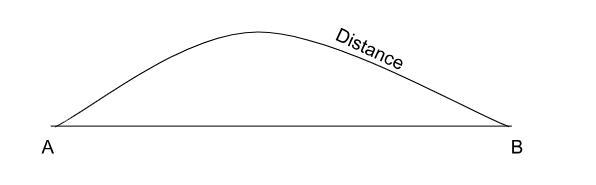
Distance measures the total length of the path an object travels. It counts every part of the motion. It is a scalar quantity where direction does not matter. The SI unit of distance is the metre.
Distance depends on the actual path taken. A longer or curved path gives more distance than a straight path. Distance can never become negative, which means it can either be zero or increase with motion.
Example: A person walks 4 m east, then 3 m west, then 5 m east. Total distance = 4 + 3 + 5 = 12 m.
Displacement
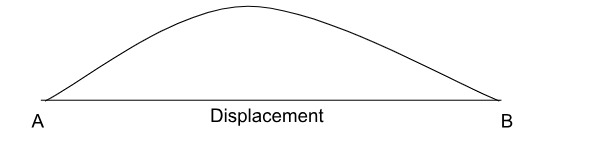
Displacement measures the shortest straight line between the initial and final positions. It always includes direction and hence is a vector quantity. A vector has magnitude and direction. The SI unit of displacement is also the metre.
Displacement depends only on the start and end points; the path taken does not matter. Displacement can have magnitude and direction, and may be zero if the start and end points coincide. The sign depends on the chosen direction.
Example: A person walks 4 m east, then 3 m west, then 5 m east. After the first two steps, the net is 1 m east. Then, walking 5 m east: 1 + 5 = 6 m east. Hence, net displacement equals 6 m east.
Differences Between Distance and Displacement
| Aspect | Distance | Displacement |
|---|---|---|
| Definition | Measures the full path length travelled. | Measures the shortest straight line from the initial to the final position. |
| Nature | Scalar (magnitude only) | Vector (magnitude and direction) |
| Change | Never decreases | Can increase, decrease, or be zero |
| Sign | Always positive | Can be positive or negative |
| Usage | Helps calculate speed | Helps calculate velocity |
Important Formulas for Distance and Displacement
Distance
- Distance = Speed × Time
- Average speed = Total distance ÷ Total time
- Unit: metre and kilometre
Displacement
- Displacement = Final position − Initial position
- Average velocity = Total displacement ÷ Total time
- Unit: metre and kilometre, with direction
Distance vs Displacement in Straight and Curved Motion
Straight Line Motion
In straight-line motion without a change in direction, distance and displacement remain equal.
Example 1: A car moves 200 m east. Distance = 200 m. Displacement = 200 m east.
A change in direction breaks this equality.
Example 2: A car moves 120 m east, then 40 m west. Distance = 160 m. Displacement = 80 m east.
Circular Motion
Circular motion shows a clear difference between distance and displacement. An object moves in a circle of radius r.
After one full round: Distance = 2πr, Displacement = 0.
After half a round: Distance = πr, Displacement = 2r.
Motion Graphs of Distance and Displacement
A distance–time graph shows distance on the vertical axis and time on the horizontal axis. The graph never slopes downward; a steeper slope means a higher speed.
Distance
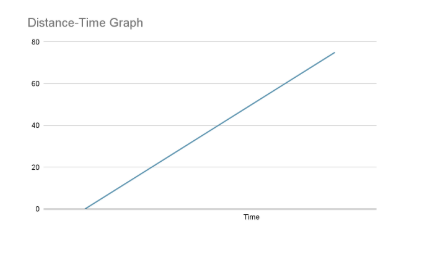
The displacement–time graph shows displacement on the vertical axis and time on the horizontal axis. The graph can slope upward or downward; a downward slope shows motion opposite to the chosen direction.
Examples to Understand Distance and Displacement
Question 1: A boy walks 300 m north, then 400 m east. Find the distance and displacement of the boy.
Distance = 300 + 400 = 700 m
Displacement = √(300² + 400²) = 500 m in the north-east direction
Question 2: A car completes one round of a circular track of radius 70 m. Find the distance and displacement of the car.
Distance = 2πr = 2 × 22/7 × 70 = 440 m
Displacement = 0
Question 3: A bus travels 5 km east in 1 hour and returns 3 km west in 30 minutes. Find the average speed and average velocity of the bus.
Distance = 5 + 3 = 8 km
Time = 1.5 hours
Average Speed = 8 ÷ 1.5 = 5.33 km/h
Displacement = 2 km east
Average Velocity = 2 ÷ 1.5 = 1.33 km/h east
Question 4: A particle moves from 0 m to 10 m, then returns to 4 m. Find the distance and displacement covered by the particle.
Distance = 10 + 6 = 16 m
Displacement = 4 − 0 = 4 m
Summary
Distance measures the total path length covered during motion and is always positive, without considering direction. Displacement, on the other hand, is the shortest straight-line distance between the initial and final positions and includes direction, so it can be positive, negative, or zero. While distance depends on the path taken, displacement depends only on the start and end points.
Speed is calculated using distance, whereas velocity is calculated using displacement. Understanding the distinction between distance and displacement provides a strong foundation for analysing motion and is essential for mastering further concepts in kinematics.
FAQs
1. Can displacement be greater than distance?
No. Displacement can never be more than the total distance travelled. Distance measures the entire path covered, while displacement is the straight-line distance between the starting and ending points.
2. Can distance be zero during motion?
No. Distance measures the total path length travelled, so as long as there is motion, the distance covered is always greater than zero. It cannot be zero while the object is moving.
3. Which graph helps find displacement directly?
The velocity–time graph allows us to determine displacement by calculating the area under the curve.
4. Why do equations of motion use displacement?
Equations of motion use displacement because it directly relates the change in position of an object to its velocity and time.

 Call Now
 Let's Chat
 Share
Share