-
Call Now
1800-102-2727


Dimensions of Viscosity

When the fluid exerts resistance against its motion or flow, its measurement is called viscosity. Viscosity can be symbolised by  . Fluids that exhibit viscous resistance, like, honey, oil, cream, ink, and so on, are utilised daily. The dimensions of viscosity are used to derive the formula or equation slang with the measurements of viscous fluids.
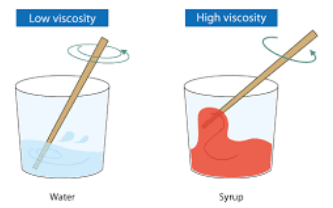
Image: Non-viscous vs Viscous Fluid
Table of Contents:
- The Formula of Viscosity
- Units of Viscosity
- Dimensional Formula of Viscosity
- Derivation of Viscosity
- Uses of Dimensional Formula of Viscosity
- Restrictions of Dimensional Formula of Viscosity
- Practice Problems
- Frequently Asked Questions
The Formula of Viscosity
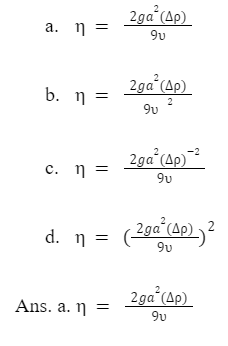
Viscosity is the calculation of the ratio between shearing stress with the fluid’s velocity gradient. Mathematically, if a sphere is dipped in any viscous fluid, the formula can be expressed as follows:

Where  represents the density difference between the fluid and sphere tested
 illustrates the radius of the sphere
 denotes the velocity of the sphere, and
g is the acceleration due to gravity.
Units of Viscosity
Viscosity can be measured in Poiseuille, denoted by PI (SI Unit). Also, Newton-second per square metre (Nsm-2) or Pascal-second (Pa - s) can be used to measure the viscosity value.
Dimensional Formula of Viscosity
The formula for the dimensions of viscosity can be expressed as follows:
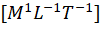
M expresses the Mass,
L determines the Length, and
T is the Time.
Derivation of Viscosity
The formula for the dimensions of viscosity can be derived via the following steps.
Viscosity = Tangential Force Distance between Layers [Area Velocity]-1 ------ (Equation 1)
We know
Therefore, the dimensional formula of Tangential Force 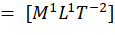 —---- (Equation 2)
The dimensional formula of Area 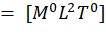
The dimensional formula of Velocity 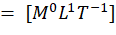 —------- (Equation 3)
Now, we substitute equations 2 and 3 in equation 1. We get
Viscosity = Tangential Force Distance between Layers [Area Velocity]-1
Or
 .
.
Therefore, the formula for the dimensions of viscosity can be illustrated as 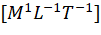 .
.
Uses of Dimensional Formula of Viscosity
There are various uses of the dimensional formula of viscosity. They include the following:
- It assists in checking the correctness and consistency of the formulas and equations.
- Aids in deriving new formulas and equations.
- Helps in performing the approximate measurements and estimates of physical quantities.
- It helps in the conversion of units of one system to another.
- The dimensional formula aids in determining the relationship between two or more variables.
Restrictions of Dimensional Formula of Viscosity
Despite various benefits, dimensional formulas also hold certain limitations. They include the following:
- They avoid dimensionless contents and ratios.
- It does not determine whether the physical quantity is vector or scalar.
- They cannot work for non-linear relationships between the variables.
- Strictly restricted to homogeneous formulas or equations.
- It does not provide any accurate numeric values.
- Provide an incomplete illustration of the intricacies of physical phenomenons.
Practice Problems
Q1. Choose the correct formula of viscosity
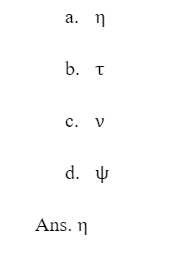
Q2. The symbol that denoted the viscosity
Q2. Choose the correct formula for the dimensions of viscosity.
a.

Q4. The SI unit of viscosity is
a. Poiseuille
b. Ampere
c. Coulomb
d. Pascal
Ans. a. Poiseuille
Q5. A U-tube viscometer is also called
a. Glass capillary viscometer
b. Ostwald viscometer
c. Bulb capillary
d. Both a and b
Ans : d. Both a and b
Glass capillary viscometers and Ostwald viscometers are the other names of U-tube viscometers.
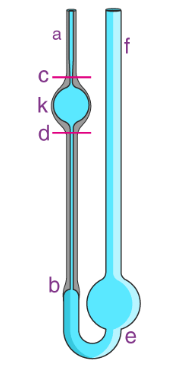
Image: U-Tube Viscometers
Frequently Asked Questions
Q1. What are the different types of viscosity?
Answer: The measurement of fluid causing friction to its flow is called viscosity, and the measurement can be performed in two ways, i.e., dynamic viscosity and kinematic viscosity.
Q2. State one difference between Newtonian and non-newtonian fluids.
Answer: Newtonian fluid follows Newton’s law of constant viscosity and remains constant when the applied stress or deformation rate is intense. At the same time, non-newtonian fluid does not possess constant viscosity and varies based on the magnitude of applied stress.
Q3. What is stress?
Answer: The force exerted within a substance per unit is due to the external force applied is called stress. The impact of that stress is called strain. The symbol denotes stress is  . The stress formula can be expressed as
  .
.
Q4. State five applications of viscosity in real-time.
Answer: The viscosity applications in real life are as follows:
- Vaccines and Drugs
- Cooking oil and Engine Oil,
- Honey
- Manufacturing of lubricants
- Printing Ink and Super glue.

 Call Now
 Let's Chat
 Share
Share