-
Call Now
1800-102-2727


Dimensions of Velocity

Velocity is the fundamental concept in Physics. It is used to understand the movement of different vehicles, sports, understanding the working of the cosmic elements. From the movement of birds to revolutionised transportation technology, velocity has progressed in several ways in our life. Dimensions of velocity play an important role in understanding the concept of velocity and help establish the relationship between velocity and several other concepts of physics.
Table of Contents
- What is Velocity?
- The Formula of Velocity
- Units of Velocity
- Dimensions of Velocity
- Factor Affecting Velocity of An Object
- Types of Velocity
- Practice Problems
- Frequently Asked Questions
What is Velocity?
It is defined as the rate of change of position by the object in a particular direction. The velocity is a vector quantity due to the directional component. It is a vector quantity, which means it has both magnitude (or numeric value) and direction. In simple words, velocity determines the speed at which an object moves and in which direction it moves.
It is important to know the difference between velocity and speed since they are actually two related but distinct notions. While velocity considers the direction of movement, speed just considers the magnitude of motion.
The Formula of Velocity
The mathematical formula of the velocity is:
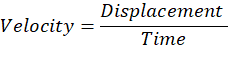
The velocity component is designated as v, displacement is designated as d and time is designated as t. The displacement is a change in the object's position, while time indicates the time taken for the same. Generally, the velocity is simply the displacement per unit time.
The velocity may also change with respect to time. In such case, the average velocity is calculated using the formula:

Units of Velocity
According to the International System of Units or SI Unit, the velocity is measured in metres per second. It represented as ms-1. Besides it, there are other units of velocity like kilometres per hour, miles per hour and feet per second. Another uncommon yet important unit in the aviation and maritime industry is knots which refers to nautical miles per hour.
Dimensions of Velocity
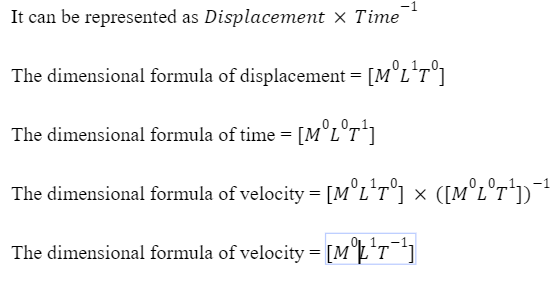
The dimensional formula is represented using M for mass, L for distance and T for time.
Moreover, 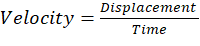
Factor Affecting Velocity of An Object
There are several factors holding the capability to influence the velocity, such as:
- Force: According to Newton’s second law of motion, the force influences the acceleration of the object. The subsequent effect is a change in velocity.
- Mass: Based on Newton’s second law of motion, acceleration is inversely proportional to mass and can influence velocity.
- Friction: Friction is the resistive force that ultimately halts the object, thus bringing the velocity to zero.
- Air Resistance: Also referred to as drag, it refers to the force exerted in a fluid medium. The air resistance has the potential to modify the shape and size of the object, further impacting the speed of movement of the object.
- Applied External Forces: Electromagnetic forces and other applied forces can also impact the velocity of an object.
Types of Velocity
There are multiple aspects of velocity, such as
- Angular velocity: It is defined as the rate of change of angular displacement of an object rotating around an axis. The angular velocity is measured in radians per unit of time.
- Terminal velocity refers to the final velocity applied by drag force on a constant velocity of a freely falling object. The force is exerted via the surrounding medium.
- Escape velocity: It is defined as the minimum velocity required for an object to overcome the gravitational pull of a celestial body. It depends on the mass and radius of the celestial body.
- Instantaneous velocity: It is an object's velocity at a specific point in time. It considers infinitesimally small time intervals.
- Relativistic velocity: It is the velocity of the object in relation to the observer. It involves a frame of reference for calculation and changes based on perspective.
Practice Problems
Q1. What is the final velocity of the ball at the highest point if its initial velocity is 20 metres per second and it reaches the height after 3 seconds?
a. 0 ms-1
b. 1 ms-1
c. 2 ms-1
d. 6.6 ms-1
Ans. a. 0 ms-1
The ball will come to a halt before continuing its journey downwards, and hence its final velocity will be 0 ms-1.
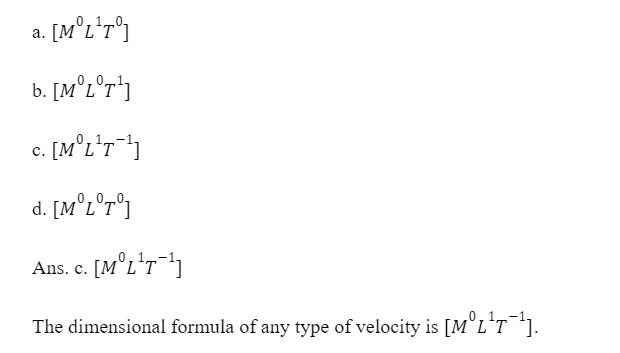
Q2. What are the dimensions of escape velocity?
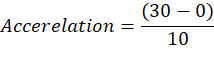
Q3. What will be the acceleration if a car accelerates from rest to a velocity of 30 metres per second in 10 seconds?
a. 0 ms-1
b. 3 ms-1
c. 3 ms-2
d. 30 ms-1
Ans. c. 3 ms-2


Frequently Asked Questions
Q1. What are the velocity measurement techniques?
Ans. The important velocity measurement techniques include Doppler effects and radar and lidar-based velocity measurement.
Q2. What is the escape velocity to reach the moon?
Ans. The average escape velocity to reach the moon is around 2.38 kilometres per second which depends on the mass and radius of the moon.
Q3. Which planet has the highest escape velocity?
Ans. The planet Jupiter has the highest escape velocity owing to its large radius and mass.

 Call Now
 Let's Chat
 Share
Share