


Dimensions of Universal Gravitational Constant

The ability to stand, the landing of an airplane and the falling of a ball on the ground are all possible due to the gravitational pull of Earth. It is the force of attraction and also contributes to our ability to stand on Earth. It is the central or gravitational force that acts along the line connecting the centre of two bodies. The gravitational effects are calculated using the gravitational constant, or Universal Gravitational Constant utilised in Newton’s Law of Gravitation and Einstein’s theory of relativity.
Table of Contents
- What is the Universal Gravitational Constant?
- The Formula of Universal Gravitational Constant
- Value of Universal Gravitational Constant
- Dimensions of Universal Gravitational Constant
- Practice Problems
- Frequently Asked Questions
What is the Universal Gravitational Constant?
The universal gravitational constant is the proportionality constant used in the universal law of gravitation. The force of attraction among two unit masses placed at a unit distance distant is mathematically equivalent to the value of the universal gravitational constant. The gravitational force between two bodies of equal mass kept at an equal distance constitutes the universal gravitational constant.
The Formula of the Universal Gravitational Constant
Universal gravitational constant was derived by Newton to better explain the force of gravitational attraction.
 , where f is the force of gravitational attraction, m1 and m2 is the mass of object 1 and 2, and d is the distance between the centre of two objects.
The SI unit of the universal gravitational constant is  .
.
Value of Universal Gravitational Constant
Considering the SI unit, the value of the Universal Gravitational Constant is  . In the CGS system, the value is
  .
.
Dimensions of Universal Gravitational Constant
In the dimensional formula, mass is depicted as M, length in depicted as L and time is depicted as T. The derivation of the dimensional formula is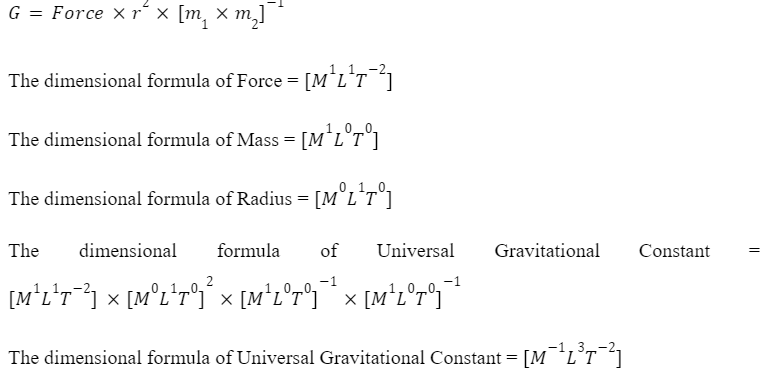
Practice Problems
Q1. What is the relationship between acceleration due to gravity and the Universal Gravitational constant?
a. 
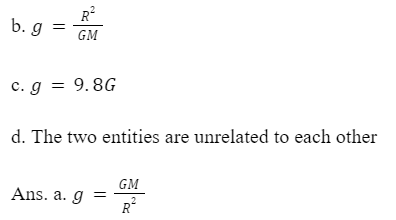
The stated formula relates the acceleration due to gravity and Universal Gravitational Constant. In this formula, g is the acceleration due to gravity, G is the Universal Gravitational Constant, M is the mass of the body, and R is the radius of the body.
Q2. Who actually discovered Universal Gravitational Constant?
- Newton
- Einstein
- Cavendish
- Kepler
Ans. c. Cavendish
Newton stated the gravitational law, and Cavendish found the gravitational constant.
Q3. What is the current status of G or the Universal Gravitational Constant?
- The Universal Gravitational Constant is static
- The Universal Gravitational Constant is increasing gradually
- The Universal Gravitational Constant is decreasing gradually
- The Universal Gravitational Constant is decreasing rapidly
Ans. c. The Universal Gravitational Constant is decreasing gradually
Since the world is expanding, the distance between the bodies is increasing. According to the formula, the Universal Gravitational Constant is inversely proportional to the square of the radius, decreasing gradually.
Frequently Asked Questions
Q1. What factors influence the Universal Gravitational Constant?
Ans. The Universal Gravitational Constant is a ‘universal constant’ and hence is unaffected by any factors.
Q2. What are the applications of the Universal Gravitational Constant?
Ans. The Universal Gravitational Constant finds significant application in determinations of the mass of celestial bodies such as the sun, earth and moon. It is also useful in calculating motion prediction and trajectory of astronomical bodies. The Universal Gravitational Constant helps to discover new planets and stars in the universe.
Q3. What hinders the calculation of the accurate value of the Universal Gravitational Constant?
Ans. The experimental uncertainties, complex data analysis, influence of environmental conditions and sensitivity of measurements limit the calculation of the Universal Gravitational Constant.
NEET Related Links
JEE MAIN Related Links
JEE Main marks vs rank vs percentile
JEE Advanced Related Links
JEE Advanced Eligibility Criteria
JEE Advanced Chemistry Syllabus
JEE Advanced Registration Dates
CUET Related Links
Important Topics
Anemometer : Measurement of Wind Speed
Angular Acceleration Atomic Theory Audible and Inaudible Sound Average Speed and Average Velocity Average Velocity Avogadros Number Avogadros Hypothesis Azimuthal Quantum Number Balanced Force Bar Magnet Biconvex Lens Boyles Law Buoyancy Calorimeter Carnot Engine Celestial Bodies Centripetal And Centrifugal Force Concave and Convex Lenses Concave Convex Mirrors Contact and Non Contact Force Controlled Thermonuclear Fusion Convection Currents Convex Lens Convex Mirror Destructive Interference Difference Between Conduction Convection and Radiation Difference Between Electric Field and Magnetic Field Difference Between Heat And Temperature Difference Between Series And Parallel Circuits Differences Between Acceleration And Velocity Distance and Displacement Distance Time Graph Electrical Force : Electric Forces and Their Types Electromagnetic Waves : Definition, Equation and Properties of Electromagnetic Waves Electromagnetism Electron Spin Fluid Flow : Bernoullis Equation Derivation and Fluid Mechanics Fluid Friction : Types and Factors of Fluid Friction Frames of Reference : Inertial and Non- Inertial Frame of Reference Frequency and Wavelength Frictional Force Importance of Hydrosphere Instantaneous Speed and Velocity Introduction to Motion Kinetic and Potential Energy Difference Law Of Conservation of Energy Layers of the Earth Light Energy Light Sources List of physics scientists and Their inventionsLoudness of Sound
Magnetic Dipole Moment Magnetic Field Non - Contact Force Non - Renewable Energy Ohms Law Optics P Wave Physics Symbols Plane Mirrors Poissons Ratio Projectile Motion Properties of Water : Anomalous Expansion of Water Radius of Gyration Reflection of Light Reflection of Waves Relative Density Resonance Reverberation Rolling Friction Rotation and Revolution Screw Gauge Semiconductors and Insulators Sliding Friction Speed Time Graphs Static Friction Stefan Boltzmann Law Stress Tension Tension Force Thermometer: Clinical Laboratory Thermometer Types of Rocks Types of Waves Uniform Motion and Non Uniform Motion Unit of Voltage Uses of Convex Lens Uses Of Convex Mirror Uses of Electromagnet Uses of Optical Fibre Wave Wavelength of Light What is Scattering of Light Working of Electric Bell Conventional and Non-conventional Sources of Energy Buoyant Force Bulk Modulus of Elasticity Bernoulli’s Principle Angular Momentum Difference Between Speed And Velocity ForceUnit of Heat
Difference between Distance and Displacement Simple Microscope Derivation Of Equation Of Motion Thermometer: Clinical & Laboratory Thermometer Difference between Concave and Convex LensDerivation Of Lens Maker Formula
Unit Of Pressure Velocity Uses of Plane Mirror
Wave Theory of Light
Unit of Density Unit of Light Unit of Force Unit of Magnetic Field Unit of wavelength Unit of Viscosity Uses of Electroplating Young's Modulus
What is the Scattering of Light
Lenz Law Space Wave Propagation Schrodinger Wave Equation Relation between Fahrenheit and Celsius Refractive Index Potentiometer Working Pascal Law Oscillatory Motion Optical Instruments Newton's Laws of Motion - First Law Modulation and Demodulation Magnetic Flux Lens Formula and Magnification Kaleidoscope Faradays Law Epsilon Naught Value Energy Bands Electrostatics Electroscope AC Generator Unit of Current Lithosphere Bending Equation Derivation Difference Between Pound and Kilogram Semiconductor Devices OTEC - Ocean Thermal Energy Conversion Hall Effect Rectilinear Propagation of Light Difference Between Ammeter and Voltmeter Coefficient of Linear Expansion Ampere’s Law Cyclone and Thunderstorm Save The Environment From Pollution Particle Nature of Light Types of DC Motor Uses Of Transistor Derivation of Phase Rule Unit of Humidity

 Call Now
 Let's Chat
 Share
Share