-
Call Now
1800-102-2727


DC Motor - Types, Practice problems, FAQs

Sumi has always been fascinated by the functioning of motors in the toys. They rotate when the motors are connected with the battery and switch is on. They stop instantly when the switch is off.
Motors are electrical devices which are capable of producing rotation when current is passed through them. Due to their versatile property of rotating, they find applications in several devices like toys and drilling machines. Motors work on the principle that when a current carrying conductor is placed in a magnetic field, it experiences a torque. This torque tends to rotate the coil. In this article, we will explore different types of DC motor.
Table of contents
- Definition of DC motor
- Construction and working of DC motor
- Types of DC Motor
- Applications of DC motor
- Practice problems
- FAQs
Definition of DC motor
A DC motor is a device which is used to convert electrical energy into mechanical energy. Unlike AC motors, DC motors rely on unidirectional current. The emf that is induced in its coil is called the back emf; it acts in a direction opposite to that of the applied voltage.
Construction and working of DC motor
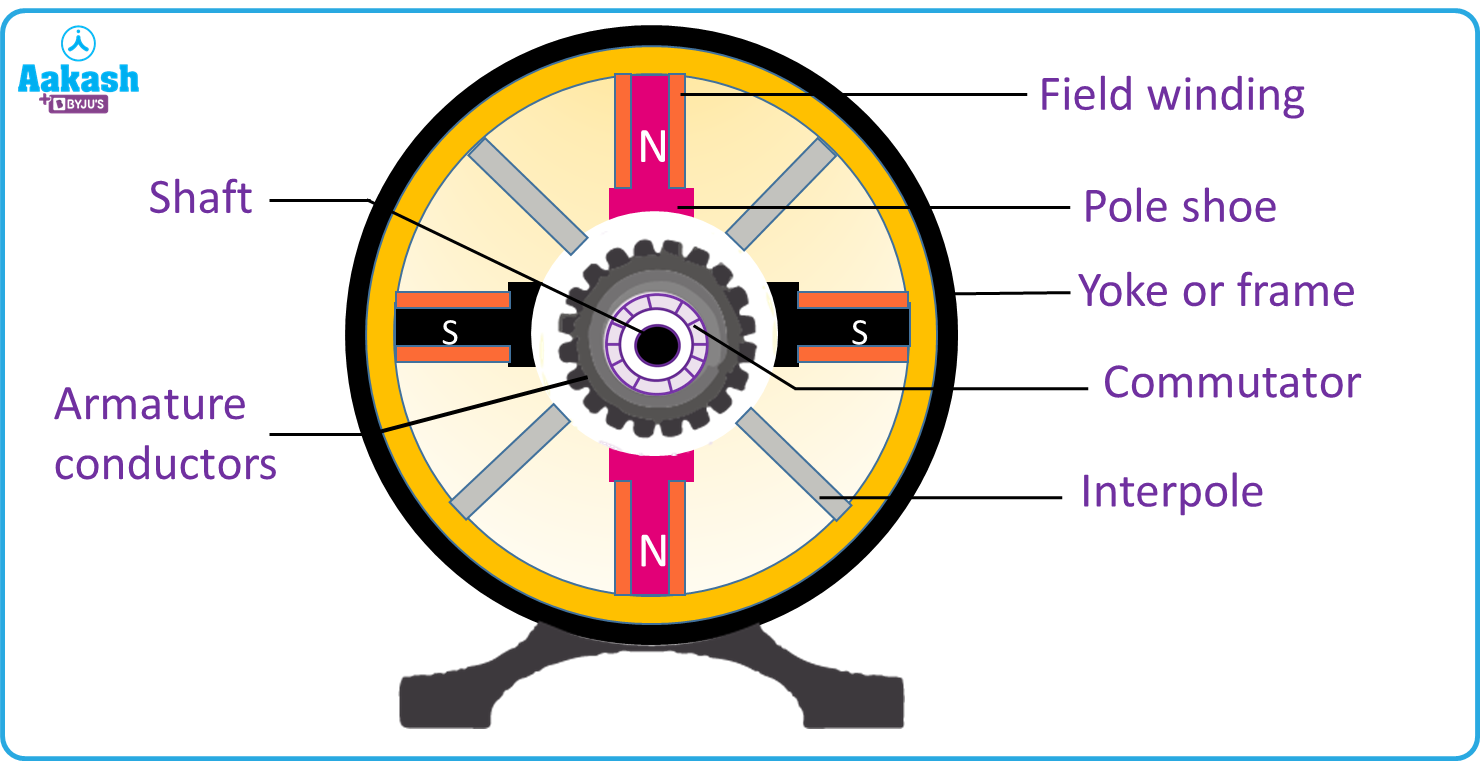
1) Armature
It is a rotating coil wound on a soft iron core. The core is laminated so as to reduce its cross sectional area and thus, prevents eddy current losses.
2) Stator coil
The stationary part of the DC motor which produces the necessary magnetic field is called its stator. It is sometimes called the field windings.
3) Commutator
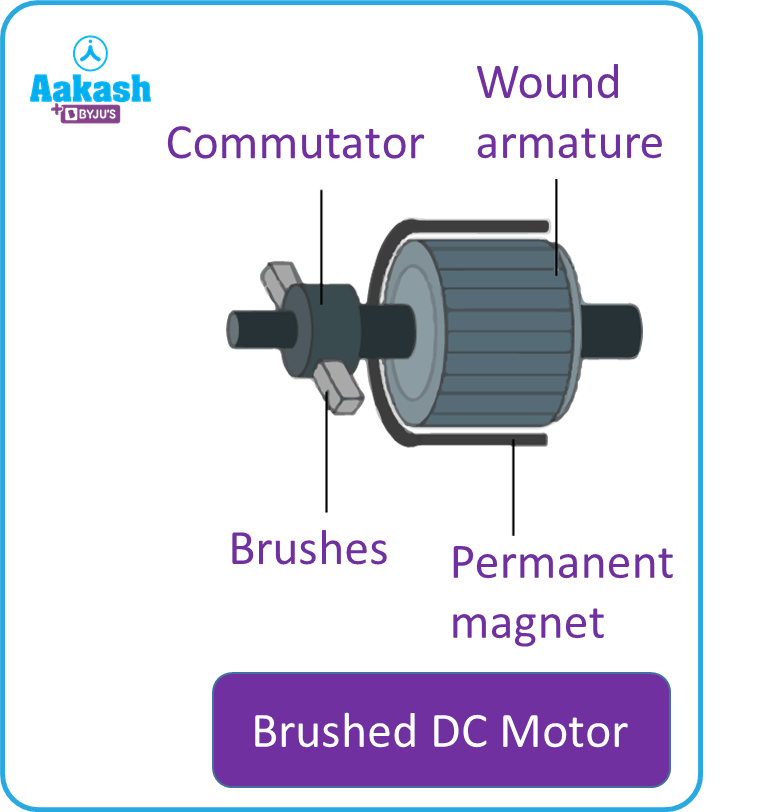
The function of the commutator is to reverse the direction of electric current each time the brushes connected to the armature change poles. With the commutator we can get the electricity only in one direction in the circuit. They also provide supply of electric current to the external circuit. Typically, commutators are made of copper.
4) Brushes
Brushes are made of graphite. They conduct current from the armature to the external circuit.
Working principle
A current carrying conductor when placed in a magnetic field, is acted upon by two equal and opposite forces. These forces constitute a torque, which tries to rotate the coil.
Types of DC Motor
Based on how the field windings are connected to the armature, the DC motors are of following types.
1) Self excited DC motor
In such motors, the field winding is connected either in series or parallel to the armature windings. They are further classified into
- Shunt wound DC motor
- Series wound DC motor
- Compound wound DC motor
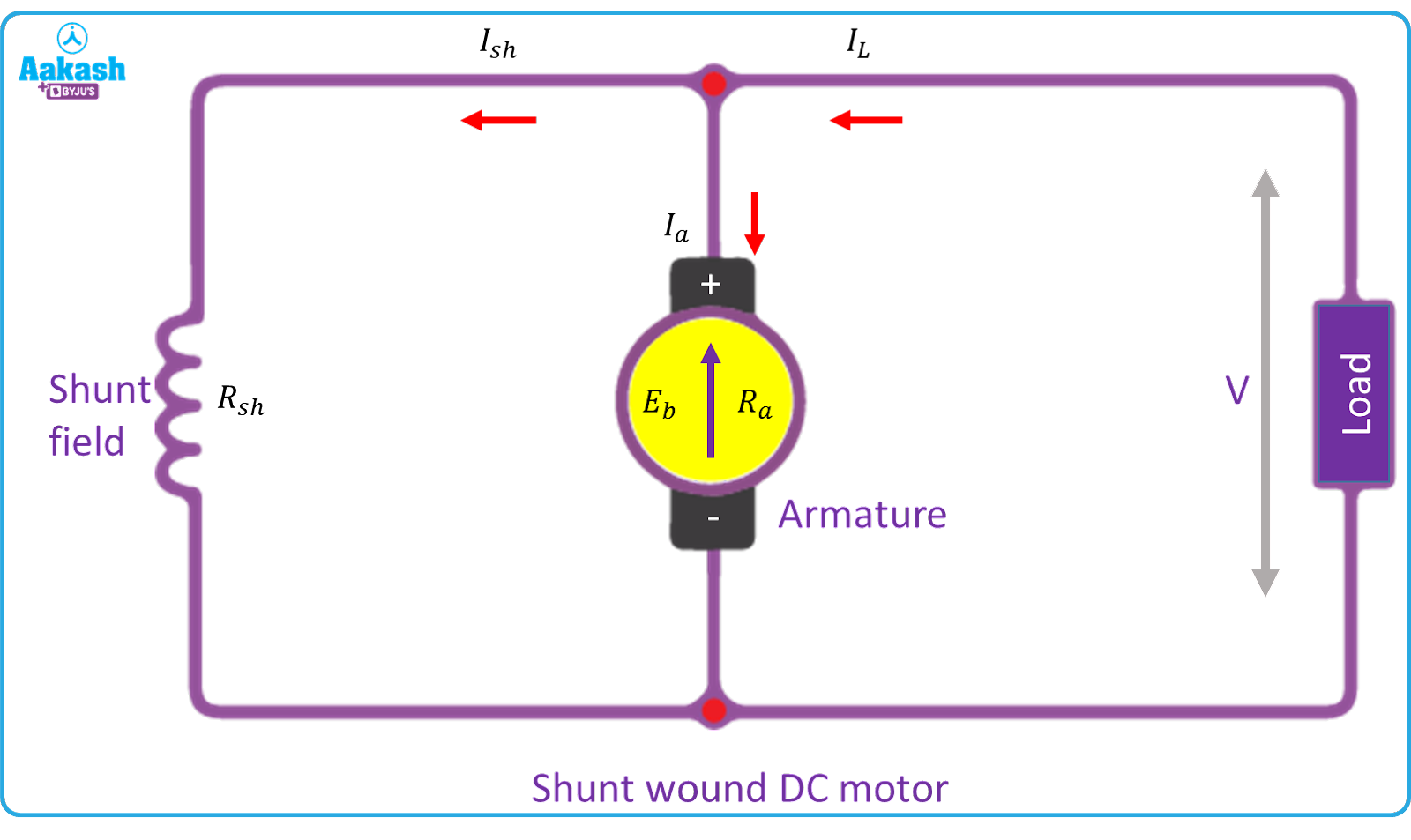
Shunt wound DC motor
In a shunt wound DC motor, the field winding is connected in parallel to the armature.
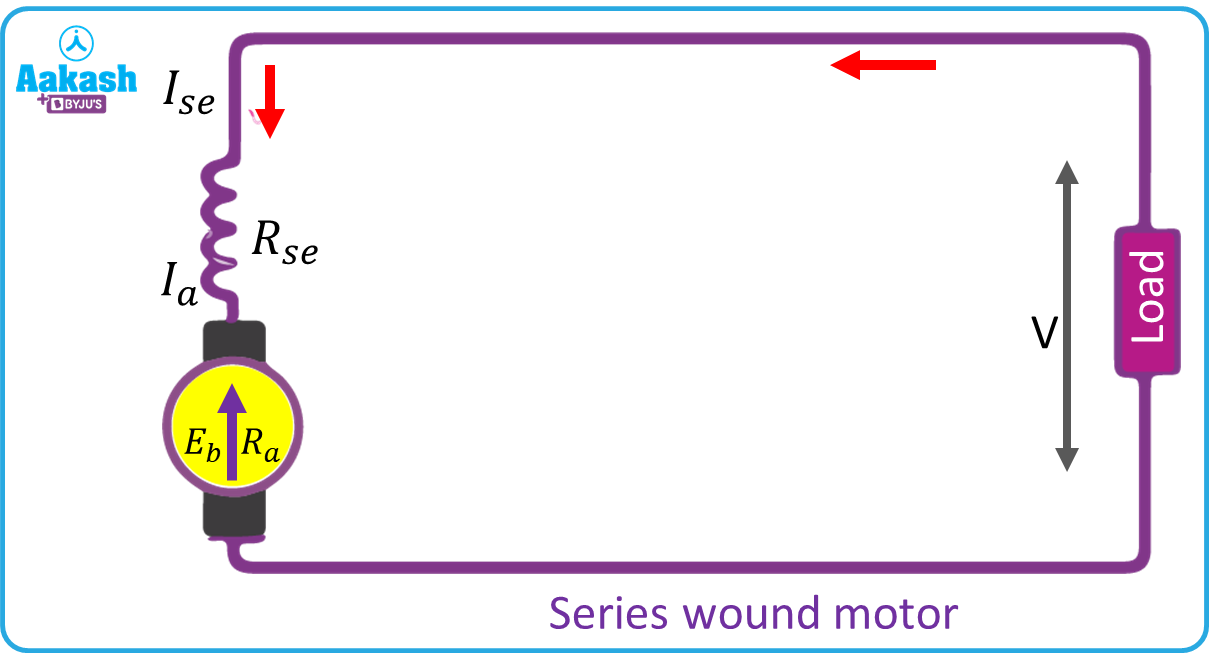
Series wound DC motor
In a series wound DC motor, the field winding is connected in series with the armature winding.
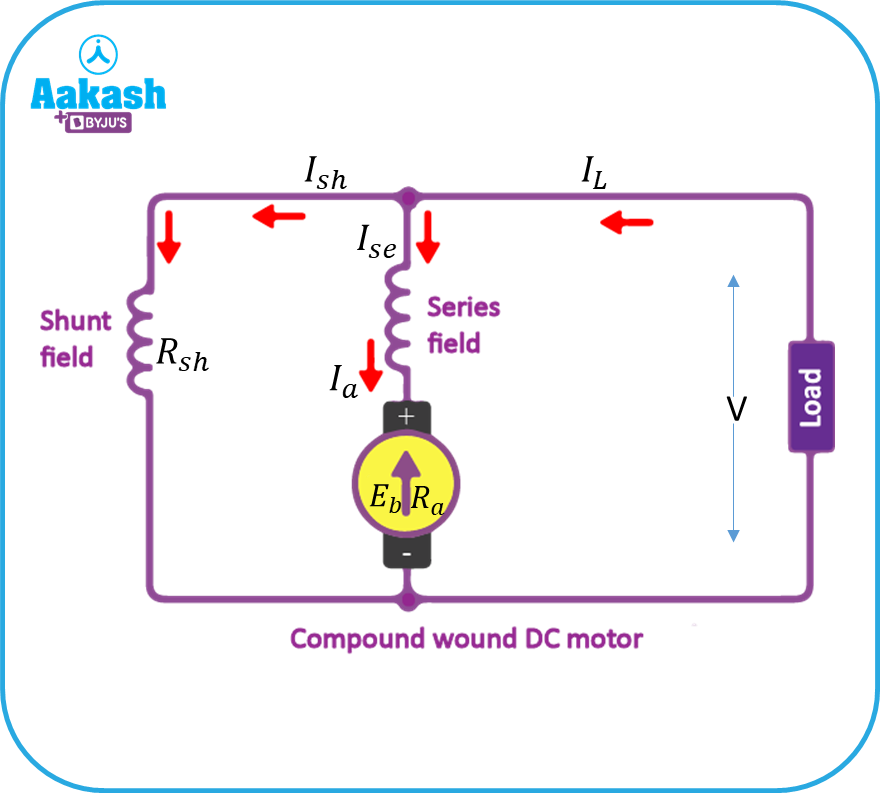
Compound wound DC motor
DC motors that have both shunt(parallel) and series windings with the armature is called a compound DC motor.
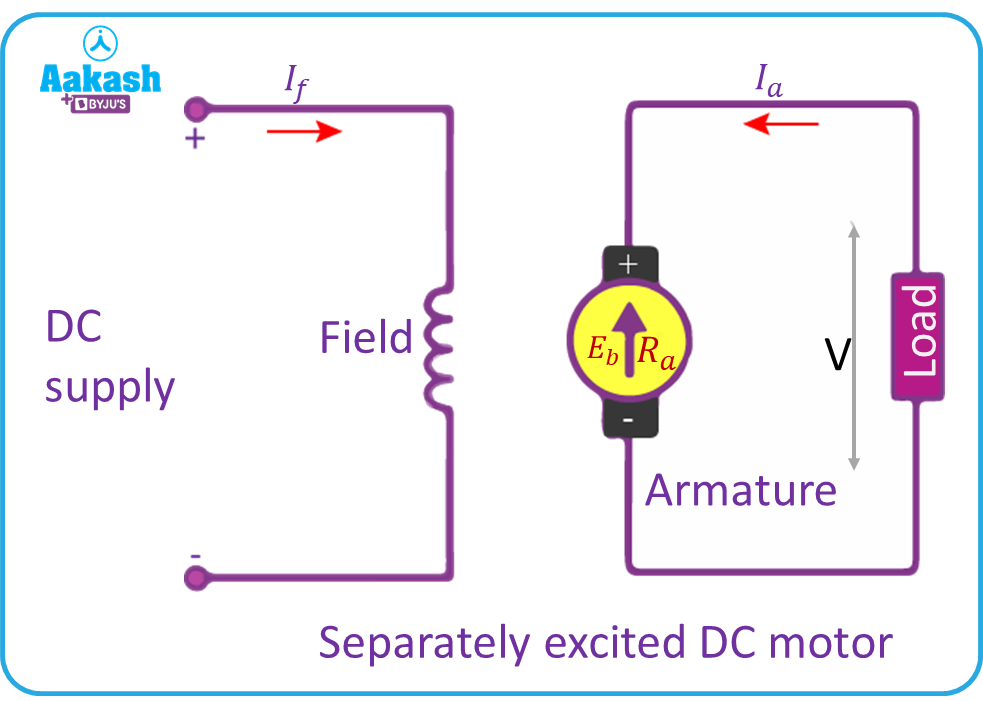
2) Separately excited DC motor
In a separately excited DC motor, the field windings are supplied with energy from an external DC supply.
3) Brushed DC motor
A brushed DC motor is one which uses a commutator that reverses the direction of current flow for every half cycle. It makes use of brushes to transfer the current to the external circuit. They offer a few advantages like low construction cost, and ability to be operated in extreme environments.
4) Brushless DC motor
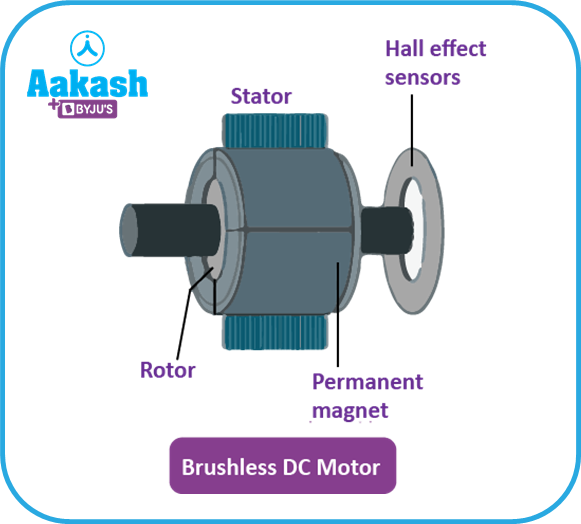
Unlike brushed DC motors, brushless DC motors do not make use of a commutator and produce a single directional torque.
Applications of DC motor
The following are the applications of shunt DC motors: Centrifugal pumps, Lathe machines, Drilling and Milling machines. They usually operate at high speed.
Applications of series DC motors: conveyors, elevators, locomotive engines where a high traction is needed..
Practice problems
Q. A brushless DC motor has an armature that has a resistance of 10 . It is operated on a voltage of 250 V. What is the maximum current it can draw from the external source?
(a) 10 A (b) 20 A (c) 14 A (d) 25 A
A. d
Given,
Maximum current
Q. A DC motor operates on a 200 V supply and draws a current of 5.0 A at a full load speed of 100 rad/s. The resistance of the armature coil of the motor is 10 . Calculate the back emf induced in the armature.
(a) 150 V (b) 250 V (c) 200 V (d) 120 V
A. a
Given,
Vi=200 V , I=5 A, R=10 , =100 rad/s.
Let indicates the back emf in the armature.
Load voltage,
Q. A DC motor is operated on a 100 V source and draws a current of 2 A at a full load speed of 200 rad/s. The resistance of the armature coil is found to be 1 . Calculate the input power supplied to the motor.
(a)150 W (b)200 W (c) 250 W (d)120 W
A. b
Given, V=100 V,I=2 A
Input power supplied
Q. A compound DC motor is operated on a 150 V source and draws a current of 3.5 A. The resistance of the armature coil is found to be 20 . Calculate the power drawn from the external circuit.
(a) 150 W (b) 200 W (c) 250 W (d) 280 W
A. d
Given,
Output power drawn,
FAQs
Q. Why is a DC motor preferred over an AC?
A. DC motors offer a range of speed controls. They also offer a variety of starting, stopping and reversing their direction of spin.
Q. What type of magnet is used in a DC motor?
A. Usually permanent magnet is used in DC motors. So the material should be perfect to make a permanent magnet. Alnico is used as magnets in DC motors. Chromium steel is also a best fit material for the permanent magnets and so for the DC motors. In many cases tungsten steel is also used to make DC motor’s magnets.
Q. What is the role of back emf in DC motors?
A. As the speed of armature rotation increases, back emf increases as well and this causes the armature current to decrease. Also, when the load connected to the motor reduces, the torque becomes momentarily high, thereby increasing the back emf.
Q. What are the 4 types of DC motor?
A. The four types of DC motor are Series/parallel, Compound DC motor, Brushed DC motor and Brushless DC motor.

 Call Now
 Let's Chat
 Share
Share