-
Call Now
1800-102-2727


Damped Oscillations - energy, practice problems, FAQs

Have you ever swung on a swing in the parks? You may notice that after some time the swing stops by itself. But why does it stop? When the swing is in motion the resistance force acts on it due to the surrounding medium - like air and friction at contacts. Because of these forces the energy of the swing dissipates to the surrounding, hence the amplitude of motion keeps on reducing and after some time motion ceases. These resistance forces are called damping forces and the motion is called damped oscillatory motion. Let's learn what the damped oscillation is!
Table of content
- What is oscillation?
- What is damping?
- Damped Oscillations
- Energy of damped oscillation
- Practice problems
- FAQs
What is oscillation?
When a body is in periodic motion such that it moves in a to and fro motion about a fixed point, then it is said to be in oscillation and the motion associated with this is called oscillatory motion. One cycle of to and fro motion is termed as one oscillation. The maximum distance traveled by the body from its mean position is called the amplitude of oscillation. Time taken by the body to complete one oscillation is called the time period. The number of cycles completed in one second is called frequency of oscillation.
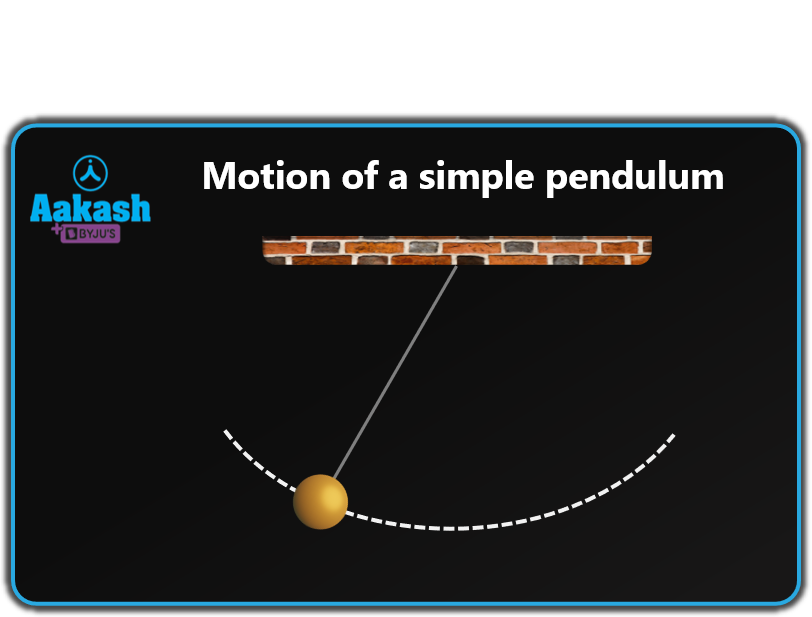
Motion of a simple pendulum, motion of spring block system, motion of a mass along the diameter of earth, motion of swing in the park are some examples of oscillatory motion.
What is Damping?
Damping is the resistance to an oscillatory motion. Every oscillatory motion has energy and this energy dissipates gradually with time due to resistance such as air or friction. Because of this resistance the displacement of particles keeps on decreasing and after some time it vanishes. Damping can be of two types natural damping and forced damping.
When oscillation vanishes due to air resistance or inertia, it is called natural damped oscillation. Example: the motion of a pendulum.
When the body stops oscillating due to some external applied force, then it is called forced damped oscillation. Shock absorber used in vehicles is an example of forced damping.
Damped Oscillations
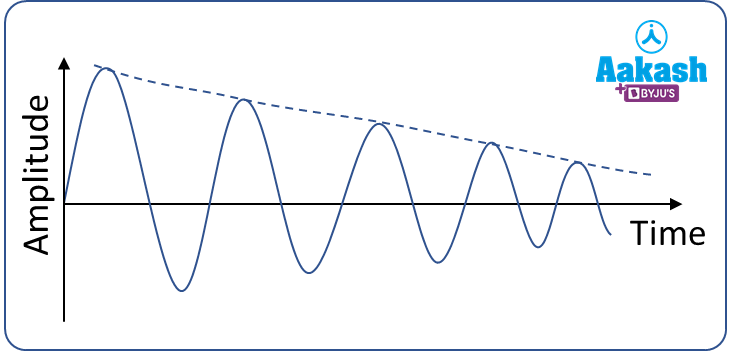
An oscillation whose amplitude decreases with time is termed a damped oscillation. In such oscillation the energy of the system goes on decreasing, hence amplitude also decreases and after some time motion stops.
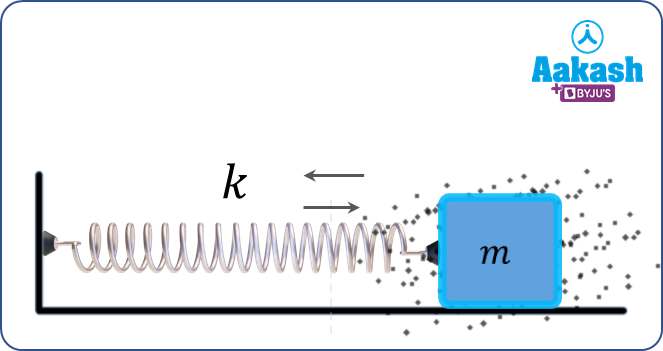
Let us consider a block of mass m attached to the spring of force constant k. It is placed in a damped medium (represented by dots). If we push this block to the right and release it, due to spring force and inertia of the block it will start oscillating. If the angular frequency of the oscillation is given by , then we know
Ideally the spring block system keeps on oscillating for a long time but in reality it will stop oscillating after some time. As it starts oscillating, a damping force will act on it by the surrounding medium. Because of these resisting forces, the energy of the system will dissipate in the form of heat to the surrounding area. The nature and magnitude of damping force depends upon the surrounding medium and the velocity of the system. If the medium is air then the resistance force will be lesser and if the medium is fluid then resistance will be higher.
We know, the damping force is proportional to the velocity of the block and it will act in the opposite direction to the velocity. Let the velocity of the block at a instant is , then damping force on the spring block system , for small velocity, is
Where b is a damping constant whose value depends upon the shape of the object and the viscous effect of the medium in which the spring block system is placed.
As the block is pushed by some distance, the extension in the spring will take place, so the spring will exert a restoring force on the block. If the extension in the spring is , then restoring force on the block is
Now at any time the net force on the system is given by
F=-kx-bv
If is the acceleration of block at time t, then using Newton’s second law, (for 1D analysis vector notation can be dropped),
We know that the velocity can be expressed as and acceleration can be expressed as , so we have,
This is a differential equation of the motion representing the damped oscillation in which the damping force is proportional to the velocity. The solution of this differential equation will give the damped motion of the block in oscillation. The solution of the differential equation is given as,
Where A= the amplitude of motion at t=0
b= damping constant
m= mass of block
frequency of damped oscillation
From this equation we can conclude that the motion is periodic in nature with time period . The amplitude of oscillation is exponentially decreasing with time and at a longer time it will return to zero. The motion can be represented by the cosine function of decreasing amplitude.
The relation between the amplitude and time for damped oscillation is given as,
Energy of damped oscillation
As we know the energy of the oscillation depends upon the amplitude. The expression for the energy is given as,
In damped oscillation the amplitude is not constant but decreases with time. So the energy will also keep on decreasing. The expression on energy for damped oscillation can be found by putting the value of amplitude for damped oscillation in the above expression as,
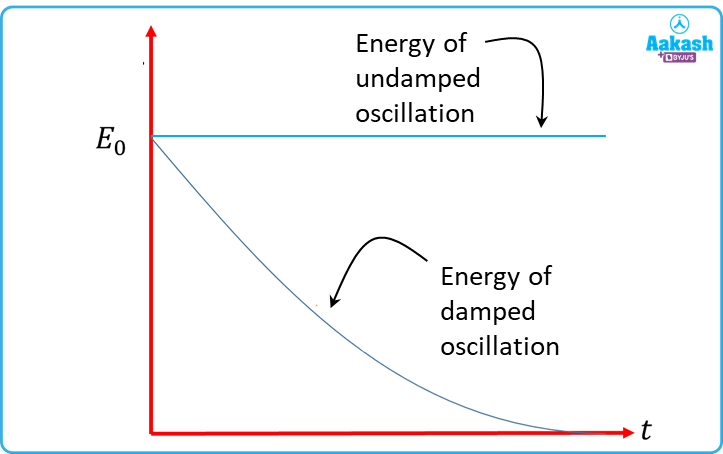
From the expression we can say the energy of damped oscillation decreases with time.
The figure below shows the variation of energy with time of the undamped and damped oscillation.
Practice problems
Q1. In a damped oscillation the amplitude of the oscillator becomes half in 1 min. What will be the amplitude after 2 minutes?
Answer. Given
As we know the amplitude of an oscillatory motion is given as
At time t=1 min
Now for t=2 min
So the amplitude will become a quarter of the initial amplitude.
Q2. A block of mass 5 kg is oscillating with the help of spring. The damping constant for the medium is . If the initial amplitude of oscillation is 7 cm, then find the amplitude of oscillation after 3 sec.
Answer. Given m=5 kg , , t=3 sec and Ao=7 cm
As we know the amplitude of damped oscillation at time t is
Hence the amplitude of oscillation at t=3 sec is 0.63 cm.
Q3. A block of mass m=10 kg is attached to the spring of spring constant . If it is oscillating in a medium having damping constant , then find the damped angular frequency of oscillation.
Answer. Given m=10 kg , and
The damped frequency is given as
Q4. The energy of a damped oscillation at t=1 sec is 10 J, then what is the energy of oscillation at t=4 sec ? The mass of the system is 3 kg and damping constant is .
Answer. Given m=3 kg ,
The formula for the energy is given as
At t=1 sec E=10 J so,
And t=4 sec
Dividing equation (ii) by equation (i), we have
Hence energy of oscillation at t=4 sec will be 1.35 J.
FAQs
Q1. What is free or undamped oscillation?
Answer. Oscillations whose energy remains constant over the time are termed as free or undamped oscillations.
Q2. What are examples of damped oscillation?
Answer. Oscillation of a simple pendulum, string in guitar, oscillation of spring block system in air or water medium, oscillation of swings etc.
Q3. What is the application of damped oscillations ?
Answer. Damped oscillations dissipate the energy over time, so it is helpful in a motor vehicle to decrease the oscillation of the wheel when it comes on the bumps.
Q4. When a block is immersed in water, the damping will increase or decrease?
Answer. Damping will increase because the resistance due to water is greater than air.

 Call Now
 Let's Chat
 Share
Share