-
Call Now
1800-102-2727


Coupling of inductors - Practice problems, FAQs

Resistors are electrical components that are not capable of storing electrical energy when current is passed through them. Joule observed that the heat dissipated in a resistor varies as the square of the current which passes through it. On the other hand, inductors store energy in the form of magnetic fields. When a time-varying current is passed through the inductor, then a magnetic flux is produced in and around it, which causes an emf to be developed between its ends. Now imagine a situation where a change in flux in one coil can cause emf to be induced in the other. Such a phenomenon is called mutual induction–commonly used in transformers. In this article, we will explore such coupling of inductors in detail.
Can you imagine the situation where the electrical energy is stored in a conducting coil? Or there is a transmission of energy without any medium ? Just the mutual inductance which does the magic!
Table of contents
- Coupling of inductors
- Different cases of coupling
- Practice problems
- FAQs
Coupling of Inductors
When two inductor coils are kept in such a way that the current flowing in the first coil causes flux change in the other coil, such an arrangement is called coupling of inductors. Coupling is due to a phenomenon called mutual induction.
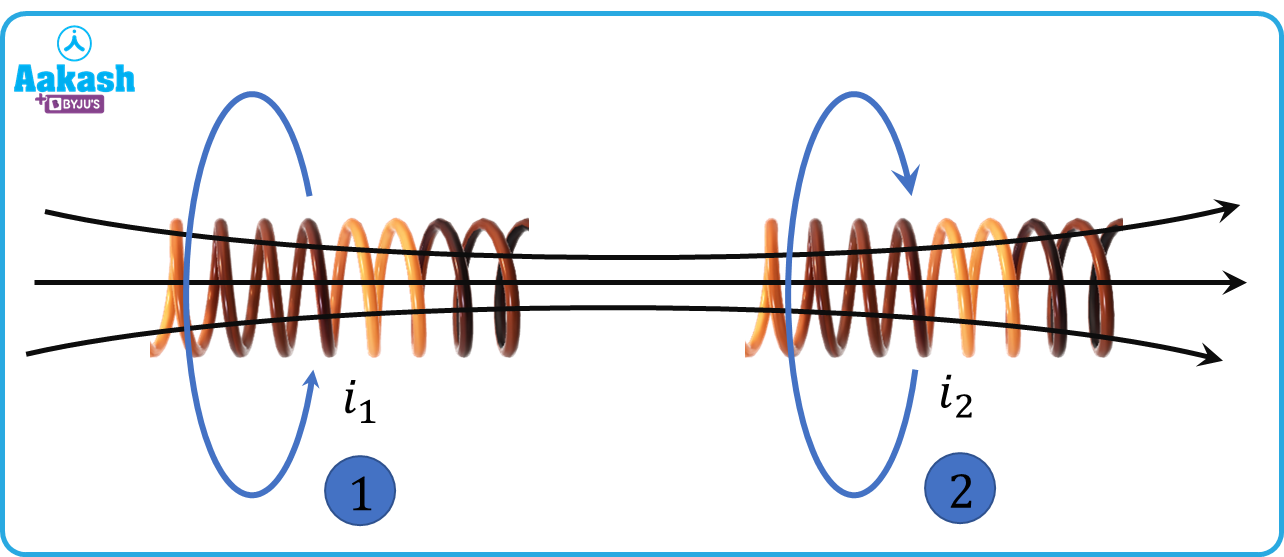
where i1 is the current flowing in the first coil(also known as primary coil) and denotes flux change in the second coil (also known as secondary coil) due to i1.Then,
Similarly, the flux linked with the first coil due to current i1 flowing in the second coil would be,

Here M is mutual inductance.
Self inductance is the property by which a coil opposes growth of current in it. Its unit is Henry(H). Its dimensional formula is 
Let L1 indicate the self inductance of the first coil, then

The self inductance of the second coil,

Where and
and  are the number of turns in the coils and
  is the area of the coil.
  is the permeability of free space.


The field B1 due to current in coil 1 can be written as,


Magnetic field  due to current in coil
  can be written as,


Substituting the value of in equation  we get,

But  indicates the flux linked with coil
Comparing equations


Now ,
 indicates the relation between self induction and mutual induction.
 is called the coefficient of coupling or simply the coupling coefficient.
For iron or ferrite materials, the value of is  and for air cored solenoids, the value ranges between
  to
to 
When  it means that the coils are perfectly coupled.
On the other hand, if
Different cases of coupling

(i) When the coils are placed as shown in arrangement (a), there is maximum flux linkage. Hence, the induced emf would be maximum in this case.
(ii) When the coils are placed as shown in arrangement (b), there is zero flux linkage since they are perpendicular. Hence, the induced emf would be zero(minimum) in this case.
(iii) When the coils are placed as shown in arrangement (c), zero flux is linked between the two coils, since they are perpendicular. Hence, zero emf is induced in the other coil.
Practice problems
Q.If two coils having inductances L1 = 2 mH and L2 = 8 mH are placed coaxially over one another. The coefficient of mutual induction between the coils would be
(a) 2 mH
(b) 4 mH
(c) 6 mH
(d) 8 mH
A.b
Given,
L1 = 2mH ; L2 = 8mH
So, the coefficient of mutual inductance, .
Q. Two solenoids are placed coaxially with each other. The time varying current flowing in one of the coils is 0.1 A/s. If the coefficient of mutual induction between the coils is equal to 10 H, the emf induced in the second coil would be
(a) 1 V
(b) 2 V
(c) 2.5 V
(d) 1.5 V
A.a
M = 10 H.
Given, .
emf induced in the second coil,
Q. Two coils have 
 and a length of
(a)
A.a
Given, 


Q. The coefficient of mutual induction between two coils is
(a)
A.c
Given,
Mutual inductance,  ∝
∝ 


FAQs
Q. On what factors does mutual inductance depend?
A. It depends upon: the number of turns, the area of the coils, the length of the coils and relative permeability of the core used.
Q. Can mutual inductance be negative?
A. The mutual inductance can be negative or positive depending upon the polarity of the induced voltage between the terminals of the coil.
Q. Where is mutual induction used?
A. It is used in transformers, generators and motors.
Q. How many coils are used in mutual induction?
A. Two coils are used in mutual induction. It happens when the flux of one is also linked to the other.

 Call Now
 Let's Chat
 Share
Share