-
Call Now
1800-102-2727


Convex Lens – Ray Diagrams, Formula & Images

A lens is a transparent optical medium, usually made of glass or plastic, that refracts light and helps form images. Lenses work by bending light rays as they pass through their surfaces. Based on their shape and effect on light, lenses are mainly classified into convex and concave lenses. A convex lens is thicker at the centre and thinner at the edges. It converges parallel rays of light to a point called the focus and is therefore also known as a converging lens.
Physical Meaning of a Convex Lens
A convex lens is a transparent optical medium that is thicker at the centre and thinner at the edges. Its shape determines how it refracts light. When light passes through a convex lens, each ray is refracted at the air–lens boundary and again at the lens–air boundary. Due to the curved surfaces, parallel incident rays bend toward the principal axis and converge at a point called the focus. For this reason, a convex lens is also known as a converging lens. The change in direction of light occurs because its speed differs in air and in the lens material, resulting in controlled refraction without any force acting on the light.
Refraction as the Foundation of Lens Behaviour
Refraction is the fundamental principle governing the behaviour of a convex lens. This is because: when light passes from air into glass, its speed decreases, and the ray bends toward the normal; when it exits the glass into air, it speeds up and bends away from the normal.
In a convex lens, these two refractions act together due to the curved surfaces. Rays passing through the edges bend more than those near the centre, causing parallel rays to converge toward a common point. If the lens surfaces were flat, this convergence would not occur.
Thus, both the refractive properties of the material and the curved shape of the lens determine its optical behaviour.
Important Terms in Lenses
Principal Axis: physicists define certain reference lines and points to analyse lenses systematically. The principal axis is an imaginary straight line that passes through the centre of the lens and is perpendicular to its surfaces. It is not a physical entity but a conceptual tool used to describe ray paths and measure distances.
Optical Centre: it is located on the principal axis within the lens. A light ray passing through the optical centre (for a thin lens and small-angle/paraxial rays) emerges without any net deviation. Although refraction occurs at both lens surfaces, the symmetrical shape of the lens cancels the overall bending. This property is especially useful when constructing ray diagrams, as it provides a predictable reference ray.
Principal Focus: when a beam of light consisting of rays parallel to the principal axis passes through the lens, the rays converge to a single point on the axis after refraction. This point is known as the principal focus.
Focal Length: a convex lens has two principal foci, one on each side of the lens, both located at equal distances from the optical centre. This distance is designated as the focal length of the lens. It indicates the strength of the lens in converging light.
A short focal length indicates a powerful lens giving rise to sharp bending of light, whereas a long focal length refers to a less powerful lens producing softer convergence.
In everyday experience, focal length governs the size of the image and the distance at which the image is formed from the lens.
Ray Diagrams
A ray diagram is a graphical representation used to show the path of light rays as they pass through an optical system such as a lens or mirror. It helps in determining the position, size, and nature of the image formed.
For the convex lens, three rays are critical:
- A ray parallel to the principal axis gets refracted through the principal focus.
- A ray going through the principal focus emerges parallel to the principal axis.
- A ray that goes through the optical centre moves straight without any change in direction.
If we draw any two of these rays from the object point, we can find where the image point is. The point where the rays cross shows the location of the image.
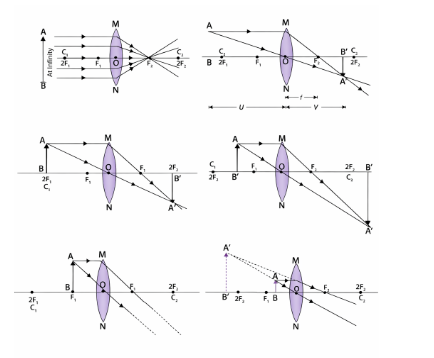
Nature of Images Formed by a Convex Lens
The location of the image formed by a convex lens is completely determined by the object's position with respect to the focal length. If the object is placed at a great distance from the lens, the rays that hit the lens are almost parallel, and the image will be located quite near the focus. When the object is moved closer, the image also moves away and becomes larger.
Four typical cases are studied:
- As the object is placed beyond 2f, the image is real, inverted, and reduced.
- If the object is at 2f, the image is real, inverted, and the same size.
- If the object lies between f and 2f, the image is real, inverted, and enlarged.
- If the object is at the focus, the image is at infinity.
- If the object is between the focus and the lens, the image is virtual, erect, and magnified.
These standard cases are not rules to be memorised; rather, they are results of the convergence or divergence of light rays after passing through the lens.
Lens Formula
While ray diagrams provide visual understanding, mathematics allows us to predict image formation precisely. The lens formula establishes the connection among object distance, image distance, and focal length:
1 f = 1 v − 1 u
This equation is formulated by considering the lens to be thin and assuming that rays make small angles with the principal axis. The formula assumes the Cartesian sign convention, where distances measured in the direction of the incoming light are positive.
The lens magnification is:
Magnification indicates the relationship between the size of the image and the size of the object. A negative magnification indicates that the image is inverted; a positive magnification indicates that the image is upright.
Power of a Convex Lens
The power of a convex lens indicates how strongly the lens can converge light rays. It is defined as the reciprocal of the focal length of the lens (measured in metres) and is expressed in dioptres (D).
A convex lens has a positive focal length and therefore has a positive power. A lens of higher power bends light more strongly and thus has a shorter focal length.
Real-Life Importance and Applications
Convex lenses are essential in scientific and everyday life. These are used in: microscopes, to study very small things undetectable by the human eye; telescopes, to collect and direct light from far-off objects; and cameras, to form clear images on sensors or film.
The most remarkable application is in the human eye. Here, the flexible convex lens continuously adjusts its curvature to change its focusing power, allowing it to focus light from objects at different distances.
Conclusion
A convex lens is an optical element that bends light inward and brings parallel rays to a common point. Its ability to form images arises from refraction at its curved surfaces and the difference in light speed between air and the lens material. Concepts such as the principal axis, optical centre, focus, and focal length are used to describe how light behaves through the lens.
Image formation depends on the object's position and can be studied using ray diagrams and mathematical relations like the lens formula. The strength of a convex lens is expressed by its power. Convex lenses are essential in devices such as microscopes, cameras, telescopes, and in the functioning of the human eye.
FAQs
1. Why is a convex lens thicker at the centre?
The thick shape of the convex lens at the centre ensures inward refraction and convergence of light rays.
2. Can a convex lens form both real and virtual images?
Yes, depending on the object's position relative to the focal point, a convex lens can form both real and virtual images.
3. What determines the strength of a convex lens?
The curvature and the refractive index of its material determine the strength of a convex lens.
4. Can a convex lens be used as a magnifying glass?
Yes, when the object is placed between the lens and its focus, a convex lens produces a virtual, enlarged image.

 Call Now
 Let's Chat
 Share
Share