-
Call Now
1800-102-2727


Charging by Induction, The Law of Conservation of Charge, Practice Problems, FAQs

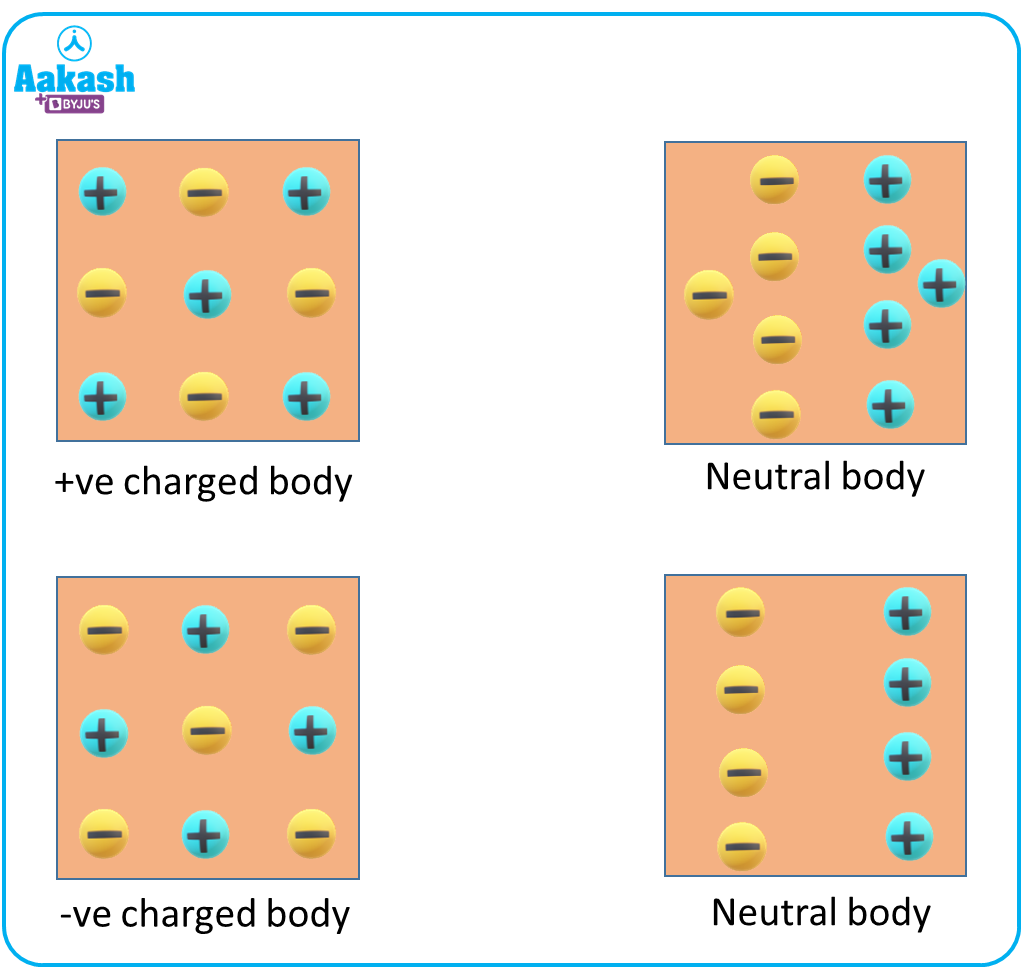
You would have heard that like charges repel each other, and unlike charges attract each other. What happens if one charged body is brought close to a neutral body? Will there be any attraction or repulsion? You might intuitively think, no. But, the answer is, yes, there will be a force between them. Let’s understand this in this article!
Table of content:
- Charging by Induction
- The Law of Conservation of Charge
- Practice Problems
- FAQs
Charging by Induction
Charging by induction is used to charge any given object without touching the object to any other charged body. It needs an understanding of the conductor's nature and also the understanding of the polarization process.
When an electrically charged object is brought near a material, electrostatic induction takes place where electrical charges are redistributed in the material. Thus, it creates static electricity. It is most effective when done with the conducting materials. When the electrically charged object is removed, the conductor loses its redistribution. Some non conducting materials can also be electrically charged by electrostatic induction.
The Law of Conservation of Charge
The law of conservation of charges tells, the charge is neither created nor destroyed during the charging process; it is simply transferred from one object to the other object in the form of electrons.
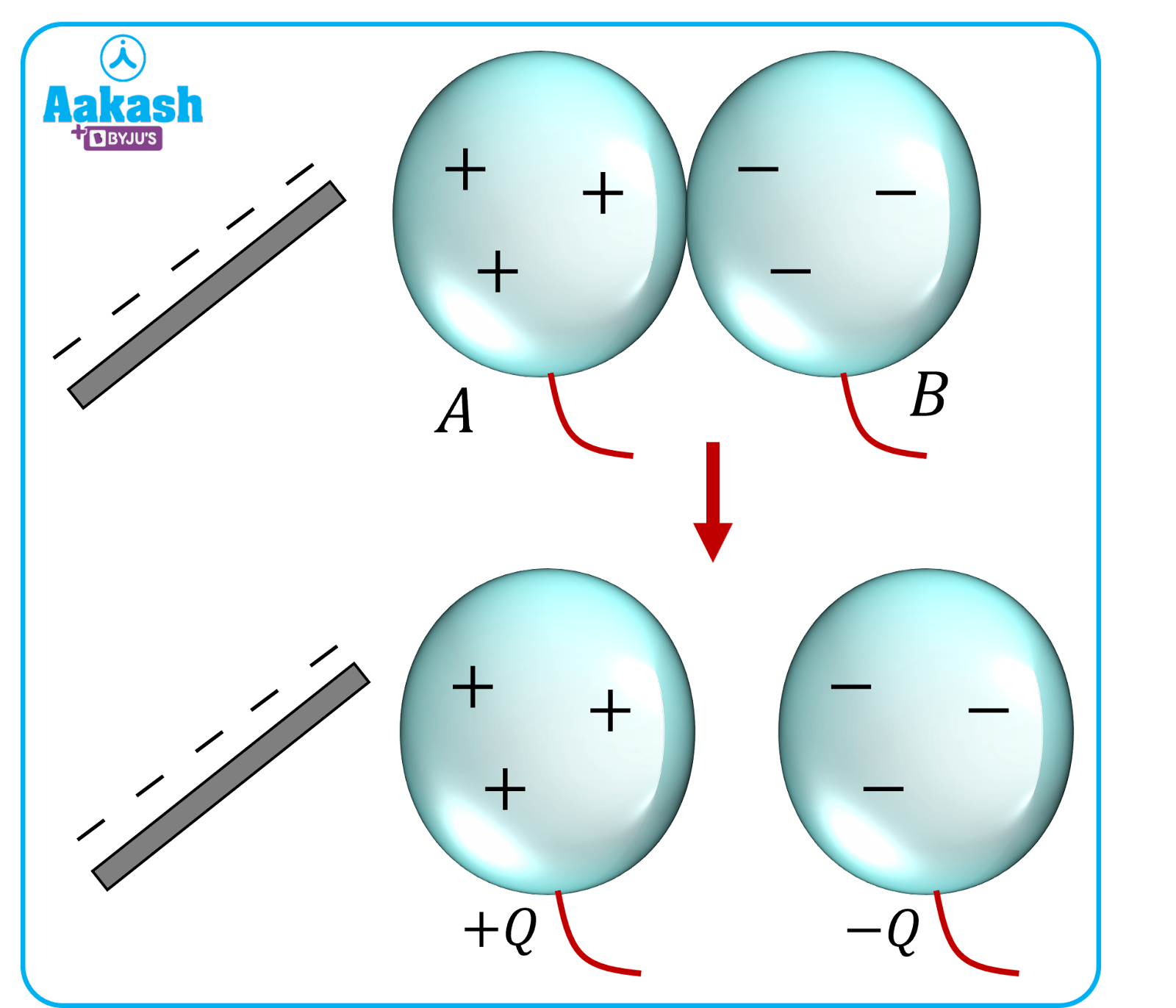
The law of conservation of charge can easily be observed in the charging by induction process itself. Let’s take the example of the two balloons system. Before the start of the charging process, the net charge on the system was zero as the whole system was neutral. So, there were equal numbers of electrons and protons in the two balloons separately and combined. When the negatively charged rod is brought nearer to the system, the electrons are repelled into moving from balloon A to balloon B. At this point, the individual balloon becomes charged. The quantity of net positive charge on balloon A (let +Q C) equals to the quantity of net negative charge on balloon B (let -Q C) magnitude wise.
The overall charge contained in the system is just the arithmetic sum of the charges on the individual balloon. Total charge on the two balloon = +Q units + (-Q units) = 0 units
It is thus proved that the net charge on the system of two bodies remains the same even after the charging is completed.
Practice Problems
Q. Explain the process of charging a single sphere or an object.
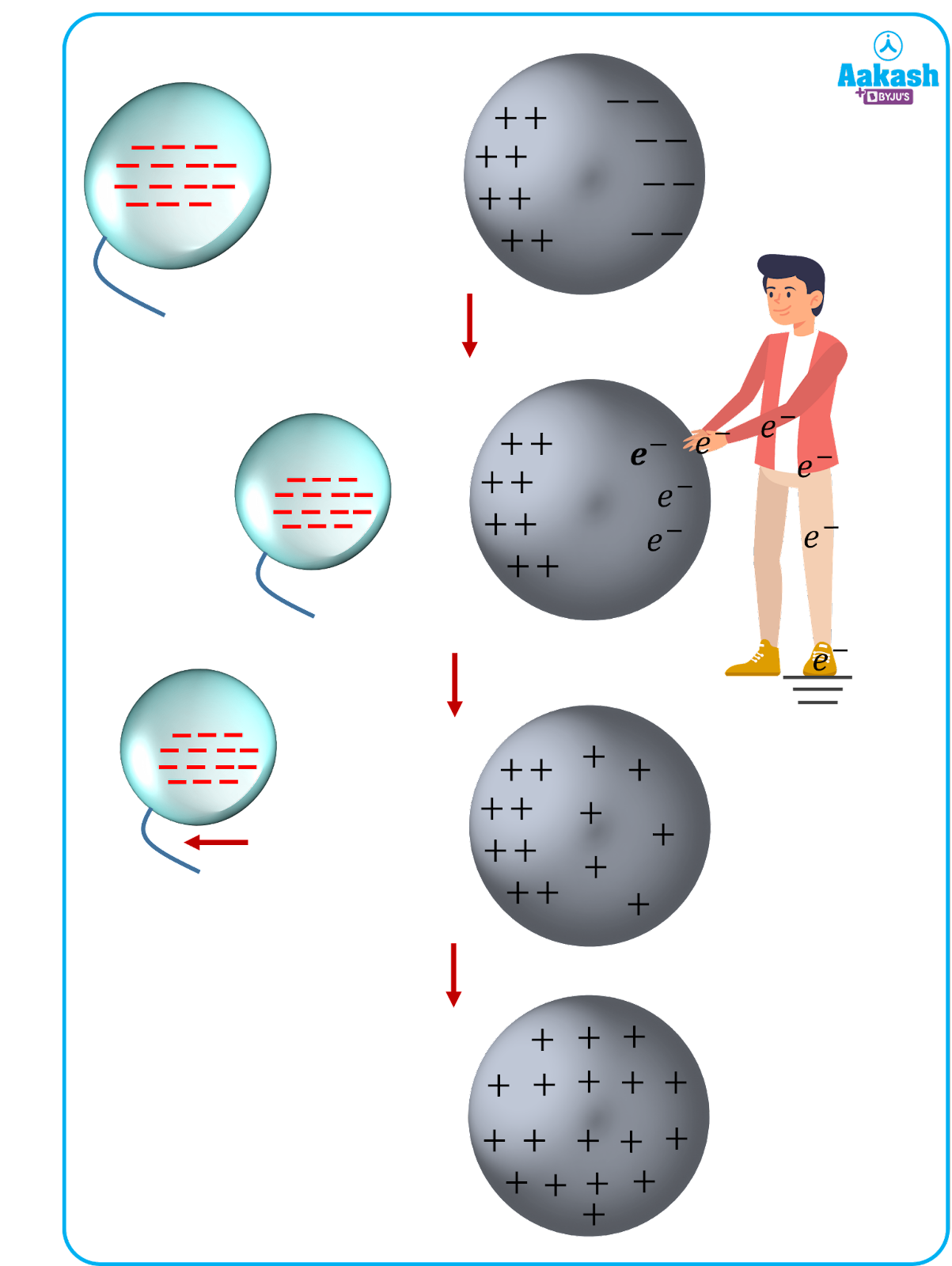
A. Let us consider the process of induction charging of a single conducting sphere. Let a rubber balloon having a negative charge be brought nearer to a sphere as shown. The negative charge present in the balloon will readily induce movement of electrons in the sphere. Negatively charged electrons inside the metal sphere will repel the negatively charged balloon. This is because of the electrostatic principle of like charges repel and unlike charges attract. So, there will be a mass movement of electrons from one side of the sphere which is nearer to the negatively charged balloon to the right side of the sphere which is far from the balloon. Thus, the sphere becomes polarized into positive charge concentration and negative charge concentration as if it were poles. After this, the sphere is made to touch on the far end of the balloon. This contact of the sphere results in electrons to exit and move via the hand to the earth. Now the neutrality of the sphere vanishes. The sphere gains a charge. As the electrons leave the sphere, the sphere finally gets a positive charge. When the negatively charged balloon is moved away from the sphere, this excess positive charge gets redistributed on itself about the surface of the sphere.
Q. Explain the process of charging a Two-Sphere System with a Negatively Charged Object.
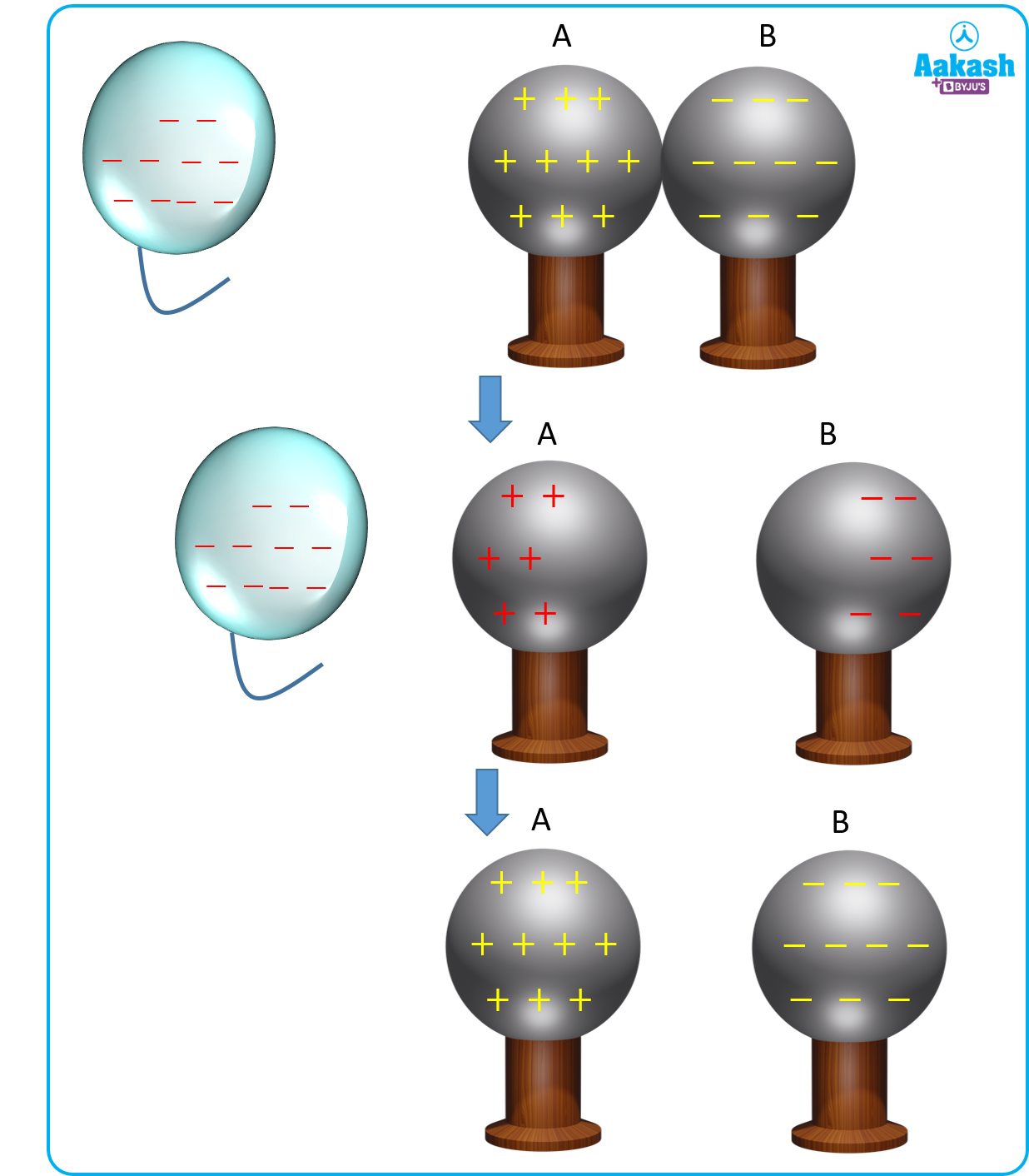
A. We can easily demonstrate and explain the charging by induction of two metallic spheres. Two metallic spheres are placed on insulating stands in order to prevent the charge gained by the spheres from flowing to the earth. The spheres are placed one beside another. Thus, it forms a two-sphere system. The spheres are made of metal which is a conductor. So, electrons can freely move between and around the spheres. It means electrons can flow freely from sphere A to sphere B and even from one part of the sphere to another part.
Now, a rubber balloon is negatively charged by rubbing it with soft woollen cloth. Then, it is brought near the spheres. Because of the simple principle of electrostatics i.e., like charges repel and unlike charges attract each other, within the two-sphere system electrons will move away from the balloon. Electrons present inside a conductor can freely move around the surface of the conductor. As a result, there is a migration of electrons from sphere A to sphere B. Thus, the spheres get polarized as shown in the diagram. Initially, the two-sphere system was electrically neutral. But the movement of electrons from the sphere A and into the sphere B thus creates a negatively charged sphere and a positively charged sphere. Now the spheres are separated from each other without touching them. It can be done by using the insulating stands. When the spheres are pulled away from each other, the charges can redistribute uniformly on the spheres. If the negatively charged balloon is still nearby, the charges will be concentrated on one side of the sphere. Now, when the balloon is taken away, then there will be a uniform distribution of charge about the surface of either spheres.
Q. Explain the process of charging a two-sphere system with a positively charged object.
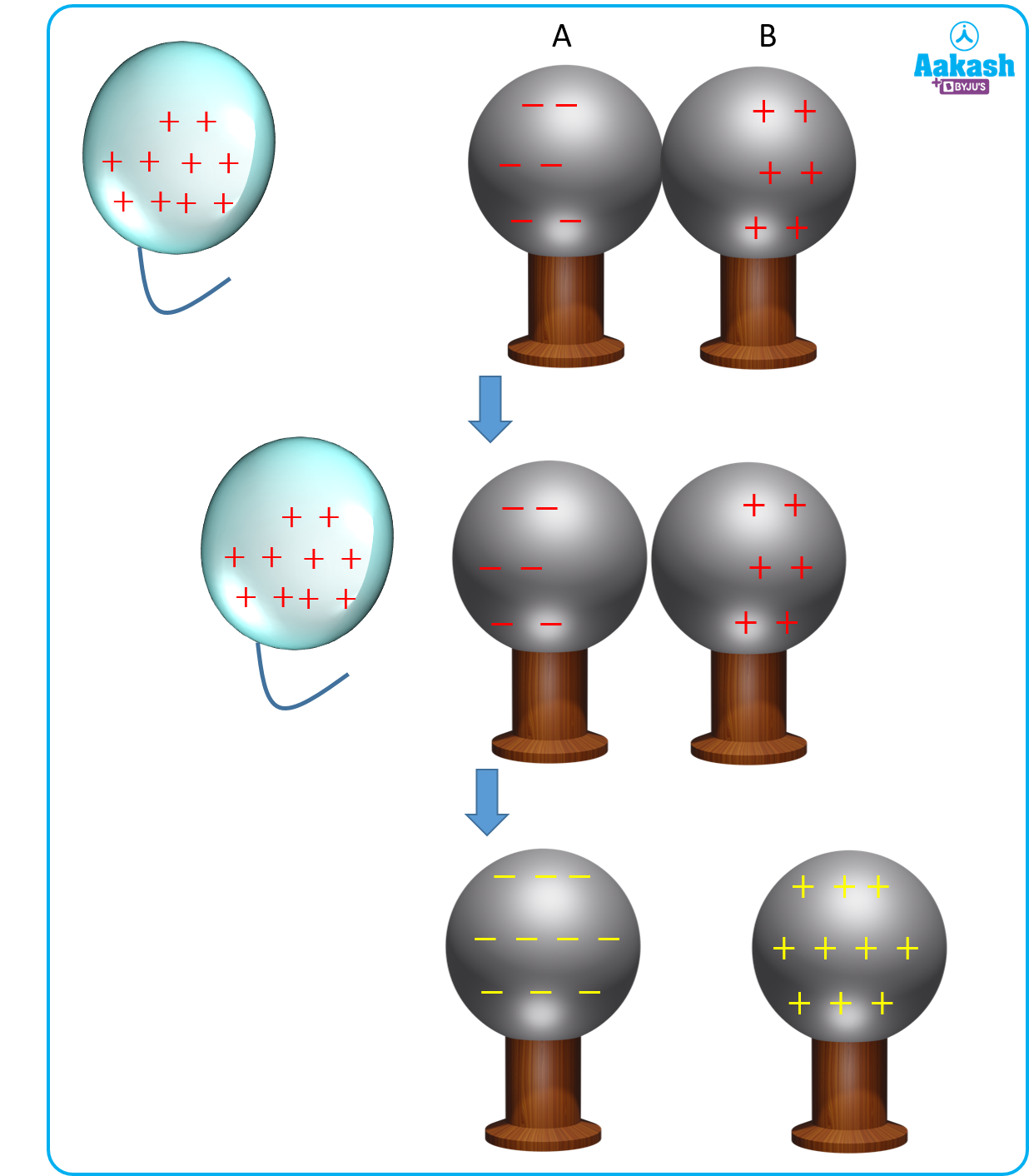
A. A positively charged balloon is taken near sphere A. The positively charged balloon induces a negative charge i.e., accumulation of electrons on the nearer sphere. It means a mass movement of electrons occurs from the sphere B towards the sphere A. So, negatively charged electrons throughout the system get attracted towards the positively charged balloon. Thus, sphere B gets an overall positive charge and sphere A an overall negative charge. Now the positively charged balloon is held as it is and the spheres are physically separated from each other. Thus, the negative charge on sphere A remains concentrated towards the side of the sphere closer to the balloon and positive charge remains concentrated away from the balloon. When the balloon is removed, electrons in the sphere A redistribute evenly across the surface, and the same thing happens with B. At last, sphere A becomes negatively charged and sphere B becomes positively charged with uniform distribution.
FAQs
Q. Explain the importance of grounding in the induction charging process.
A. In the process of induction charging the object which is to be charged is touched by a human at the end. This process provides for the role of grounding. In the process of charging by induction of a two sphere system, the grounding is done by the second sphere. When the negative balloon is brought nearer the electrons in the sphere are repelled by the negative charge balloon because of the simple electrostatic principle of like charges repelling each other. Not only are they repelled by the negatively charged balloon but also repelled by themselves as all the electrons are crowded into one place. At this time the hand (another object) comes nearby and these negatively charged electrons get the room to move even farther away from each other. We can say that the object on which it is placed serves as a ground. We can simply define a ground as a very big object which serves as a considerably bigger source or sink of electrons. If we use an object having positive charge in order to charge a neutral body by induction, then the neutral body will become negatively charged.
Q. Why are the metallic spheres mounted on a stand made of insulating material in the electrostatic induction experiment?
A. In the electrostatic induction experiment, it is important to preserve the charge in the sphere and drain out the charge as desired. That is why it is important to remove any connection from those spheres. If it were a conducting material, then whenever the sphere gets charged, the earth as a big source or sink of electrons will always make these spheres neutral.
Q. Why can earth be considered to have zero potential?
A. Since the radius of earth is huge, it can be considered to have zero potential since the potential of a sphere is inversely proportional to its radius.
Q. While charging an object does the mass change?
A. Charging an object means to break the electrical neutrality of the object. To do that we have to increase or decrease the electron number in the object. When an object is made negatively charged, it means that the number of electrons is in excess in comparison to the neutral body. Electrons, though they have negligible mass, will add up to the body making it heavier.
Similarly, in case of a positively charged body, there will be a deficiency of electrons as compared to the neutral body. So the mass will be lighter.

 Call Now
 Let's Chat
 Share
Share