-
Call Now
1800-102-2727


Centre of mass of continuous body, rod, circular ring and semicircular ring, Practice problems , FAQs:

You can simplify many problems if you assume all of the mass of an object is at one place. Provided that you choose the correct position, the equations of motion work in the same way as the true, but more complicated, situation with the mass spread out. This special location is called the centre of mass.
Table of content:
- Centre of mass of continuous body
- Centre of mass of a uniform rod
- Centre of mass of circular ring
- Centre of mass of semicircular ring
- Centre of Mass of a Semicircular Disc
- Practice problems
- FQAs
Centre of Mass of Continuous Bodies
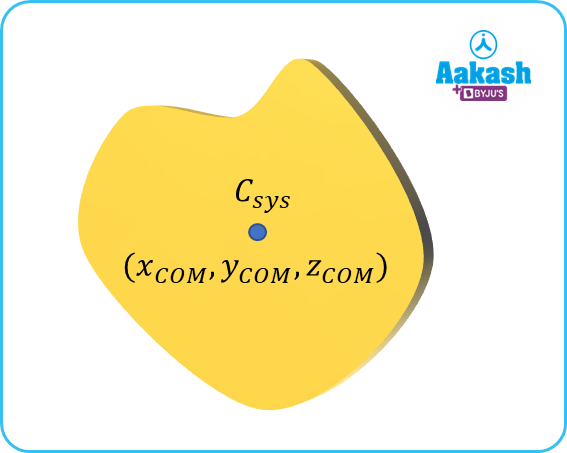
Let us consider a body to have a continuous distribution of matter, then the centre of mass of such a body is given as follows:
Centre of mass of a uniform rod
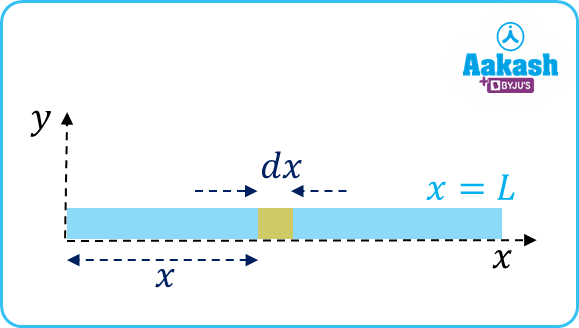
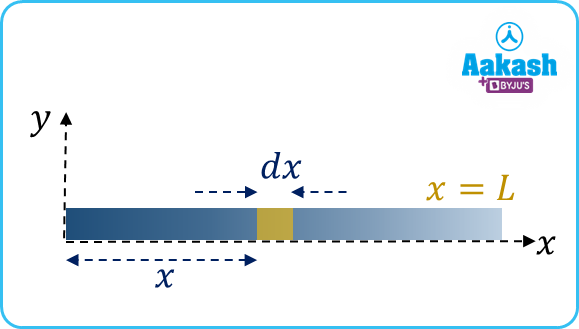
Consider a rod of mass M and length L lying along the x-axis with one end at the origin.
For finding the centre of mass of this rod, let us consider a small element of length dx and mass dm at a distance x from the origin along the x-axis as shown in the figure.
Now, by unitary method, we get,
The centre of mass is given as follows:
Centre of mass of circular ring
The centre of mass is a unique position of an object or a system of objects where the entire mass of the system is concentrated. The motion of this unique point is identical to the motion of a single-particle whose mass is equal to the sum of all individual particles of the system.
Let a circular ring be placed with centre at origin in the XY plane.
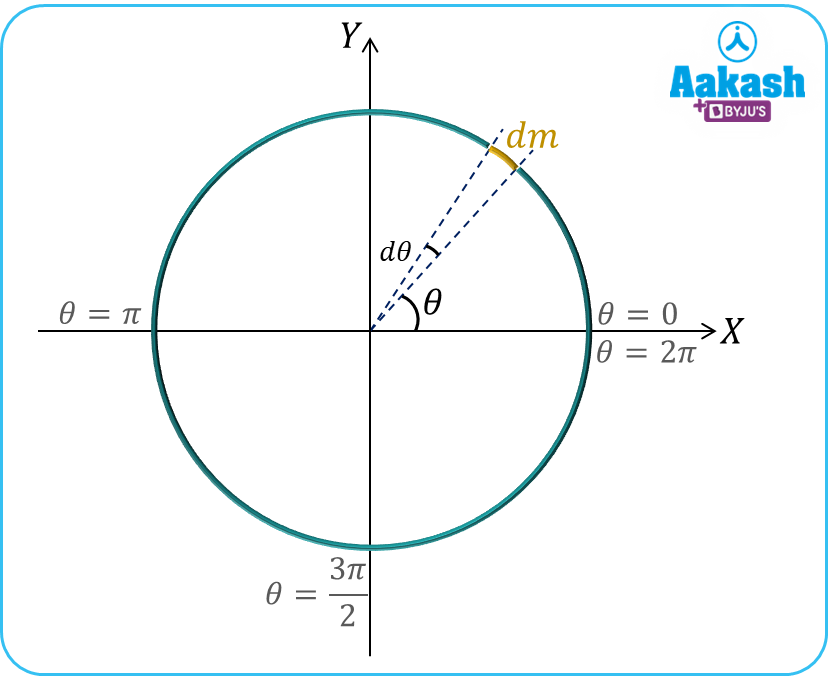
Let us choose an elementary mass dm at angular position θ.
Then x=R cos θ, y=R, dm =R dθ [µ = mass per unit length].
The x-coordinate of centre of mass, Xcm may be written as:
The y-coordinate of centre of mass, Ycm may be written as:
Thus, the centre of mass of the uniform ring lies at the centre of the ring.
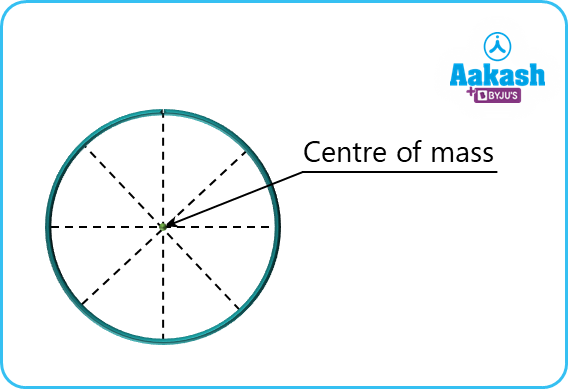
Centre of mass of circular ring from symmetry
The centre of mass of a complete ring should be located at the centre of the ring , because every infinitesimal element of a uniform ring is distributed at the same distance from centre because of the symmetry . So, the centre of mass of the complete ring should be at the centre of the ring.
Centre of mass of semicircular ring
Consider a uniform semi-circular ring of radius R and mass M as shown in the figure.
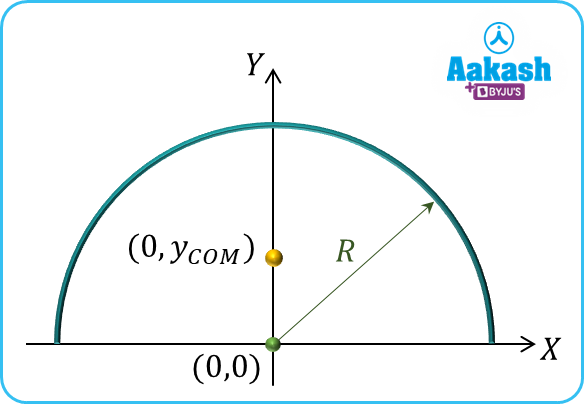
As the ring is symmetrical about the y-axis, thus the centre of mass will lie along the y-axis.
Let the coordinates of the centre of mass be (0, ycom).
Consider a small element of length , mass dm subtending angle at the centre, and located at an angle with the positive x-axis as shown in the figure.
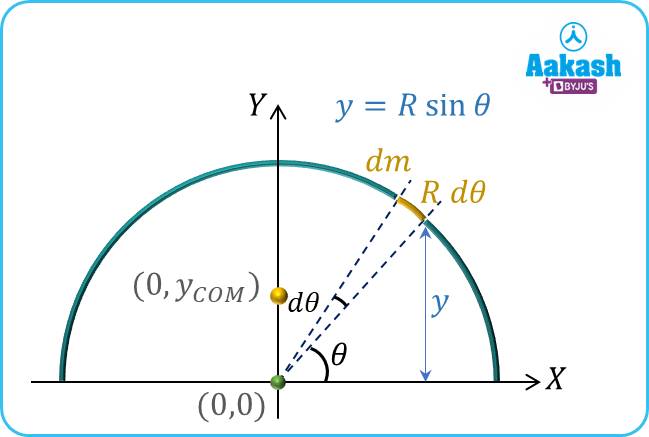
Now, mass of the element is as follows:
And y = R sin θ
The centre of mass is given as follows:
Therefore, the coordinates of centre of mass is
Centre of Mass of a Semicircular Disc
Consider a uniform semicircular disc of radius R and mass M as shown in the figure.
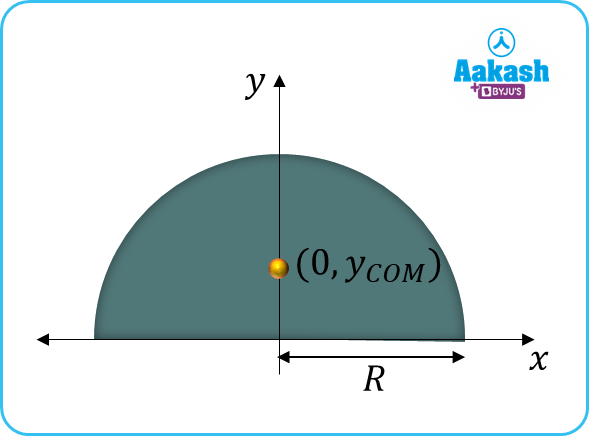
As the disc is symmetrical about the y-axis, the centre of mass will lie along the y-axis.
Let the coordinate of the centre of mass be (0, ycom).
Consider a thin circular element of thickness dr and mass dm at radius r from the centre as shown in the figure.
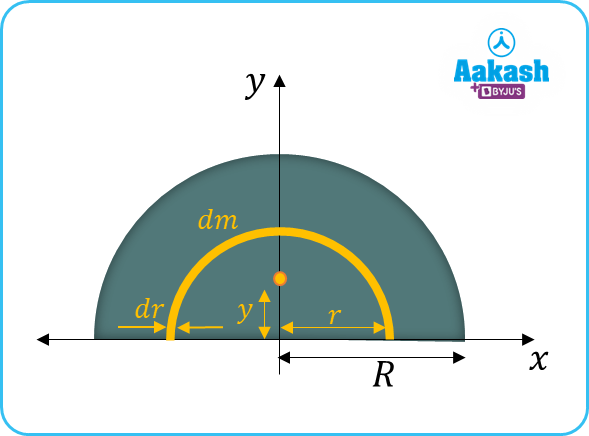
Now the area of the element,
Ignoring (dr)2 as it is very small, we get,
Mass of the element,
Now, the y-coordinate of the centre of mass is given by,
Here, y= centre of mass of the elemental ring
Therefore, the coordinates of the centre of mass (0, ycom) is
Practice problems:
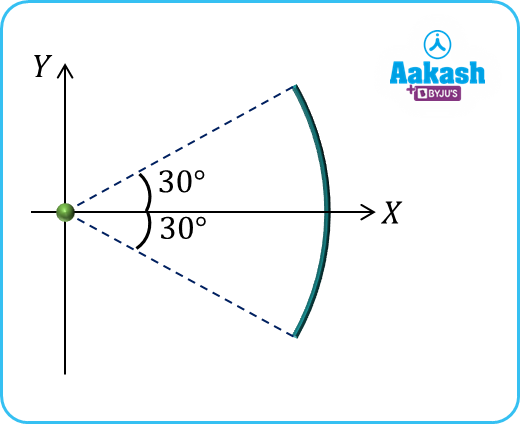
Q1. Find the centre of mass of uniform circular arc of radius R as shown below:-
Sol.
Let's take a small mass at an angle
Since the arc is symmetric, COM will lie on the x-axis.
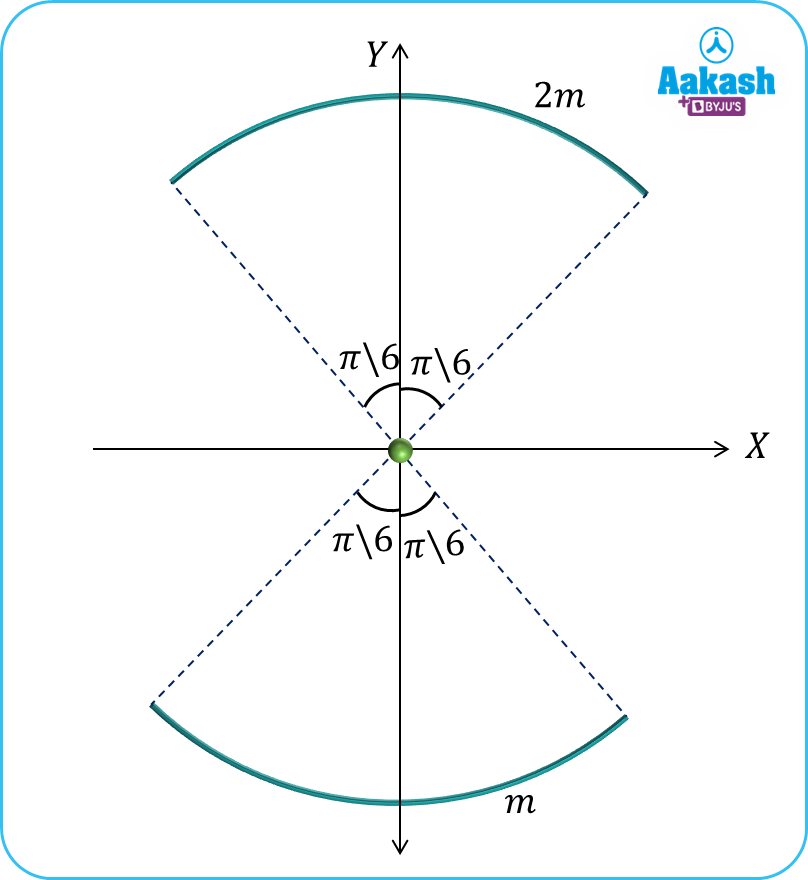
Q2. Find the centre of mass of a given figure :
Sol.
Both masses are symmetric about the y-axis, therefore their respective COM will lie along the y-axis.
Above x- axis the mass is different as compared to below x-axis so , the centre of mass definitely does not lie on the origin.
By applying the formula of com:
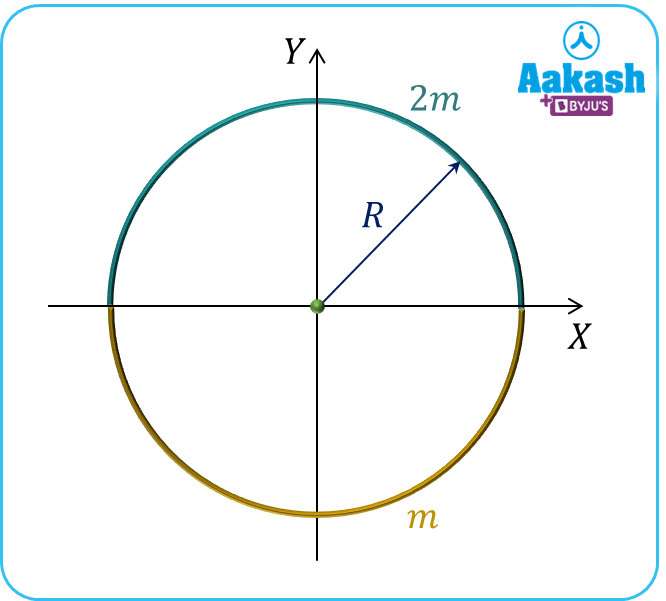
Q3. Find the centre of mass of a given figure :
Sol.
Both masses are symmetric about the y-axis, therefore their respective COM will lie along the y-axis
Above x- axis the mass is different as compared to below x-axis so, the centre of mass definitely does not lie on the origin.
By applying the formulae of com,
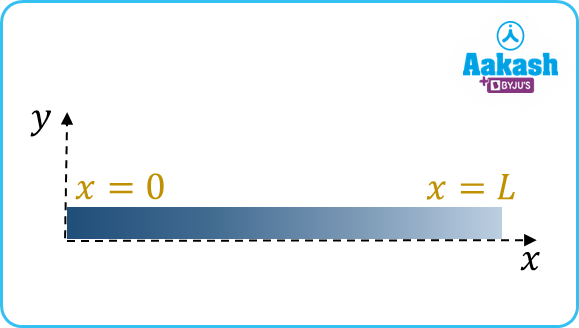
Q4. A rod of length L is placed along the x-axis between x=0 and x=L. The linear density (𝜆) of the rod varies with the distance x from the origin as 𝜆 = kx. Here, k is a positive constant. Find the position of the centre of mass of this rod.
Sol.
Given,
Linear density of rod, 𝜆 = kx
Length of the rod = L
For finding the centre of mass of this rod, let us consider a small element of length dx and mass dm at a distance x from the origin along the x-axis as shown in the figure.
Now,
The centre of mass is given as follows:
FAQs:
Q1. What is the centre of mass?
Sol: The centre of mass is a unique position of an object or a system of objects where the entire mass of the system is concentrated. The motion of this unique point is identical to the motion of a single-particle whose mass is equal to the sum of all individual particles of the system.
Q2. What is the significance of the centre of mass?
Sol: The Centre of Mass of a system is that one point where any uniform force is acted upon the object. It is important to find the Centre of Mass of objects as it makes it easy to solve the Mechanics' problems in order to describe the motion of complicated and oddly shaped objects.
Q3. Can the centre of mass be outside of the physical body?
Sol: For asymmetrical or hollow objects, the centre of mass can be located outside the body. For objects like the horseshoe, the boomerang centre of mass lies outside the body due to uneven distribution of mass. Also for a circular ring centre of mass lies at the centre.
Q4. What affects the centre of mass?
Sol. The following factors affect the centre of mass:
- The position of mass from the axis.
- The mass of the rigid body.
- The axis of the system.
- The distribution of mass.

 Call Now
 Let's Chat
 Share
Share