-
Call Now
1800-102-2727


Capacitors, Capacitance, Practice Problems, FAQs

Capacitors can be seen in an electronic circuit, appliances or our earth. Capacitors store energy in the form of electric charges. Not only in electric circuits, storing and discharging of electric charges can be seen in nature. Sometimes cloud formation makes discharge which actually charges the earth, a big spherical capacitor. Let’s understand more about capacitors in this article!
Table of content:
- Capacitors
- Capacitance
- Unit and dimension of Capacitance
- Practice Problems
- FAQs
Capacitors
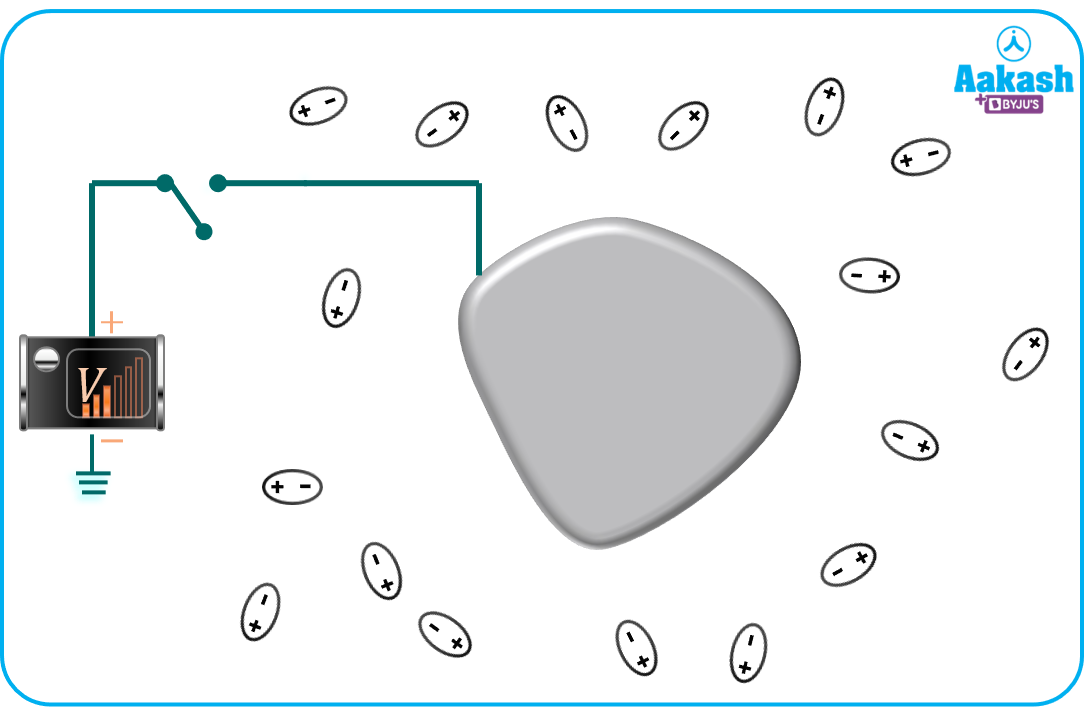
A random shaped, isolated, uncharged conductor placed in a dielectric medium (example: air) can form a capacitor. Though the conductor is neutral, it has an enormous number of free electrons. In the presence of an electric field there are small dipoles in the dielectric medium at the surroundings of the conductor.
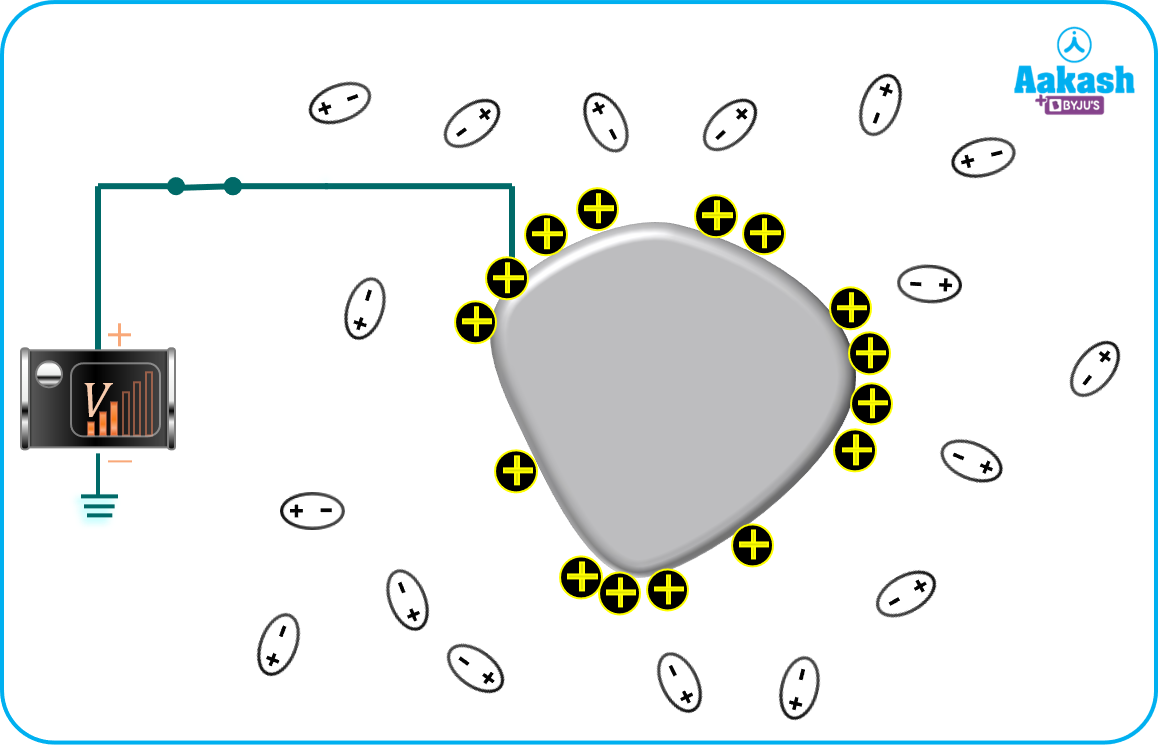
When, the conductor is connected to the positive terminal of a battery of potential difference V, the free electrons of the conductor are pulled towards the battery. The left-out positions of the electrons are the holes (vacant positions) or positive charges. Electrons flow to the conductor through the battery. So, the number of holes (positive charges) on the conductor increases. Since it is an isolated conductor, the electric field needs to be zero inside the conductor. So, all the positive charges reside on the surface of the conductor.
The local charge density on the surface of the conductor is inversely proportional to the local radius of curvature of the conductor.
: Surface charge density and 𝑟: Radius of curvature
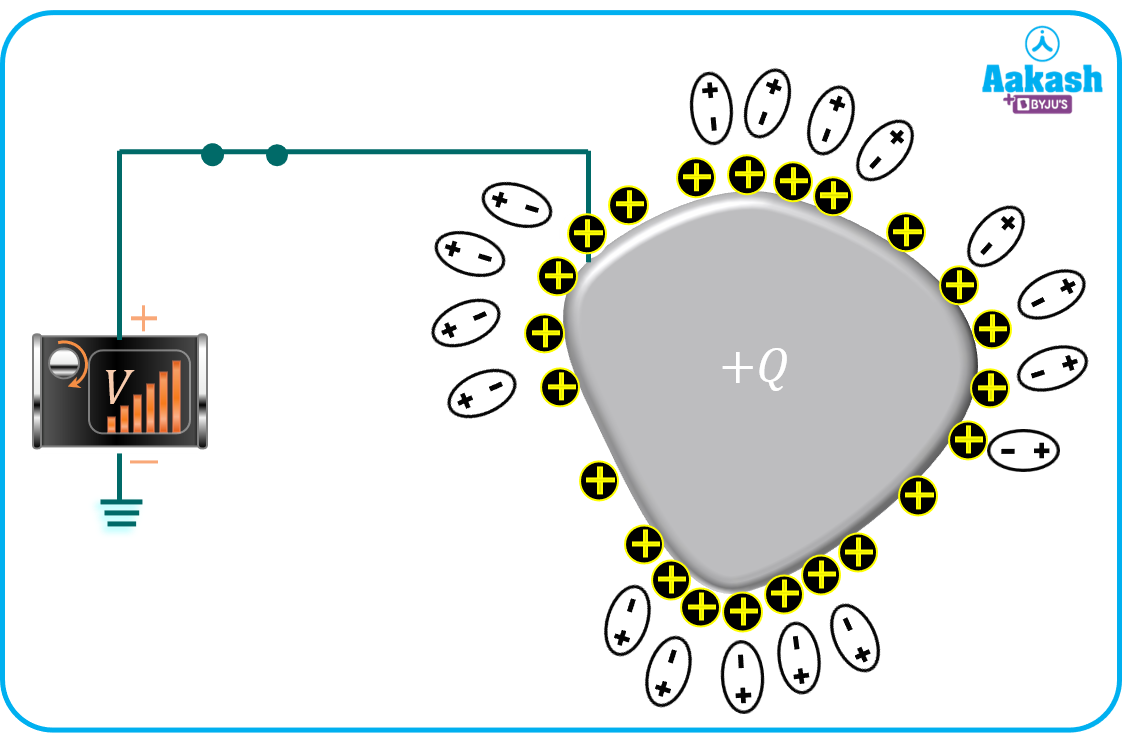
As the voltage of the battery is increased, more electrons will be pulled out by the battery and the amount of induced positive charge on the surface of the isolated conductor will increase.
The electric field due to it also increases. Because of this electric field, the negative charges of the electric dipoles in the surrounding dielectric medium experience an electrostatic attraction and hence, they accumulate near the surface of the conductor. The negative charge and the positive charge of each dipole experience an equal and opposite electrostatic force.
At a particular voltage, the electric dipoles in the medium cannot sustain more electrostatic force and breaks into free positive and negative charges and hence, electric sparks originate.
Due to electrostatic attraction, the negative charges of the broken dipoles get attracted towards the conductor and nullify the net positive surface charge of the conductor. As a result, the charge of the conductor decreases.
The positive charges that become free from the dipoles are known as the Leakage charge. Potential that is responsible for this is known as the Leakage potential or Breakdown potential. After the breakdown takes place, no more charge can be added to the conductor no matter how much we increase the battery's potential.
Capacitance
The capacitance of a conductor can be defined as the amount of charge required to increase the potential of the conductor by 1 V.
When the charge is given to an isolated conductor, its potential increases, i.e.,
Where, C is the constant, known as the capacity or capacitance of the conductor.
Capacitance is the ratio of the charge stored to the potential at the surface of the conductor and it determines the capacity of the conductor to hold an electric charge.
Unit and dimension of Capacitance
Farad is the basic unit of capacitance. Capacitance is measured in the small units of Farads for usual cases, like microfarads (µF) or pico-farads (pF).
The dimension of capacitance can be deduced as
Practice Problems
Q. A capacitor for camera flasher charges at 200 V and has a capacitance of 80 μF. How much charge does it hold?
A. The charge a capacitor holds=CV
So the charge the flash capacitor holds is,
Q. A spherical shell has a charge content of 1 C. The voltage at the surface is 3 V. Calculate its capacitance.
A. We know,
Q. Explain the significance of capacitors used as energy storing devices.
A. Capacitors are used to store electrical energy. Capacitors can provide only limited power for electronic devices. It can be used during temporary power outages or at the time of additional power requirement.
Supercapacitors can have high capacitances up to 2 kF. These capacitors store large amounts of energy and are used in areas such as electric cars and in industrial electrical motors, computer memory backup during power loss etc.
Q. Explain how capacitors can be used as sensors.
A. Capacitors are used as sensors. It can sense its surroundings. This is used to measure a variety of things including humidity, mechanical strain, and fuel levels. Two aspects of capacitor construction are used in the sensing application - the size, shape of the capacitor and the material inside it. The former is used to detect mechanical changes such as acceleration and pressure. The latter is used in sensing surrounding property such as humidity.
FAQs
Q. Explain why capacitance is not in terms of energy like Joule ?
A. Here the capacitance is not independent of the medium in which it is kept. Capacitance changes with the medium. Therefore, it is difficult to express the capacitance in terms of the energy content. If we had expressed capacitance in terms of energy content, we had to specify the medium also. Like 3 Joule in the medium air. Thus, capacitance is expressed as a ratio between charge and voltage. Knowing the value of capacitance, a person can easily find the maximum charge it can store with the given medium.
Q. What are the applications of capacitors?
A. Capacitors have many applications in our day-to-day electronics.
Capacitors for Energy Storage
Capacitors are used in electrical energy storage devices. They can provide enough power for electronic devices.
Capacitors for Power Conditioning
Capacitors allow only AC signals to pass through when they are charged. They block DC signals. This effect of a capacitor is majorly used in separating or decoupling different parts of electrical circuits to reduce noise. This improves efficiency. Capacitors are also used in substations to counteract inductive loading introduced by transmission lines.
Capacitors as Sensors
Capacitors are used in sensing its surroundings. This is used to measure a variety of things including humidity, mechanical strain, and fuel levels.
Capacitors for Signal Processing
There are advanced applications of capacitors in information technology. Capacitors are used in Dynamic Random Access Memory (DRAM) devices which are used to represent binary information as bits.
Q. Explain why capacitance is not in terms of charge like Coulomb.
A. Actually, capacitance is not independent of the medium. Capacitance changes with the medium. So, it is difficult to express capacitance in terms of the charge content. If we had expressed capacitance in terms of charge content, we had to specify the medium also. For example, 0.9 C in the plastic medium. That is why capacitance is expressed as a ratio between charge and voltage. Knowing the value of capacitance, a person will understand the maximum charge and the energy it can store with the given medium.
Q. What is the basic construction of a capacitor?
A. Capacitor is made of two electrodes which are separated by a dielectric medium or material. The electrodes are metal plates of conductive material. So, they allow electric current to pass through. The dielectric medium or material present between the electrodes is a poor conductor of electricity. So, it does not allow electric current to pass through it.
With the application of voltage, the electric charges try to move from one plate to another plate. They get trapped within the electrode because of the strong opposition from the dielectric medium. Thus, electric charge builds up on the electrodes.

 Call Now
 Let's Chat
 Share
Share