-
Call Now
1800-102-2727


Energy Levels in an Atom

Atoms are the fundamental building blocks of matter, and they are composed of positively charged nuclei with one or more negatively charged electrons that rotate around the nuclei. Electrons do not occupy arbitrary energy values; they exist in discrete energy levels. Instead, they are positioned in particular allowed energy states, or so-called 'energy levels'. Every energy level consists of specific and distinct amounts of energy, and the electrons remain in these levels. This is called quantisation of energy.
The concept of energy levels explains why an atom has stability and why it emits or absorbs light of certain energies. It describes that an electron within an atom does not have an arbitrary energy level. It can only exist at definite energy levels. An electron in a stationary energy level does not radiate energy. It can only gain energy if it jumps from its definite energy levels. These definite levels of energy can be represented as whole numbers, called principal quantum numbers. These whole numbers can be marked as follows: n = 1, 2, 3, etc., in which n = 1 describes the lowest energy level, while other numbers signify the highest levels of energy.
Bohr’s Atomic Model & Energy Levels
Fixed Energy Levels (Stationary Orbits)
In 1913, Bohr developed the idea that electrons revolve in circular orbits around the nucleus of an atom, which are referred to as 'energy levels'. It is clear that every energy level possesses a definite energy value, and an electron never loses energy when in a stationary circular path.
Quantisation of Energy
The electrons are permitted to possess definite states of specific, allowed energy levels, denoted by the principal quantum number n = 1, 2, 3, …. These specific levels are given by the equation:
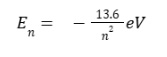
showing that energy is quantised
Importance of the Model
The Bohr model has been successful in revealing the stability of the atomic structure and the hydrogen spectrum, and the method has incorporated the idea of energy levels. The energy absorption process occurs when the electron jumps into a higher energy level, and the release of energy occurs when the electron falls into a lower energy level. The energy change in the process is given by
ℎ𝜈=𝐸2−𝐸1
Mathematical Expression for Energy Levels
According to Bohr’s theory, the energy of an electron in the nth energy level of a hydrogen atom is given by:
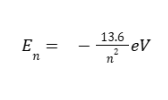
where
- En is the energy of the electron.
- n is the principal quantum number.
- eV is electron volt.
The negative sign indicates that the electron is bound to the nucleus.
Ground State and Excited State
Ground State - Lowest Energy Level
The ground state is the lowest energy state of an atom. In a ground state, the principal quantum number is 1. That is, the lowest energy of the atom is when the value of n is 1. In such a state, the energy of an electron is at its lowest, and, therefore, the atom is stable.
Excited State – Higher Energy Levels
When an atom absorbs the energy, an electron leaves its ground state or a state of lower energy and moves to a higher energy level (i.e., 'n' is greater than 1), termed an 'excited state', and is therefore in a state of more energy than in its ground state.
Energy Transitions in Atoms
Absorption of Energy
When an electron gains some amount of energy, it changes its position from a lower energy level to a higher energy level. For this, it absorbs exactly that much energy as is present in the jump from that energy level to the next, i.e.
ℎ𝜈=𝐸2−𝐸1
This process gives rise to the absorption spectra.
Emission of Energy
When an electron jumps from a high to a lower energy level, it releases the extra amount of energy it was holding, which shows up as electromagnetic rays. The emitted radiation has energy equal to the difference between the two energy levels.
ℎ𝜈=𝐸2−𝐸1
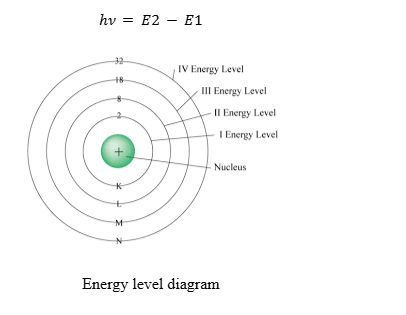
Quantum number
The set of numbers used to describe the position and energy of the electron in an atom is called 'quantum numbers'. There are four quantum numbers: principal, azimuthal, magnetic, and spin quantum numbers. In quantum numbers, energy levels are divided into sublevels (s, p, d, f). Electron position is described by probability. Energy levels are still quantised.
Limitations of Bohr’s energy levels
- The Bohr theory of energy levels applies only to hydrogen, and this theory is incapable of accounting for the energy levels of an atom containing multiple electrons.
- It fails to explain the structure of spectral lines, or their splitting, when magnetic or electric fields are present.
- It assumes that the motion of electrons takes place in circular paths, and the wave properties have been neglected, which goes against the concept of the de Broglie hypothesis and the uncertainty principle formulated by Heisenberg.
Conclusion
Energy levels can be defined as the definite and quantised states where the electrons are found within the atom. Moreover, the electrons can change the energy levels only under the condition and possibility where they either emit certain amounts of energy or receive certain amounts of energy. Even though the idea of the Bohr atom has limitations, the theory of energy levels within the atom still applies.
FAQs
Q1. What are the energy levels of atoms?
Energy levels (also called electron shells) are fixed distances from the nucleus of an atom where electrons may be found. As you go farther from the nucleus, electrons at higher energy levels have more energy.
Q2. What is the difference between a ground state and an excited state?
The ground state of an atom is its most stable, lowest-energy configuration, where all electrons occupy the lowest possible energy levels available. An excited state is a temporary, higher-energy state that occurs when an electron absorbs a specific amount of energy (like from a photon or a collision) and jumps to a higher, vacant energy level. The excited state is unstable and temporary, and will eventually return to the ground state by emitting the excess energy.
Q3. What is the reason for the separation of energy levels in the hydrogen atom?
Energy levels in the hydrogen atom are separated due to the quantised nature of electron energy, which arises from the Coulomb attraction between the electron and nucleus and the allowed solutions of the Schrödinger equation.

 Call Now
 Let's Chat
 Share
Share