-
Call Now
1800-102-2727


Mean And Variance

Mean and variance are important measures in statistics. The mean gives the average of a set of numbers. Variance shows how far the numbers spread out from the mean. Let us understand them in detail.
What is Mean?
Mean measures the average of a group of values. It is computed by dividing the sum of observations by the total number of observations.
The four types of means are:
- Arithmetic
- Geometric
- Harmonic
- Weighted Arithmetic
A disadvantage of mean as a central tendency metric is that it is very open to outliers. The data set may have values that are significantly greater or less than the rest of the data.
For an ungrouped dataset
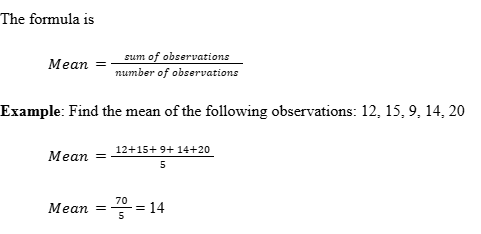
For grouped datasets or discrete frequency data
The formula is

Where
x̄ = mean
Σfx = summation of the product of frequency and class
Σf = summation of the frequencies
Example: Find the mean weight from the following data.
| Age | Frequency |
|---|---|
| 10 | 9 |
| 11 | 8 |
| 12 | 10 |
| 13 | 7 |
| 14 | 4 |
Solution:
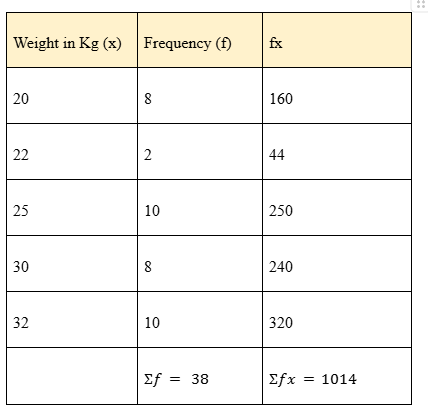
The formula for the mean of grouped data is given as
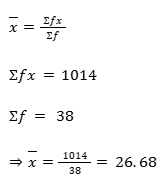
Properties of Mean
The mean has the following properties:
- When each value is increased by k, the mean also increases by k.
- When each value is decreased by k, the mean also decreases by k.
- If every value is multiplied by k, the mean is also multiplied by k.
- If every value is divided by k, the mean is also divided by k.
What is Variance?
Variance is a measure of dispersion. It helps assess how data deviates from its average value. In other words, it is the average of the squared differences between each value and the mean.
Data can be either grouped or ungrouped. Grouped data is organised into class intervals, while ungrouped data comprises individual data points.
Specific Symbols for Variance
- σ²: (sigma squared): Denotes the variance of an entire population.
- s²: Denotes the variance of a sample taken from a population.
- Var(X): A general notation for the variance of a random variable X.
Statistical variance is put in two categories depending on your dataset:
- Population variance
- Sample variance
For an ungrouped dataset
The formulas for population variance and sample variance are as follows:
Population Variance:
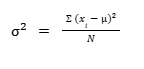
Here,
σ² represents the population variance
xᵢ represents each observation in the data
μ is the population mean
N is the total number of observations or the population size.
Sample Variance:
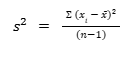
Here,
s² is the sample variance
xᵢ represents individual data points
x̄ is the sample mean
n is the sample size or the number of data values in the sample
Example: Calculate the Variance of Test Scores
Suppose four students scored: 70, 75, 80, and 85. To calculate the variance:
Step 1: Calculate the mean (average) of the scores:
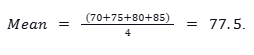
Step 2: Calculate the squared differences from the mean:
(70 − 77.5)² = 56.25
(75 − 77.5)² = 6.25
(80 − 77.5)² = 6.25
(85 − 77.5)² = 56.25
Step 3: Take the average of the squared differences:

For a grouped dataset
The variance formulas are:
Population Variance for Grouped Data:
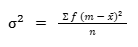
Here,
f represents the frequency of each class
x is the midpoint of the class
Sample Variance for Grouped Data:
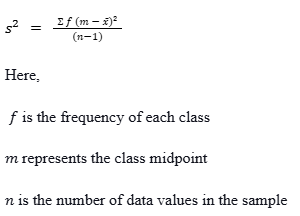
Example: The marks obtained by 20 students in a test are grouped as follows:
| Marks (Class Interval) | Frequency (f) |
|---|---|
| 0–10 | 2 |
| 10–20 | 3 |
| 20–30 | 5 |
| 30–40 | 6 |
| 40–50 | 4 |
Step 1: Find the midpoints (x) of each class.
| Class Interval | Frequency (f) | Midpoint (x) |
|---|---|---|
| 0–10 | 2 | 5 |
| 10–20 | 3 | 15 |
| 20–30 | 5 | 25 |
| 30–40 | 6 | 35 |
| 40–50 | 4 | 45 |
Step 2: Compute f×x
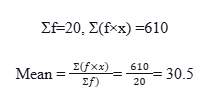
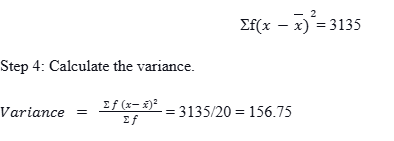
Step 3: Find squared deviations (x − x̄)² and f(x − x̄)²
| x | f | x − 30.5 | (x − 30.5)² | f(x − 30.5)² |
|---|---|---|---|---|
| 5 | 2 | -25.5 | 650.25 | 1300.5 |
| 15 | 3 | -15.5 | 240.25 | 720.75 |
| 25 | 5 | -5.5 | 30.25 | 151.25 |
| 35 | 6 | 4.5 | 20.25 | 121.5 |
| 45 | 4 | 14.5 | 210.25 | 841.0 |
Properties of Variance
- If the variance is zero, it means all values in the dataset are the same as the mean.
- A small variance shows that the data points are close to the mean, while a large variance shows that the data is widely spread out.
- If we add or subtract a constant (a) to every observation, the variance does not change.
- If we multiply every observation by a constant (a), the variance gets multiplied by a².
Summary
Mean and variance in statistical calculations are important as they describe central dispersion in a dataset. Mean represents the average (central tendency). On the other hand, the variance quantifies the spread or uncertainty around that average.
FAQs
Q1. How is the mean related to the mode and the median?
The formula that connects the three is Mode = 3 × Median − 2 × Mean.
Q2. Can variance be negative?
Variance is never negative.


 Call Now
 Let's Chat
 Share
Share